Thursday, October 16, 2014

Did you know …

that Paul Revere, the founder and keyboardist of the 1960s rock group Paul Revere and the Raiders, was of Molotschna Mennonite heritage? In fact, his full legal name was Paul Revere Dick, and he was born on 7 January 1938 in Harvard, Nebraska, which is not far from Henderson. He passed away last week at age seventy-six (see here).

Those of us of a certain age will remember that Paul Revere and the Raiders were best known for their Number 1 hit from 1971, “Indian Reservation (The Lament of the Cherokee Reservation Indian)” (video below).


How do we know that Paul Revere Dick really was from Molotschna? Well, the GRANDMA database includes him (number 64191) and reports further that Paul Revere Dick’s grandfather emigrated from Margenau, Molotschna, to the U.S. aboard the S.S. Strassburg, arriving in New York on 2 July 1878. Another name to add to the people-I-never-would-have-connected-to-Molotschna list! (We will return tomorrow to our series of ancestral photographs, as we take another step back.)

*****

Thanks to my colleague Bille Jean—second cousin to Paul Revere Dick!—for alerting me to his Molotschna heritage.

Wednesday, October 15, 2014

Taking it a generation back

Recent photos have focused on Peter P and Margaretha Epp Buller, moving sort of backward in time: first their sixtieth anniversary in 1950 (here and here), then their 1940 fiftieth anniversary celebration (here), and, finally, a 1929 family photo including, among others, Peter P, Margaretha, and Chris and Malinda Franz Buller (here).

This post continues to step back in time, to the generation preceding Peter P and Margaretha, to the woman pictured below, who has become sort of well known to us.


She was born on 22 August 1847 in an unknown village of the Molotschna colony, then moved with her family to Kleefeld sometime between 1854 and 1857. When she was ten, she attended school in Kleefeld, along with her older brother Cornelius and her younger sister Katharina. Five days after her nineteenth birthday she married and began her own family. So it was that thirteen years later, when she emigrated to the U.S. with the rest of her extended family, she already had two daughters and four sons and was pregnant with yet another son.

The ship manifest does not record her name, simply lists her as “Wife,” but we know her as Sarah Siebert Buller. We previously saw Sarah’s sister Margaretha (Grandma’s grandmother; see here), but now we see Sarah all on her own.

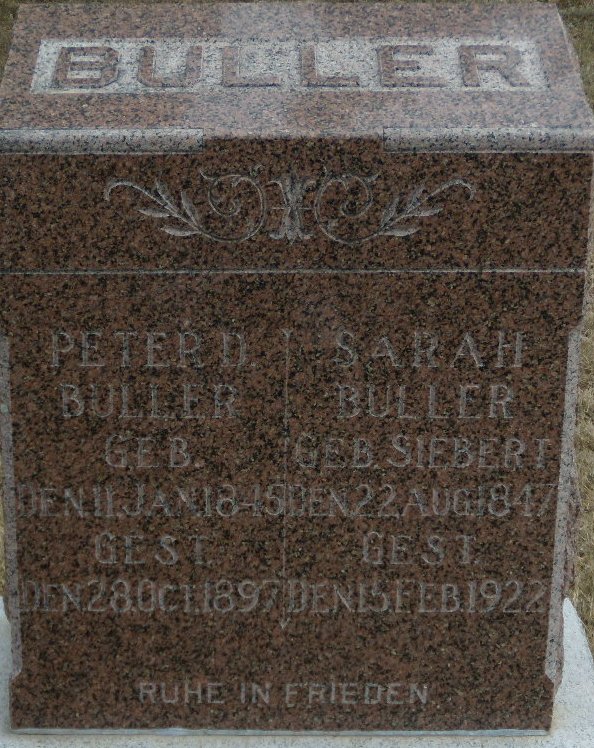
Sarah outlived her husband Peter D by quite a few years: he died in 1897 at the age of fifty-two; she lived to be seventy-four and passed away on 15 February 1922. She is buried alongside Peter D in the Friesen Cemetery a mile and a half west of Henderson—within sight of the farm that she and Peter D established in 1879.


Monday, October 13, 2014

Peter P and Margaretha plus …

The photograph below contains a mix of faces familiar, less familiar, and completely unknown. On the right we see Grandpa (Chris) standing behind Grandma (Malinda), who is holding one-year-old (or thereabouts) Matilda on her lap. Matilda’s age enables us to date the picture to sometime around 1929.

Next to them are two men thus far unidentified. Could either of them be related to Margaretha Epp Buller? Her father was no longer living at that time, so we can exclude him from consideration.

Next to the unidentified men are Peter P and Margaretha Epp Buller. Peter would have been roughly sixty at the time of this picture, Margaretha fifty-nine. On the far left of the picture is an unidentified woman of about the same age as (or possibly a little older than) Margaretha.


Given the year, this photograph was probably taken in Nebraska (since Peter P and Margaretha did not move to California until 1936). Beyond that, it is hard to say. Identifying characteristics are few: only a brick sidewalk running across the yard. One wonders if the location was the Epp family farm where Peter P and Margaretha lived until they left for California.

Feel free to add further information or suggestions in the comments.

Sunday, October 12, 2014

Peter P and Margaretha Epp Buller photos

More photos, courtesy of you know who. The first two photos were taken on the occasion of Peter P and Margaretha’s fiftieth anniversary (see here and here for their sixtieth). The date was 27 February 1940, four years after Peter P and Margaretha moved to California. Peter was seventy-one, Margaretha sixty-nine.


Another photo from the same occasion, this one includes (probably) four of Peter and Margaretha’s five daughters. Two of them are certainly Sara and Maria, who lived with their parents. A third is likely the youngest daughter Anna, who lived in California (possibly with Peter and Margaretha). Of course, all of this is guesswork, so if anyone can identify the four in back, please do so.


This photo of Peter and Margaretha is undated, but it may be from the 1920s, when both were in their fifties and they lived north of Lushton. Beyond that, we have no idea who took this photo or where, although it was likely taken in a photographer’s studio.


Saturday, October 11, 2014

Lushton then and now 2

In addition to the photograph of George’s filling station (which no one seems to remember) and the bank (here), the Lushton Centennial book contains other treasures, including an 1889 plat map of the town.

Lushton spring to life in 1887 when the Kansas City & Omaha railroad laid tracks to connect Sutton and McCool Junction and built a depot roughly halfway between, on the site of Lushton. Already in 1889 a number of businesses and public buildings lined Lushton’s well laid out streets (for a larger and higher-resolution version of the plat map below, see here).


  • The depot, of course, is situated between the main rail line on the south and the rail siding on the north. (Were there two sets of tracks in the 1960s?)

  • The elevator was located then where it has always been and remains even today.

  • In the southwest corner of block 12 one sees a building identified as a bank, with another building just to the north—perhaps the building that later became George’s filling station (or Wayne Harrington’s trucking company)?

  • The map identifies two buildings as hotels in the block south of the bank, although it may be that both labels apply to a single place of business.

  • The black rectangle in the southeast corner of block 32 is the U.B. (United Brethren) church. This church building had been located across the road north of the Lushton cemetery but was moved into town in 1888, where it remained until it burned in May 1943.

  • The stock pens where farmers brought their livestock for transport to Omaha or some other stockyard were located west and slightly north of the depot, but what was the long building just east of the stock pens?

  • The town plan included forty-one or forty-two full blocks (depending on how you count). Did the town ever fill the platted area, or were some of the streets and blocks to the west planned but never established?

  • Grandpa and Grandma’s Lushton house was located in the northeast corner of block 11, unless I am mistaken.
Much has changed in the 125 years from when the plat map was drawn until now (see below). Some of the streets from 1889 still remain: Gilbert (main), Phillip, Henderson, and First through Fifth. The train tracks that gave birth to the town are gone, but some buildings and houses remain. Of course, the memories will likely outlast them all.


Friday, October 10, 2014

Peter P and Margaretha’s anniversary—the photographic trail

Yesterday’s post had only a poor scan of the photograph of Peter P and Margaretha that appeared in the Lincoln Sunday Journal and Star. Twenty-four hours later (thanks to the wonder of scanners and email), we can trace that photo back two more steps to see what appears to be the original shot. In the process, we discover a little more about the story behind the photo.

We start with the photo from yesterday, which is actually two generic photos placed side by side. The photos themselves offer no clues as to when and where they were taken.


The photograph below, however, reveals the source of the first photo. That is, the newspaper photo was pieced together from the single photograph below. The expressions and the tilts of the heads are identical, leaving little doubt as to the source of the newspaper’s photograph. Notice further that Margaretha is wearing two corsages and Peter one. Obviously, this is a photo from a special occasion.


Yet another version of the photograph, apparently the original (notice the scalloped edges typical of home photographs of the mid-twentieth century), broadens the context further. The background of the photo is not a photographer’s backdrop but a wall in someone’s home: a picture hangs above their heads, and a light switch (or electrical outlet?) is located to Margaretha’s left and what appears to be a thermometer to Peter’s right.


Of course, pictures cannot tell the entire story: we do need words to fill in the blanks. Thankfully, the 28 February 1950 newspaper from Ontario, California, clarifies (I believe) what we are seeing. The newspaper story begins: “Sixty years of wedded life were quietly celebrated yesterday by Margaretha and Peter P. Buller of 426 East I street. Throughout the afternoon a number of the friends called for tea to extend congratulations. They brought with them many cards and lovely floral tributes.”

Putting all the hints together—the association of the picture with the sixtieth anniversary in the first newspaper article, the corsages, the setting of the photo in the home, a second newspaper report about a quiet celebration of friends stopping by to offer congratulations—it is reasonable to conclude that this photo is not just associated with the anniversary but actually records a moment from the sixtieth anniversary celebration, with Peter P and Margaretha in their own home ready to greet the next group of friends who will stop in to congratulate and wish them well. The photo thus does more than show us two of our ancestors; it lets us share on some level in a significant moment of their lives. (Thanks to Dad and Suely for making this possible.)


Thursday, October 9, 2014

Peter P and Margaretha’s anniversary

On 4 June 1950 the Lincoln Sunday Journal and Star recognized Peter P and Margaretha’s sixtieth wedding wedding anniversary, even if if was a few months late. The article reads:

ONTARIO, Calif.—Mr. and Mrs Peter P. Buller, former Nebraskans, observed their sixtieth wedding anniversary February 27, 1950, at their home here.
Both are of Dutch descent and came with their parents from South Russia to settle in America in the 1870s. Mr Buller at the age of 10 came with his parents, Mr. and Mrs. Peter D. Buller, to locate in Hamilton county, Nebraska, in 1879.
Mrs. Buller, the former Margaretha Epp, accompanied her parents, Mr. and Mrs. Cornelius Epp, to York county, Nebraska, in 1877.
The Bullers were married February 27, 1890, and lived on the Epp farm near Lushton for many years. Here they reared their family of 12 children.
They have five daughers, Mrs. D. C. Quiring, Henderson, Neb., Sarah and Maria, both at home; Mrs. David Regier, Lushton, Neb., and Anna, Los Angeles, Calif.; five sons, Benjamin of York, Klass of Lushton, Cornelius of Grafton, Neb., Peter of Omaha, and Henry of Newton, Kas.; 43 grandchildren and 24 great grandchildren. A son died in infancy and a daughter, Mrs. K. T. Friesen of York, Neb., has also passed away.
The Bullers moved to Ontraio [sic] in August, 1936. Mrs. Buller is 79 years old; her husband is 81.

A little more than fourteen months after this article appeared Margaretha passed away (19 August 1951). Peter P lived for another thirteen years and died at age ninety-five. I have a vague memory of meeting/seeing him once, so presumably he visited Nebraska sometime in his nineties. Does anyone have any other photos of Peter P and/or Margaretha?


Tuesday, October 7, 2014

It’s settled

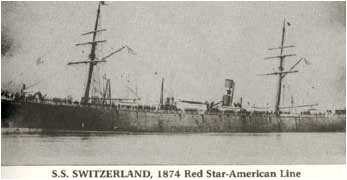
Not that there is any real doubt about the name of the ship that carried Peter D, Sarah, and family to a new life, but e-copies of the S.S. Switzerland manifest for the voyage ending 24 June 1879 settle the question once and for all.

The National Archives maintains microfilm records of various historical documents, including ship manifests from the heydey of European immigration to the U.S. (see here). Further, anyone can ask the Archives staff to look for a particular immigrant’s name on a given manifest, and they will send (for a nominal fee) an e-copy (jpeg file) of the manifest page, if they are able to find the name.

So it was that several months ago I emailed the National Archives and requested the page(s) for Peter D and Sarah Buller and their six children. I dutifully noted that they had arrived on 24 June 1879 on the S.S. Vaderland. In the meantime, of course, we learned that Peter D and clan did not come to the U.S. on the Vaderland but on the Switzerland, which led me to assume that I would never hear from Archives staff, since I had sent them down a dead end.

Much to my surprise, a CD arrived in the mail this week, and on it I found several pages from the boarding manifest of the S.S. Switzerland (not the Vaderland!) for the voyage that arrived in Philadelphia on 24 June 1879. The first page sent was the first page of the manifest, which documented, among other things, the name of the ship, the port of departure, the port of entry, the tonnage, and the master who recorded the names as passengers boarded the ship: J. B– (?) Andersen.


Archives staff directed my attention to line 543 of the second page sent, which would have been, probably, page 15 of the manifest. There he was: “Peter Buller … 33 [actually, he was thirty-four] … Farmer.” Under the column “To what Country belonging” one reads “Russia”; under “Country of which is their intention to become Inhabit[ants],” “U.S.”

Listed immediately below is “Wife … 30” (Sarah was thirty-one), then their children Johann, Peter [P], David, Cornelius, Cathar., and Sara, followed by Peter D’s brother David. Above the Bullers one sees the end of the Johann Siebert family: Cornelius Siebert, age thirteen (a family’s last name was repeated whenever a new page began); Margar., Anna, and Diedrich. The twenty-three-year-old Margar[etha] listed here, of course, was Malinda Franz Buller’s grandmother (see here).


That is pretty much the rest and the end of the story. Even though we already knew how this part of the Buller story ended, it is still interesting to see the actual documents that record our ancestors’ voyage to the U.S.

Monday, October 6, 2014

Lushton then and now

The Lushton Centennial book (1987) identifies the buildings in the photograph below as George’s filling station on the left and the Lushton bank on the right.


Of course, the bank building remains today, but the filling station and the trees in front of it are gone without a trace.


The quality of the top photograph does not permit us to make out much detail, but there is clearly writing in the windows, a gas pump with a glass globe at the top, and possibly several signs or banners out front. That leaves a lot of questions unanswered:
  • Who was George?
  • When was this photograph taken?
  • What happened to this filling station?
  • Where were Lushton’s other gas stations located?
  • Does anyone remember going to this gas station?
As always, further information is welcome!

Sunday, October 5, 2014

53.2

It’s funny how the simplest of things—a cancelled check from the 1960s, a yarn-covered hanger from a Christmas long ago, or even a number—can help us remember, or perhaps learn about, our family history. Yes, even a bare number such as 53.2 has a story to tell about a Buller moment in the sun a little more than sixty years ago (cue music from Chariots of Fire).

Beginning in the 1950s (and continuing even today) Doane College of Crete, Nebraska, sponsored an invitational high school track and field meet, a place for the top athletes across the state (for example, a certain Gale Sayers from Omaha Central in 1961) to compete against one another in two classes: A for the larger schools, B for the smaller schools.

Of most interest to us is the April 1954 meet, when a certain runner from Grafton High School set the class B Doane Invitational record for the 440-yard dash with a time of 53.2 seconds. That runner was none other than Wayne Buller. Wayne’s record was tied in 1956 and again in 1959, but it was not actually broken until 1961, seven years after he set it (see newspaper clipping on the right).

Remarkably, Wayne had an even better 440 time that year. According to the 29 April 1956 Lincoln Sunday Journal and Star (see below), Wayne set the Class D district record of 52.9 in 1954, and it still held two years later. Further, the 27 April 1954 Lincoln Evening Journal and Nebraska State Journal reports that in 1954 52.9 was the second fastest time of all high school quarter-milers in the entire state. Not bad for a Lushton farmboy!

Records, of course, will inevitably be broken, but they need not be forgotten. So it is that we add this episode, this shining moment to the telling of our family story. Let us tell the story often.


Saturday, October 4, 2014

Mystery solved?

Does it bother you that one of the central facts of our family history, the name of the ship that brought our forebears to the U.S., dutifully recorded in the Buller Family Record, is apparently wrong? It seems indisputable that Peter D, Sarah, and family made the journey on the S.S. Switzerland, not on the S.S. Vaderland. How could the family oral history get such a basic fact so very wrong? In fact, there may be a perfectly reasonable and simple explanation.

While exploring background on Margaretha Epp Buller (wife of Peter P) in the GRANDMA database I encountered the screen pictured below. Notice anything interesting?


Maria and Sara report in the Buller Family Record that their father Peter P came to the U.S. on the S.S. Vaderland, but it was actually their mother Margaretha who came on that ship.

Notice several other similarities: even though Margaretha arrived in 1877 and Peter P in 1879, they both arrived in Philadelphia in late June (the 24th for Peter P, the 29th for Margaretha); further, they both sailed on a ship of the Red Star Line based in Antwerp, Belgium. It is not surprising that some of the details became mushed together—especially when one recalls that Peter was only ten when he came to the U.S., Margaretha seven.

It is easy to imagine how the names of the two ships were switched or conflated in Maria and Sara’s or their parents’s memories. But however it happened—whether Maria and Sara were told the wrong ship or they were told the right ship and made a mistake in assigning it to their father rather than their mother—it seems likely that this particular mystery is solved: Peter P did journey to the U.S. on the Switzerland, his future wife Margaretha on the Vaderland.

****

As hinted at earlier, twenty-one-year old Jacob Epp, grandfather of Malinda Franz (Grandma), and his family were on the same voyage as seven-year-old Margaretha Epp and her family. The families were not related, to my knowledge, merely passengers on the same voyage.

Friday, October 3, 2014

Grandma at one plus …

Thanks to an old photograph and modern technology, we can see some of our Russian ancestors with our own eyes. Pictured below are one-year-old Malinda Franz and her grandparents on her mother Sarah’s side: Jacob Epp and Margaretha Siebert Epp (i.e., sister of Sarah Siebert Buller).


As noted earlier, Grandma’s mother Sarah Epp Franz was the daughter of Jacob Epp and Margaretha Siebert Epp. Jacob was born on 12 November 1856* in Tiegerweide, a village roughly six miles northwest of Kleefeld in Molotschna colony. He was baptized at Neukirch, four miles east of Kleefeld, on 16 May 1877, then shortly thereafter emigrated to the U.S. aboard the S.S. Vaderland, arriving in Philadelphia on 29 June 1977 (remember that date). He passed away on 18 February 1921 in Henderson, at the age of sixty-four.

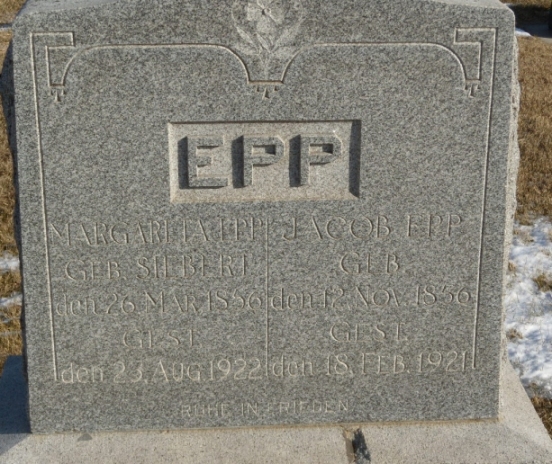
Margaretha Siebert Epp was born to Johann and Katharina Rempel Siebert on 26 March 1856. Her place of birth is not recorded, but it was likely in Kleefeld, since her sister Maria was born there three years earlier, and Johann held a full land allotment at that time and thus was unlikely to have moved during the interim. She was baptized sometime in 1874 and traveled, as was discussed earlier, to the U.S. with the majority of her family, including Peter P and Sarah Siebert Buller, in 1879. Margaretha outlived her husband Jacob by a little more than a year, passing away on 23 August 1922 at the age of sixty-five. Both are buried at the Bethesda Mennonite Cemetery (see photograph below; note the use of German on the tombstone).

Jacob and Margaretha would have been fifty-one or fifty-two when the photograph above was taken by Pont Soderberg of Sutton, Nebraska. Thanks to Suely and Dad for scanning and sending this treasure of a photo. Believe it or not, there are more to come!

* GRANDMA lists Jacob’s date of birth as 31 October but includes the note that “his n.s. birth date was 12 Nov 1856.” Why the discrepancy? Today we follow the “new style” (or n.s.) Gregorian calendar, which differs from the Julian calendar formerly in use. The older Julian calendar remained in use in Russia until 1914, so Jacob’s birth on 31 October (Julian) in Russia was the same as 12 November (Gregorian) in the U.S. (the U.S. and other British colonies converted to the Julian calendar in 1752). For more on the differences between the two calendars, see here. One wonders how many other ancestral dates from Russia are given according to the Julian calendar.


Thursday, October 2, 2014

Grandma at one

Malinda Franz was born 20 October 1906 to Isaac G. and Sarah Epp Franz. The picture below was probably taken in late 1907 or early 1908, when Grandma was one.


This post seems a good opportunity to offer a bit more background on Grandma’s family:
  1. Grandma was the oldest child in her family and was followed by Lydia (1910), Albert A. (1914), Eduard (1917), and August (1925). Unless I am mistaken, August and his son Randy sang at the graveside services for Grandma.

  2. Grandma’s father Isaac was the son of Gerhard, who was born in Gnadenfeld, Molotschna, and came to the U.S. aboard the S.S. Teutonia in 1874.

  3. Grandma’s mother Sarah Epp Franz was the daughter of Jacob Epp and Margaretha Siebert Epp. Jacob came to the U.S. on the S.S. Vaderland in 1877; he and Margaretha were married six years later.

  4. If the name Margaretha Siebert Epp sounds familiar, it’s because she was the sister of Sarah Siebert Buller, and she journeyed to the U.S. with Sarah (and Peter D) and the rest of the family on the S.S. Switzerland in 1879.

  5. Thus, Johann Siebert lies at the base of both branches of the family tree:
Johann Siebert > Sarah Siebert || Peter D Buller > Peter P Buller > 

Cornelius Buller || Malinda Franz 

< Sarah Epp Franz < Margaretha Siebert Epp < Johann Siebert               

I never before realized just how deep our ties to the Sieberts really are.

****

Thank you to Dad and Suely for sending the scanned photograph of Grandma. Does anyone else have any photographs they would like to share?

Monday, September 29, 2014

Chris Buller, early irrigator

The Lincoln Journal of 12 August 1949 includes an article titled “Tour of York Farms ‘Sells’ on Irrigation” (p. 5). The article begins:

Five hundred farmers can’t be wrong. And it’s their opinion that irri[g]ation is crop insurance for central Nebraska.

Alvah Hecht, agricultural agent in York county, estimated that was the number of farmers attending the 4th annual York county irrigation tour. Altho the irrigation systems on each farm visited differed, the principle of “getting the water when and where it’s ne[e]ded” is the same.

FOR INSTANCE, there was the sprinkler system C. P. Buller has used on his farm near Henderson since 1946.… [the rest of the article appears below]

Yes, that’s him—Grandpa Buller was one of the earliest irrigators in York County. After two emails and a phone call, the rest of the story is now ready to be told.

If you recall from the earlier post (here), the 160-acre Lushton farm included 80 acres on the south that Grandpa and Grandma owned and 80 acres north of the shelterbelt that they rented from Grandpa’s older brother Peter.

Dad tells me that in 1946 Grandpa had a well drilled on the west end but south of the shelterbelt (i.e., on Grandpa’s land). They used that well to irrigate several fields.

For example, they ran a ditch to the south and irrigated corn using siphon tubes, a method that was still used into the latter decades of the twentieth century (and still may be used, for all I know).

They also pumped water out onto the ground and let it run east along the shelterbelt, where it collected in a hole, then was picked up with a booster pump and pumped to the sprinkler mentioned in the article.

Remarkably, Suely and Dad scanned and sent to me several pictures of that arrangement.


The photo above shows the John Deere GP running the booster pump with a belt. Grandpa is standing behind the tractor; the man smoking the pipe next to him is Alvah Hecht, the York County agent who is quoted in the newspaper article.

In the background you can see sprinklers irrigating the pasture; you can also see the roof of the barn peeking up behind the car.


This photograph shows the sprinkler system a bit better. Grandpa is in the background walking back toward the tractor; Alvah Hecht and the other county official are leaned up against the car. Far in the distance are a few cattle grazing in the pasture. Both of these photos are taken from a spot west of the farmstead looking toward the southeast or straight east.

It is reasonable to imagine that these photos were taken around the time of, and maybe in preparation for, the 1949 irrigation tour. That explains the presence of the county agents with Grandpa but no one else—there is certainly no sight or sign of 500 York County farmers.

I never knew before that Grandpa was, in fact, an irrigation pioneer in York County. Using the well he had drilled in 1946, he ditch-irrigated corn and, with the help of a John Deere and a booster pump, sprinkler-irrigated both the pasture and the milo field on the hillside. Like all of you, I knew he was special, but this adds another facet to my image of him.

P.S. These were not the only photographs that Suely and Dad scanned and sent. Keep watching for a photo of one-year-old Malinda Franz…

**********

The Lincoln Journal article continues:

Roger Weber Leroy uses garden hose with connections on steel pipe to get the needed water to his corn. Besides a well, Raymond Ronne, Henderson has several dams constructed from which he pumps water to his fields.

Bryce Tracy, by using an electric motor, pumps water to his pasture, garden, shelter belt, and corn fields. He floods his brome and alfalfa pasture by bordering the area. John Wocher, does something that others say “can't be done.” He is irrigating on the contour. He pumps water from a large basin up to the higher ground, then is able to farm the land in the basin.

OPERATING A 1,200 acre farm north and west of York, Wayne W. Harrington irrigates 250 acres of corn land. He uses two wells, one pumped with a caterpillar diesel and one with propane. The one pumped by diesel puts out 2,000 gallons per minute.

Herman Fenster, Bradshaw, irrigates has land by an underground tile and soil soaking canvas system. This is a system used in Texas and California that Fenster had seen in operation. He explained this was expensive to install but he feels that it will pay for itself over a number of years because he can water ten acres more of land with the water saved by being carried in canvas ducts rather than in ditches.

THE HARRINGTON farm was the last stop of the tour. Here the York chamber of commerce and Harrington fed the farmers a ton and a half of watermelon plus several hundred bottles of pop. At the Harrington farm the recently constructed 15,000 bushel corn and 6,000 bushel small grain crib and the new air conditioned hog barn attracted nearly as much attention as did the irrigation system. According to Hecht, this was the,most successful of the tours held in the county.

Saturday, September 27, 2014

Family historical documents

The scraps, bits, and pieces from which we reconstruct the details of our family history sometimes pop up from the most unexpected of places.

An earlier post on Grandpa and Grandma’s houses (here) mentioned that Grandpa and Grandma Buller sold their first Friend, Nebraska, house to my other grandparents, Art and Geraldine Meinke. So it was that, while thumbing through some Meinke papers this evening I stumbled across several items of interest to my Buller side.

First is the newspaper ad (from the Friend Sentinel?) listing the house. I do not know when Grandpa built this house (someone please provide a date if you can), but the house was described as “like new” no later than mid-1965, so it was likely in 1964.

I also learned from other papers that the “lot” on which the house was located was actually two lots: lots 11 and 12 in P. C. Larsen’s addition to the city of Friend. The exact address was 106 6th Street.

Other papers reveal further details: the sale price was $15,500, on which a $5,000 down payment was made on 21 September 1965. The balance was paid 17 December, at which point, one would assume, the sale of the house closed.

Grandpa and Grandma sold the washer and drier in the house for an additional $500 on 17 December as well.


The second discovery was a cache of cancelled checks that executed the sale/purchase. The one pictured to the left interests me the most, since in endorsing the check Grandpa signed his name once, crossed it out, and then signed again with his full first name.

Dad confirmed tonight that Grandpa always signed his name “C. P. Buller,” which explains why that name appears first on the endorsement: habit led him to sign his name as he usually did.

However, this important check was made out to “Cornelius P. and Malinda Buller,” so presumably when Grandpa noticed (with Grandma’s help?) that his full name was given on the front, he signed a second time with his matching signature.

Comparing Grandpa’s two signatures, one can see that he was not used to signing his full first name: he obviously messed up toward the end and had to go over the last three letters twice. By way of contrast, his two signings of Buller are nearly identical. (I must add, on a personal note, that I see hints of a Carl signature in the way Grandpa begins Cornelius.)

Grandma’s signature is smooth and clear—I would bet that this is how she signed her name all the time.

Just scraps of paper of no legal significance today, these historical records do allow us to glimpse a slice of Grandpa and Grandma’s life together in 1965. Not just the details of their life are clarified (when they sold the house and for how much), but their persons come to life in this unexpected find.


Thursday, September 25, 2014

Life and death on the S.S. Switzerland

Reading through the S.S. Switzerland manifest for the voyage that brought our family to the U.S., one encounters several depressing marginal notes:

  • Aaron Cornelson, age twenty-one, “died at sea from meningitis”
  • Helena Wiens, thirty-four-year-old mother of two, “delivered stillborn child on Tuesday, June 17, 1879; 11 p.m.”
  • Sara Voth, twenty-five-year-old mother of a one-year-old daughter, “died in child bed June 23, 1879, 11:30 a.m.” (the fact that no newborn child is listed on the manifest probably means that mother and child both died during childbirth)

At least four people died on this one journey to a new land and a new life—Sara Voth and newborn child a mere day before the ship docked in Philadelphia.

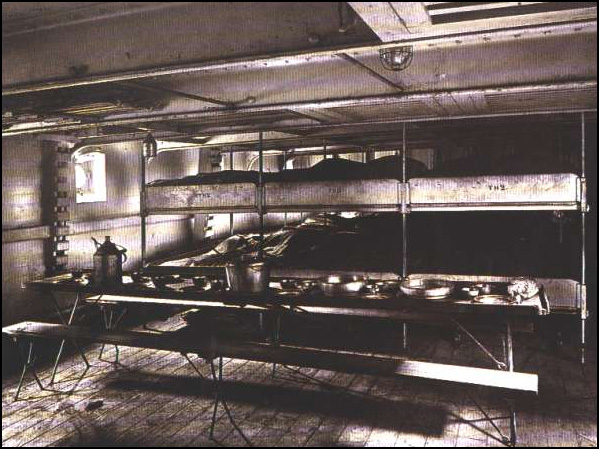
To make matters worse, it is likely that not one of these individuals endured his or her final struggle in any form of comfort or even privacy. As the earlier discussion on traveling in steerage class made clear (see here), the 700+ Mennonites on this ship had little if any “personal space” during the voyage. Thus, these life-and-death events were played out within full hearing, and probably in partial view, of all who shared that limited space.

How were Peter Voth and one-year-old Maria able to go on after the loss of wife and mother? What thoughts and fears passed through the mind of six-months-pregnant Sarah Siebert Buller as she learned of the childbirth-related deaths that took place on board? It is fascinating to speculate, but that is all it really is—speculation. The one thing we can know with certainty is that we owe our forebears a debt of gratitude for the courage and determination that led them to undertake such a difficult and perilous journey on the way to a new land and a better life for all of us.


Wednesday, September 24, 2014

S.S. Switzerland arrival

The Herald of Truth (see further here), a Mennonite newspaper published between 1864 and 1908, when it was folded into another periodical, provided news about Mennonites across the the United States and Canada. (The first Mennonites came to the U.S. circa 1683 and settled in Pennsylvania.) It also noted, from time to time, the arrival of new emigrants from other parts of the world, including Russia.

So it is that the July 1879 issue (the Herald of Truth was a monthly at that time) included a short article entitled “Arrival from Russia,” quoted in its entirety below, that should be of interest to this group of Bullers.

The Red Star Line Steamer “Switzerland” from Antwerp, arrived at Philadelphia, June 24th, with 726 Mennonites from South Russia, under the leaders, Franz Toews, Cornelius Regier, Julius Friesen, Jacob Neufeld and David Hiebert.

They were landed on the afternoon of the 24th, and on the afternoon of the 25th they were forwarded over the Pennsylvania Railroad by special train, to their respective desinations.

64 families, numbering 354 souls, Nebraska
42     "                 "         260     "     Kansas
14     "                 "           77     "     Minnesota
  7     "                 "           35     "     Dakota

During their stay at Philadelphia, they had the advice and adtendence of the Mennonite Executive Aid Committee of Pennsylvania, of whom were present Brother Amos Herr, Gabriel Baer, H. K. Godshall, and Albert E. Funk, who had also as the representatives of the American Mennonites paid the fare of twenty of the new arrivals from Antwerp to their destination in the West.

Brother D. Gaddert from Kansas, also met the new arrivals on their landing, and in a very effective way assisted the committee, helping and advising the newly arrived brethren cheerfully and untiringly.

The Red Star Line and its General Agents, Messrs Peter Wright & Sons, and the Pennsylvania Railroad and its Agent, Mr. Francis Funk, again earned the acknowledgement of the committee and the newly arrived brethren, thus recommending themselves to the continuing favors of the Mennonites in America and in Russia. (reproduced in Hiebert 1974, 358, 363)

Of course, Peter P, Sarah, and family—not to mention the rest of Sarah’s extended family—were on that particular ship. More questions come to mind:

  • Did the Johann Siebert family travel as their own group, or were they part of an even larger group emigrating to the same area?
  • How many of the Nebraska group initially settled in Henderson? How many of the Johann Siebert group?
  • Where did the Pennsylvania Railroad line end, and what railway did the Henderson contingent take from that point on?
  • Did agents of the second railway accompany the parties to their destinations? More important, did they broker sales of railroad land to the new immigrants?

Perhaps someday we will find answers to all these questions. For now it is sufficient to know that our ancestors’ arrival on this land did not go unnoticed. We know when and where and with whom they began their new life in America.

Source

Hiebert, Clarence. 1974. Brothers in Deed to Brothers in Need: A Scrapbook about Mennonite Immigrants from Russia, 1870–1885. Newton, KS: Faith and Life Press.

Sunday, September 21, 2014

Grandpa and Goldie

Enjoy! (This is my first try at posting a video, so please email if you encounter any difficulties.)


Thanks to Dad for taking the video thirty-two or thirty-three years ago and to Dan for making it available.

Tuesday, September 16, 2014

Village plot sizes 3

Not to beat a dead horse, but additional research first clarifies, then muddies, then clarifies once again the claim made by Heinrich Goerz in an earlier post that village plots were roughly 280 feet wide.

On the one hand, Helmut T. Huebert offers the same picture as Goerz when he describes the earliest Molotschna settlements as follows:

The villages were laid out accordingly to the principles of German order and regularity. … Each of the first villages consisted of 20 establishments, with a plot of 1½ dessiatines, 40 fathoms wide (l fathom is roughly 2.13 meters or 7 feet) along the village street, as well as additional land for home use immediately behind this area. Houses were placed 14 fathoms from the street, leaving room for a small front garden. … Later villages had somewhat larger farm sites, and also 25–30 households. (1986, 25–26)

However, comparison of Huebert’s description with Goerz’s earlier account (see here) reveals that Huebert is merely repeating Goerz, not independently confirming him. The following parallels make the dependence fairly clear (Huebert’s wording given first, then Goerz’s):
  • German order and regularity ≈ orderly, systematic manner according to German practice; 
  • leaving room for a small front garden ≈ room for a small garden in front; 
  • Later villages … larger farm sites ≈ Farmsteads in the later villages … considerably wider
The real complication arises later in Huebert’s book when he writes that the village of Hierschau was laid out as follows:

A Vollwirtschaft [full farmstead] consisted of a yard with buildings in the village, the area being one dessiatine and, according to regulation, 30 fathoms wide by 120 fathoms long. This included the house, barn, cattle sheds, threshing area, garden and general yard area. (Huebert 1986, 129)


Layout of Hierschau (from Huebert 1986, 49).  Note the pasture land across the river to the north.
This would have been community land open for any villager’s use.


One wonders how to explain all this. If the earlier village plots were 40 fathoms/280 feet wide, and if Goerz is correct that later village plots were wider than the earlier ones (1993, 10), then why are the village plots in Hiershau, which was established in 1848 (forty-four years after the first settlements in Molotschna), 10 fathoms/70 feet narrower than the earlier village plots are claimed to be both by Goerz and earlier in Huebert’s own book?

Fortunately, William Schroeder’s map of Alexanderkrone (where Peter D, Sarah, and family lived for two years) helps us resolve the question.


Map © William Schroeder, used by permission. For the original, see http://www.mennonitechurch.ca/programs/archives/holdings/Schroeder_maps/059.pdf


Unnoticed until today is that Schroeder includes a scale, so we can calculate the approximate length of the village and from that the average width and length of the village plots within. The main part of the villages (that is, from farmstead 21 to 40) was roughly 4,400 feet. If we subtract 30 feet for the street separating farmsteads 30 and 31, then divide by 20, we discover that the average village plot was 220 feet wide, which is 31.4 Fäden/fathoms (assuming Huebert and Goerz’s 1 Faden = 7 feet). This is not an exact match with Huebert’s claim that village plots were, “according to regulation, 30 fathoms wide,” but as a certain uncle used to say, it is close enough for government work.

Using Schroeder’s scale, we can measure the length of the plots to roughly 975 feet, which would be 139 Fäden/fathoms. This is not as close as the width measurement, but it still seems to support the notion that village plots were, as Huebert described in the second passage, roughly 30 fathoms by 120 fathoms. Based on Huebert’s testimony and Schroeder’s map, it is safe to conclude that village plots measured, on average 210 feet by 840 feet.

Finally, these measurements also correspond to Huebert’s original claim that a village plot was 1.5 dessiatines in size. A plot of land 210' x 840' equals 176,400 square feet, that is, 4.05 acres. Since 1 dessiatine = 2.7 acres, 1.5 dessiatines would equal that same 4.05 acres. However, it does not match his later claim that village plots were 1 dessiatine in size. In the end, it seems best to overlook the confusion and conclude, even if tentatively, that Huebert’s earlier estimate of size (1.5 dessiatines) is correct, as is his later estimate of dimensions (30 x 120 Fäden).

The former village of Alexanderkrone today (Ukranian Hrushivka). Note the windmill to the extreme right of
the photo (see also here). The area highlighted in green is equivalent to 1.5 dessiatines/4.05 acres. 

One final note: at 4,400 feet in length, the main part of the village of Alexanderkrone was over three quarters of a mile long (the red line in the photograph above), which is a considerable distance for an area that contained only forty households.

Apologies if this has been overly boring. It was one of those questions that I needed to work out in order to let it go!

Sources

Goerz, Heinrich. 1993. The Molotschna Settlement. Translated by Al Reimer and John B. Toews. Echo Historical Series. Winnipeg, MB: CMBC Publications and Manitoba Mennonite Historical Society.

Huebert, Helmut T. 1986. Hierschau: An Example of Russian Mennonite Life. Winnipeg, MB: Springfield Publishers with Kindred Press.

Sunday, September 14, 2014

GRANDMA knows

My brother Dan told me about the GRANDMA (Genealogical Registry and Database of Mennonite Ancestry) database a little while back, and recently I finally found time to start exploring its riches. What I discovered was … well, enlightening.

The entry for a certain Peter Buller (number 67824 in the database), who was born 11 January 1845 and married to Sarah Siebert—in other words, the ancestor we know as Peter D—records that he immigrated to the United States aboard the SS Switzerland, arriving in Philadelphia on 24 June 1879. Notice any problem with that? If not, see here.

Further on the entry cites the source of this information: a book titled Brothers in Deed to Brothers in Need (Hiebert 1974, 361). Hard to believe, but I bought a used copy of that book a month ago, so I opened it in hopes of determining how GRANDMA had gotten this vital information wrong. I first confirmed that pages 360–61 do reproduce the ship’s manifest for the SS Switzerland on its voyage from Antwerp, Belgium, to Philadelphia, arriving on 24 June 1879 (see below).


Looking more closely at page 361 (below), I spotted toward the bottom of the second column a man named Peter Buller, but his wife was unnamed—certainly no help in knowing if this was our Peter D. Add in the fact that Peter D was thirty-four when he came to the U.S., not thirty-three, and Sarah was thirty-one, not thirty, and I began to doubt that this is who GRANDMA thinks it is.

Reading on, I noticed “Johann (11)” at the bottom of the second column, then “Peter (10)” at the top of the third. Wait … Peter P was ten years old when the family came to the U.S. Looking back at the Peter D page of the Buller Family Record, I discovered that Peter P’s older (by a year!) brother was named Johann, and his younger brothers were David and Cornelius and his younger sisters Katharina and Sarah.

In other words, apart from Peter D’s and Sarah’s ages each being off by a year, the SS Switzerland passenger list appears to correspond exactly to the family of Peter D. The manifest even lacks the next child in line, Jacob P, who was not born until 2 August later that same year.


The only remaining mystery was the identity of the twenty-four-year-old David tacked on at the end of the list. According to the Buller Family Record, Peter D had a younger brother named David who was born 14 February 1855—which would have made him twenty-four in 1879. In other words, Peter D and family did not come to the U.S. all by themselves—they were accompanied by at least one close family member. More remarkably, they did not travel on the SS Vaderland but on another ship of the Red Star Line, the SS Switzerland!

But that is only a part of the story. If you recall, an earlier discussion of Sarah Siebert (here) noted that her father Johann was owner of a full land allotment in Kleefeld. Now let your eyes wander a bit up from Peter D’s listing on page 361 above. Notice any familiar names?

The family headed by Johann Siebert is apparently Sarah Siebert Buller’s birth family. According to the GRANDMA database, Johann Siebert was born on 13 June 1822, so he would have been fifty-six (not fifty-five) when the Switzerland set out from Antwerp (which is when the manifest was written). His wife Katharina was two years younger than he, so again we have a case of both parents’ ages being off by a year on the manifest.

Most important, Johann and Katharina had children named Johann, Peter, Kornelius, Margaretha, Anna, and Diedrich. Based on this close correspondence, it seems safe to conclude that Peter D, Sarah, and family were accompanied on their journey to North America not only by Peter’s brother David but also by Sarah’s parents and siblings who were still at home.

But the story doesn’t end even there. GRANDMA also tells us that Sarah, who was the oldest child in her family, had a younger sister named Katharina (born 3 April 1851, so twenty-eight in June 1879) who married one Jacob Friesen (born 23 December 1845) and had three daughters with him before June 1879: Elisabeth, Katharina, and Anna. Keep those names in mind as you let your eyes wander a bit to the left of the Peter D entry. The correspondences leave little doubt but that this Jacob Friesen was another son-in-law of Johann and Katharina Siebert.

Still more… Johann and Katharina Siebert had two other children: a son Cornelius died at the age of eleven in 1860, but a daughter Maria married Abraham A Thieszen and had several children with him: Katharina, Johann, and Maria. According to the GRANDMA database, the two older children also came over on the SS Switzerland, which gives us a partial correspondence with the Abraham Tiessen listed toward the top of column 4 on page 361 above. Specifically, Johann is missing, and Maria is listed. Either this is a different family or some of the genealogical information is confused (e.g., did someone switch the years of birth for Johann and Maria?). If this is, in fact, Maria Siebert Thieszen, then all of Johann and Katharina Siebert’s living children emigrated to the U.S. at the same time. This sheds an entirely new light on the circumstances surrounding Peter D and Sarah’s move to the U.S.

But there is still more. About a third of the way down on column 2 is another Buller, Benjamin, with an unnamed wife eight years younger than he and a son named Johann not yet a year old. According to the Buller Family Record, Peter D’s younger brother Benjamin was born 1 June 1851 (so he was just twenty-eight when the Switzerland sailed), and he married Anna Reimer, who was eight years his junior. Their first son, John (≈ Johann), was born on 10 December 1878. Unless this is the oddest coincidence, it would seem than another of Peter D’s brothers came to America not only at the same time but on the same ship.
One more? Peter D’s younger sister Elisabeth married Abraham Braun (handwritten correction in the Buller Family Record). Two years his senior, she would have been thirty-two in June 1879, and he would have been thirty. Their first four children (all born before 1879) were Elisabeth, Abraham, Isaak, and Maria—according to the Buller Family Record. The second entry of the entire passenger list (p. 360) records an Abraham Brauer with a question mark indicating an uncertain reading, followed by his wife Elisabeth, two years his senior, and five (!) children: Elisabeth, Abraham, Isaac, Maria, and Helena. Could this be the same family? The Buller Family Record has only four children before 1879, with Lena being born in the U.S. in 1883. GRANDMA explains it all. The Buller Family Record has missed one daughter named Helena, who was born 23 September 1878 and died sometime in September 1879, after the family moved to the U.S.

To recap, the family memory inscribed in the Buller Family Record of Peter D, Sarah, and their six kids coming to America on the SS Vaderland is apparently wrong. They came on a different ship of the Red Star Line: the SS Switzerland.

Perhaps more important, the Buller Family Record gives only part of the story of the family’s move to the U.S. In fact, Peter D and family were part of a large family group who journeyed at the same time and on the same ship, including Sarah’s parents and unmarried siblings, two of her married sisters and their families, Peter D’s unmarried (apparently widowed) brother David, his brother Benjamin and his family, and his sister Elisabeth and her family. Stated differently, all of Sarah’s living brothers and sisters, and three of Peter D’s five brothers and sisters all traveled together to Philadelphia.

What might this suggest about the circumstances surrounding the move? An interesting question, but it will have to wait until another time.


Source

Hiebert, Clarence. 1974. Brothers in Deed to Brothers in Need: A Scrapbook about Mennonite Immigrants from Russia, 1870–1885. Newton, KS: Faith and Life Press.

Friday, September 12, 2014

Buller bleg

I was surprised—and delighted—to learn earlier this week that someone from the Albert Abraham Buller line had discovered the Buller Time blog.

To put things in context, our family line runs Peter D || Sarah Siebert > Peter P (no. 2 in the Buller book) || Margaretha Epp > Cornelius (Chris) || Malinda Franz; theirs diverges at the level of children of Peter D: Peter D | |Sarah Siebert > Abraham P (no. 9) || Anna Petker (or is it Poetker, reflecting an original Pötker?) > Albert Abraham || Louise Epp.

Abraham P and Anna Buller and their youngest son Norman as listed on the 1940 U.S. census.

The person who contacted me is in the process of updating that part of the family line for the Buller book, which we will of course add to the copy posted on this blog. However, the primary purpose of this post (the bleg part) is to ask for any photographs, documents, or recollections of that branch of the family tree. If you have anything to share, please email me or leave a comment with this post.

Thursday, September 11, 2014

Coming to America

Emigrating to the United States required not only personal traits such as courage and determination but also more tangible resources: money. According to the Buller Family Record, Peter D, Sarah, and their six kids economized by consuming “toasted bread, ham, and coffee” on their long journey, but other out-of-pocket expenses were unavoidable.

At the least, they had to pay to ride the train from Hochstädt (across the Molochnaya River to the west of the colony) to Antwerp, Belgium, then for passage across the Atlantic on the Vaderland of the Red Star Line, then finally for the train ride from Philadelphia to York, Nebraska. Then, as soon as the family arrived, Peter D bought 80 acres of farmland on the east edge of Hamilton County. All this raises the question: How was the family able to afford not only the expenses of traveling from one continent to another but also the cost of buying 80 acres of land?

Our family history does not explain this mystery, but archival documents from Molotschna provide a plausible explanation. As noted in a Mennonite Life article from 1946 (to read the entire article online, see here), when some Mennonites decided to leave New Russia for North America, others determined to form an aid society that would provide the financial resources necessary for such an expensive undertaking. The name of that society, in English, was The Corporation of Emigrants to America.


Pages from the Alexanderwohl Schnubruch held by the Bethel College Mennonite Library and Archives. 

The CEA first formulated general articles of organization, then wrote regulations for how money was to be collected, disbursed, and repaid, including the necessity of recording all transactions. One tool for record keeping was a Schnurbuch, or “cord book.” The Schnurbuch was a regular ledger with a special feature: all the pages were bound together by an extra cord (see above), which was then sealed with wax on the outside. As Melvin Gingerich writes, “This made it difficult to tamper with the records of the book and marked the book as an official record of the church” (1946, 46).

A Schnurbuch included several sections, including one recording how much the wealthier individuals in the community agreed to loan to the fund (see photograph below), one listing the amount that was loaned to each individual needing funding, and one recording any repayments of the amount loaned (photograph above.


It is important to note that those making the loans may well have been moving to the U.S. as well. For example, nearly the entire village of Alexanderwohl (whose Schnurbuch is pictured here) left New Russia for the U.S. in 1874, meaning that those who loaned financed not only their own move but also that of their Mennonite brothers and sisters.

Three final observations:
  • the Alexanderwohl Schnurbuch lists both lenders and borrowers from a number of villages, so this was a colony-wide endeavor, not simply a village-based measure; 

  • funding for travel was given in the form of a loan, not a gift, which speaks volumes about the mentality and values of the community; 

  • early hardships on the plains of the American midwest limited the ability of some to repay their loans as quickly as had been expected; the fact that the CEA and those who funded it granted grace to those behind on their loans also speaks volumes about the mentality and values of the community.

Is this sort of arrangement how Peter D was able to move his family of eight to Nebraska in 1879? We may never know with certainty, but it seems as plausible explanation as any. Perhaps somewhere, maybe in a library archive or in a box in the corner of a dusty church attic, there is a book with Peter D’s name and loan amount and repayment in it. Wouldn’t that be a great find!

*****

The Bethel College Mennonite Library and Archives graciously offers scans of all the pages in the Alexanderwohl Schnurbuch here. Gingerich (1946, 47) notes that Bethel College also possesses a second copy of “the Schnurbuch” (presumably a second copy of the Alexanderwohl one), given to it by J. J. Friesen of Henderson. Further details about how the two copies compare are not available.

Source

Gingerich, Melvin. 1946. The Alexanderwohl “Schnurbuch.” Mennonite Life 1.1:45–47. See here.


Tuesday, September 9, 2014

Village plot sizes 2

An earlier post suggested that the typical village plot was about 48 feet wide (see here), but that was really just an educated guess based on Johann Cornies’s specifications of the distance between houses and an average house width of 20 feet.

Heinrich Goerz’s The Molotschna Settlement offers a different view:

The villages were established in an orderly, systematic manner according to German practice. The earlier ones consisted of 20 farmsteads with yards located on both sides of the street. Each farmstead was forty Faden wide [one Faden equals 2.1 metres or seven feet]. The house stood back 14 Faden from the street so that there was room for a small garden in front. Farmsteads in the later villages were considerably wider. (1993, 10)

Thus, according to Goerz the early village plots (or farmstead) were, on average, 280 feet wide, or over five times as wide as suggested earlier. This is hard to imagine for several reasons.
  1. If, as everyone agrees, the typical village included twenty plots on each side of the street, not to mention the house owners and the renters on the ends of the village, then a village would have extended over a mile from one end to the other (20 x 280 = 5,600). Although this is possible, it seems difficult to imagine.

  2. If farmsteads in later villages were “considerably wider,” then just how far did a village such as Kleefeld or Alexanderkrone stretch from one to end?

  3. If each lot was roughly 280 feet wide and contained a house 30 feet wide (to assume for the sake of argument Goerz’s later statement; see the diagram below), then the houses would have been 250 feet apart, which is much farther apart than what Cornies specified: houses were to be exactly 4 sazhens (about 28 feet) from each other (see the earlier post). One wonders how Cornies’s specifications could be so far off from the reality.

  4. If a house stood 14 Fäden back from the street and that area was devoted to a garden, how could one describe a garden potentially 100 feet by 280 feet (that is, basically two-thirds of a football field) as “small”?


“Plan of a Mennonite farmhouse in southern Russia. The dimensions of an average house were about
10 metres by 17 metres. … Photo: Mennonite Heritage Centre Archives” (Goerz 1993, 58)

Although one should not discount Goerz’s testimony (he spent his early years in the Molotschna colony, from 1890 until the mid-1920s), it is difficult to see how all the pieces fit together. A Russian sazhen (“fathom,” the unit of measure used by Cornies) is approximately the same as a German Faden (also “fathom,” used by Goerz), so we are left with the question of whether houses were 4 sazhens (= 28 feet) or 35.7 Fäden (= 250 feet) apart, whether Cornies or Goerz gives the more accurate picture—or whether we are misunderstanding one or the other or both. Just one more thing to check if anyone from the family ever makes it back to Molotschna.


Source Cited

Goerz, Heinrich. 1993. The Molotschna Settlement. Translated by Al Reimer and John B. Toews. Echo Historical Series. Winnipeg, MB: CMBC Publications and Manitoba Mennonite Historical Society.

Sunday, September 7, 2014

Consider this …

Sorry for the inactivity last week—too much work! The next Bullers in Molotschna installment is still being written, so please accept a few related observations in the meantime:

1. In 1861, the Nogai who lived in the area south of Molotschna completely abandoned New Russia and settled in Turkey instead. Of interest to us is that all their land suddenly became ownerless.

2. During the 1870s and 1880s, approximately 18,000 Mennonites left New Russia for life in North America. Although that seems like a large number, in fact it was only a third of the Mennonites living in New Russia at that time. In other words, two-thirds of the Mennonites stayed where they were.

3. By and large, Chortiza Mennonites (the Old Colony to the north; see here) emigrated to Canada, while those from Molotschna settled in the United States.
4. Mennonite advance parties met with both Canadian and U.S. governmental authorities before the wave of immigration began to ask for the religious and economic privileges they had enjoyed under the reign of the tsars. Canada granted most of their requests, but the U.S. declined them, explaining that all U.S. citizens enjoyed equal rights and responsibilities regardless of their religious affiliation.

In light of these observations, several questions come to mind:

• Why did all the Nogai emigrate to a new land but only a third of the Mennonites do so?

• What happened to all the Nogai land after they walked away from it?

• What motivated some Mennonites to leave New Russia and others to stay? What does this reveal about each group’s character? about its situation?

• How might the U.S. refusal to grant special privileges to the Mennonites who settled here help us to clarify the reasons for which some Mennonites left New Russia?

A final trivia question tailor-made for our family: Who was the first member of the Peter D Buller family to become a U.S. citizen?

More content and photographs or drawings (I hope) to come soon!


Monday, September 1, 2014

Correction

Grandpa and Grandma owned a 1929 Nash four-door, not a two-door, so the text and pictures of the “Bullers on the road” post has been corrected accordingly.

Blog housekeeping

The Buller Time blog received 452 visits during the month of August, an average of 14.6 each day. Of course, some of these visits were by bots scouring and indexing the Web (Google the three words grandma, blackwood, and brothers, and you’ll see that our blog is being indexed), but most were presumably by family members. Not too bad for a bunch of landless hicks from Molotschna!

You may notice that the sidebar to the right lists only birthdays now; since the primary sources for information (the Buller Family Record and Wayne’s 2005 family calendar) are now dated, it seems safest to include birthdays, which do not change, but to exclude anniversaries, which in some cases are no longer celebrated or are replaced by a new anniversary with a new mate.

If you notice any incorrect or missing birthday information, please email me (address: last name dot first name at gmail.com) with the correct information. Better yet, have someone in your family update all of your family’s information in the Buller Family Record, so we can distribute a completely current edition.

The Buller Time blog is also a great place to announce engagements, weddings, births, and other life events. Nothing will be posted without the appropriate person’s permission, so if you want to announce any of this news to the family, you will need to tell me to do so. To be safe, I will not post it on my own even if I know about it.

Pictures are also a great addition to the blog, whether from the past or the present day, so please consider sharing any that you have with everyone who visits. Sorry for the repeated bleg, but we will lose track of our family’s photo history if we do not take steps to archive it soon.


Our family home on the east side of Lushton; photograph taken in 1961,
when Bullers accounted for a good chunk of Lushton’s total population.