Showing posts sorted by relevance for query "isaac peters". Sort by date Show all posts

Monday, December 8, 2014

Grandma’s line 4

The first post in this series began with Grandma’s parents; the second moved to her grandparents on her mother’s side and the third one to her grandparents on her father’s side; this one deals with her great-grandparents on her father’s side. Unfortunately, we do not have a photograph of Grandma’s great-grandmother Anna Steingart Peters, so only her great-grandfather Isaac Peters is shown below. To recap, the sequence is Malinda Franz Buller < Isaac G. Franz < Anna Peters Franz < Isaac Peters || Anna Steingart.


Isaac G. Franz

Anna Peters Franz


Reverend Isaac Peters


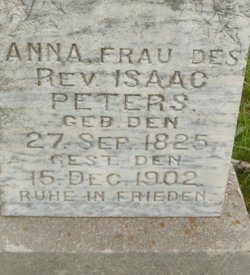
Grandma’s great-grandmother Anna Steingart (or Steingard or Steingardt) was born 27 September 1825 in the village of Pordenau, Molotschna colony (ca. 15 miles east of Kleefeld in the map here). She was married to Isaac Peters on 11 December 1849 and bore three children by him: Sara, Anna (pictured above; see here), and Isaac. She came to the U.S. on the voyage already mentioned in conjunction with her daughter Anna: the S.S. Vaderland, arriving with Isaac and her three kids in Philadelphia on 26 December 1874. She passed away on 15 December 1902, at the age of seventy-seven, and was buried in the Faith Evangelical Bible Cemetery, one-half mile south of the Henderson golf course.

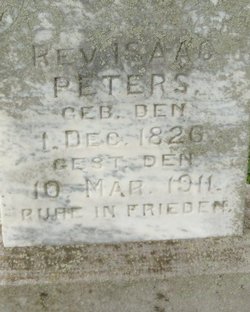
Reverend Isaac Peters (the designation Reverend was apparently important to him, since it appears on his and his wife’s headstones), husband of Anna Steingart and great-grandfather to Malinda Franz Buller, was a man of some renown. Born on 1 December 1826 in Fürstenau, Molotschna (east of Tokmak in the northeast corner of the colony), he first became a teacher in Fürstenau (1850), then an ordained preacher (1866) and elder (1867) in the Pordenau congregation (the village where Anna was born) (see Epp 1959 for much of what follows).

One of his pupils, Peter M. Friesen, described him as a “stern and ironclad ‘old Mennonite’ in all questions of teaching and doctrine relating to society and the state, but also a man who realize[d] the value of a book, especially of historical and theological works. … [Peters] preached penitence and exercised church discipline in the strictest Mennon­ite sense.” Not everyone in Pordenau appreciated his commitments and teachings, and when a schism erupted in the church Peters and his adherents first were forced to withdraw and then were excommunicated from the congregation.

Peters was well known both for what he believed and what he denied. On the one hand, he rejected immersion as a mode of baptism (most Anabaptists poured water over the candidate’s head instead) and the doctrine of the millennium. On the other hand, he was fiercely committed to nonresistance, which led him to advocate loudly in favor of emigration when the possibility of Mennonites being called into the military arose in the early 1870s. His vocal support of emigration eventually led the Russian government to banish him, which led to his emigration to the U.S. at the end of 1874.

Once here, he and other members of his group joined the Bethesda Mennonite Church in Henderson, where Peters once again was appointed elder. By 1880, however, Peters became disgusted with lax standards of living and lack of discipline in that church, so he and his group withdrew to found a new church: Ebenezer Mennonite Church (organized 5 November 1882). The original church building was erected a mile south of Henderson, thus probably on the same site as the Faith Evangelical Bible Cemetery (aka Ebenezer Cemetery).

During Peters’s tenure as elder at Ebenezer Church (1882–1892) he helped form a new association: the Conference of the United Mennonite Brethren of North America. The conference name was later changed to Defenseless Mennonite Brethren in Christ of North America, then again to Evangelical Mennonite Brethren (EMB). Peters’s conference and church continue to exist, the latter with a new name (Faith Evangelical Bible Church) and a new location within the south part of Henderson (for a fuller account of EMB origins and Ebenezer’s history, see Epp 1953).

Isaac Peters passed away on 10 December 1911 and was laid to rest, not surprisingly, in the Faith Evangelical Bible Cemetery.


Sources

Epp, H. F. 1953. Historical Sketch of the Evangelical Mennonite Brethren Conference. Online here.

———. 1959. Peters, Isaak (1826-1911). Global Anabaptist Mennonite Encyclopedia Online.

Thursday, September 6, 2018

David and Helena’s Children: Elisabeth

We begin the David and Helena’s Children series with Elisabeth, whose descendant contacted the blog a little while back and prompted an exploration to learn more about this sister of Peter D. This post gathers in one place all that we currently know about Elisabeth. It draws from Elisabeth’s entry in GRANDMA (9849), the Buller Family Record, and two memorial accounts: one for Elisabeth (here) and one for Abraham Braun, her husband (here). 

1. Birth

According to GRANDMA and the Buller Family Record, Elisabeth was born 8 February 1847 to David and Helena Zielke Buller. GRANDMA lists her as the couple’s third child and first daughter, while the BFR has her as the third child and second daughter. In this case, the BFR is correct, being confirmed by the 1850 Heinrichsdorf census (here; see the complete discussion here). Either way, our ancestor Peter D was Elisabeth’s older sister by two years (he was born 11 January 1845).

GRANDMA reports that Elisabeth was born in the Molotschna village Fischau, but this is clearly in error. Not only do we have lack any record of David and Helena ever living in Fischau, but we have documentary evidence of the family living in Waldheim in 1847, the year of Elisabeth’s birth. That is, in 1845 David and Helena added their names to a list of Waldheim residents who wished to return to Volhynia (here), and this group of thirty-five families did not leave until 1848 (here). In the absence of evidence to the contrary, we can conclude that Elisabeth was born in Waldheim, just like her older brother Peter D.

2. Marriage and Children

On 15 April 1872 Elisabeth was engaged to Abraham Braun, who was two years her junior; they were married nine days later, on 24 April 1872, in the village of Gnadenheim. Elisabeth bore thirteen children to Abraham, nine girls and four boys. Five of the children were born in Molotschna and eight in the United States. Most of the children lived to adulthood, although two daughters died at a young age (see further below).

3. Emigration

We have already discussed Elisabeth and Abraham’s emigration to the United States (see here). They were on the same ship, the SS Switzerland, and voyage as Peter D and Sarah, Johann and Katharina Siebert, and the rest of that party. They landed in Philadelphia (not New York, as stated in the Braun memorial) and then proceeded to Nebraska. According to the Abraham Braun memorial (whose dates are in error at several points), the Braun family took the train to York, “where Abraham’s cousin John Peters met them and took them to their home.” 

The reference here seems to be to Johann Peters (GM 265683), the son of Johann Peters (5718) and Helena Braun (265682). Johann/John and his wife and children emigrated to Henderson in 1878, the year before Abraham and Elisabeth. According to the Johann Peters memorial (here), John and his wife lived on section 15 of York County’s Brown township, thus 3 miles east and 4 miles north of Henderson’s northeast corner. The main complication with this identification is that Helena Braun and Abraham Braun were, as far as we can tell, only distantly related many generations back. Thus, the term cousin is apparently being used loosely here. 

Shortly after their arrival in Nebraska, Elisabeth and Abraham’s daughter Helena died just shy of her first birthday. The Braun memorial states that Helena was buried on the Isaac Peters farm in York County; the Elisabeth Buller Braun memorial specifies that this was the Reverend Isaac Peters, that is, Grandma Malinda’s great-grandfather (see here). Unfortunately, we do not yet know where Isaac Peters’s farm was located.

4. Baptism

We are accustomed to reading of young Mennonite women and men being baptized as teens or at least before they married, but such is not the case with Abraham and Elisabeth. According to the Braun memorial, Elisabeth was baptized on 26 March 1883 “in a creek in Hamilton County by Rev John Regier [see here] and Rev John Enns.” She was a thirty-six-year-old mother of eight at the time. Husband Abraham had been baptized three years earlier “in the river near his mill in York County, Nebraska by Rev Henry Nickel.” Elisabeth’s memorial adds that her husband Abraham was baptized by immersion.

This late baptism is easier to understand when we view it within the context of the couple’s religious affiliation. According to the Braun memorial, “Both Abraham and Elizabeth were lifelong members of the Mennonite Brethren Church.” The MB Church that developed out of the revivalistic spirit of the mid-nineteenth century was distinguished from other Mennonite groups, among other things, by its practice of baptism by immersion, as opposed to pouring. Consequently, anyone who wished to join the Mennonite Brethren Church had to be baptized by immersion, and Mennonites who had been baptized by some other means were required to be rebaptized by immersion.

One wonders if Elisabeth and Abraham had been baptized by pouring in some other church during their young adult years (i.e., before marriage); if so, and if they decided to join the MB Church later in life—calling into question the claim that they had been “lifelong” members of the MB Church—they would have needed to be rebaptized in order to do so. To be clear, we lack clear documentary evidence that Elisabeth and Abraham had been baptized earlier in life, but it seems reasonable to think that they were.

5. Residences

After living in the Henderson area for a decade, Abraham and Elisabeth and family moved west to Colorado. According to Elisabeth’s memorial:

In about 1889, the Abraham Braun family moved to Joes Colorado in what is now Yuma County (Joes was called Kirk at the time). … On May 14, 1897, Abraham, Elizabeth and 7 of their 11 living children, began moving to Westfield, Texas by way of two covered wagons. The 4 children who stayed behind with relatives were Elizabeth, Abraham, Isaak and Marie. After about 2 weeks of traveling, they arrived at Inman, Kansas where the Braun’s worked in the harvest while visiting Benjamin Buller (Elizabeth’s brother). On August 25th they continued their journey, and on Oct 4, 1897 finally arrived in Texas at the home of the Bernhard Kroekers.

Joes, Colorado, is on the eastern Colorado plains, approximately 120 miles straight east of Denver. Beginning in the late nineteenth century and through to the late 1980s, Joes, which was then known as Kirk, was home to a Mennonite Brethren church (see here).

Eight years after settling in Colorado, the family began a nearly 800-mile journey to southeast Texas. Like so many before them, they traveled by covered wagon. Roughly 280 miles into their trip they stopped at Inman, Kansas. If the dates given are accurate, the couple averaged around 19 miles a day. Most important for our interests is the note that the couple stopped at Inman to visit Elisabeth’s brother Benjamin. We will pick up this thread when we look more closely at Benjamin’s life. 

After spending nearly three months working in Inman, the Brauns continued their trek southeast, arriving in Westfield, Texas, forty-one days later (average travel rate was 13 miles a day). Westfield still exists as an unincorporated community 3.5 miles northwest of the George Bush Intercontinental Airport. According to M. A. Kroeker (1959), the 

Westfield (Texas) Mennonite Brethren Church, lo­cated 15 miles north of Houston, was started in 1897 when nine families from Kirk, Colorado, and some from Kansas organized a small Mennonite Brethren church here under the leadership of H. Berchtold. They had a very prosperous beginning, starting also a Christian day school. The unhealthy climate, however, forced them to leave this place in 1900. Most of the families moved to Corn and Enid, Oklahoma. 

According to this further information, we should imagine Elisabeth and Abraham traveling as part of a larger group, not on their own. They were presumably part of an MB group who first went from Henderson to Colorado, then from there to Texas. 

6. Death

Elisabeth’s days in Texas were few: on 25 March 1898, “after only a few short months in their new and very humble 2 room home at Westfield, Texas, Elizabeth Braun became very ill with appendicitis. Elizabeth died on Sunday, Apr 3, 1898, and on Monday, Apr 4 with many in attendance Elizabeth's mortal remains were laid to rest under a mighty, so-called India Rubber tree on the Braun’s land in Westfield, Texas” (Elisabeth memorial). We have no further information on where that farm was located or whether the grave was marked apart from its location under the tree.

The remainder of Abraham’s life is narrated on his memorial page. Several months after Elisabeth’s death, the family left for Enid, Oklahoma; Abraham remarried the following year, and he and his second wife settled back in Joes, where Abraham apparently lived out the rest of his days. 

One final note: an earlier post makes passing mention of Elisabeth and Abraham and their family (see here). The 22 March 1905 issue of Die Mennonitische Rundschau contains a letter from Heinrich Buller, son of David by his second wife (after Helena’s death). Heinrich is informing readers of the recent passing of his father David, and he asks readers to inform the children of Johann Wiens and Abraham Braun, who were married to his sisters Maria and Elisabeth. Heinrich is aware that both of his sisters were deceased at this time, and he wants their children to be made aware of the passing of their grandfather David.

Work Cited

Kroeker, M. A. 1959. Westfield Mennonite Brethren Church (Westfield, Texas, USA). Global Anabaptist Mennonite Encyclopedia Online. Available online here.


Tuesday, July 2, 2024

Peter D Buller’s Obituary

From time to time in our wanderings through our family history, we have had been confronted with the fact that sometimes the story remembered does not match the story as it happened. If my own memory can be trusted, we first encountered this phenomenon when considering the name of the ship on which Peter D and Sarah Siebert Buller traveled across the Atlantic to the shores of the U.S. The Buller Family Record is quite clear that they, along with Johann Siebert and others of his family, crossed on the S.S. Vaderland. However, that family memory was incorrect, as we learned in a September 2014 post (here). In fact, the entire group crossed the Atlantic on the S.S. Switzerland.

I recount that story as background to the subject of this post: the death of Peter D Buller. I have been told, and I believe this to be the current family memory, that Peter D died at the young age of fifty-two of a heart attack. However, several days ago I stumbled on his obituary in the 21 October 1897 issue of the Christlicher Bundesbote (p. 8), which calls into question the notion that he died suddenly (one would think) of a heart attack.

The published obituary appears below to the right (a transcription of the German is included at the end of this post; for the original scan of the entire page, see here). Peter’s obituary, preceded by the heading “Gestorben” (died), is the second item in a section titled “Familien-Nachrichten,” family news. (The first item reports happier news, the marriage of Heinrich Peters and Anna Dyck.) Peter’s obituary reads as follows:

Buller—On 28 September, near Lushton, Nebraska, after a long illness, Brother Peter Buller, aged fifty-two years, eight months, and eighteen days. The deceased leaves a deeply bereaved widow and ten children to mourn the death of their father. The funeral took place on 1 October. Elder Peter Friesen delivered the funeral oration, on Job 16:22, to a large gathering in the home of the deceased, to which Elder Isaac Peters gave an introduction on Isa 57:2.

The phrase “nach langem Leiden” can be translated “after a long illness” (as above) or “after a long suffering,” but they both mean roughly the same thing. Peter D’s death was not quick, as one might expect from a heart attack. It is possible, of course, that he experienced a heart attack and then suffered for some time until he finally expired. However, the obituary on its own does not give that impression. The question thus remains: What exactly was the cause of Peter D Buller’s death at age fifty-two? For the present, we cannot say.

Several other details warrant attention. 

1. According to the obituary, Peter D and family were living near (bei) Lushton at that time. This raises several important questions. First, where were they living at that time? Second, why did the family leave their original farm in Hamilton County? In a September 2016 post (here) we learned that, under the terms of the Homestead Act, Peter D had been granted ownership of 80 acres in section 12 of the Farmer’s Valley Township on 21 January 1893 (he purchased the other 80 acres of that quarter). A little more than four years later, at the time of his death, he was living near Lushton. When did he move? Why did he move? These questions merit further exploration, but one wonders if Peter D’s sudden move from the Hamilton County farm was somehow connected to his “long illness.” Perhaps someday we will learn the answer to this question.

2. Peter’s funeral was held at his home, which was not unusual. What catches my eye is that the service was led by two elders from different churches. Peter Friesen was elder at the Bethesda Church; Isaac Peters had been an elder at Bethesda but had left that church, taking a significant number of members with him, to found, on 5 November 1882, the Ebenezer Mennonite Church a mile south of Henderson. (If you recall, Isaac Peters was Grandma Malinda’s great-grandfather; see here.) Why did both elders conduct Peter D’s service. The simplest explanation would be that Peter D had been a member of the Bethesda Church (thus the involvement of Elder Friesen) but had transferred to the church founded by Elder Peters (thus his presence). Of course, this is nothing more than conjecture that awaits confirmation or correction through the discovery of additional contemporary evidence.

We began this post by noting that sometimes the family story remembered does not match the story as it happened. Peter D’s obituary seems to be another case of this kind of disconnect. Beyond that, when we consider all the questions that arose from a one-paragraph obituary, we must also admit that we know a lot less than we might think. Although we will never construct a final, unalterable version of our family story, we should continue to fill in pieces as they come to light. Doing so honors the memories of all our ancestors who have gone before.

German original of Peter D Buller’s obituary
Am 28. September bei Lushton, Nebr., nach langem Leiden, Br. Peter Buller im Alter von 52 Jahren, 8 Monaten und 18 Tagen. Der Verstorbene hinterläßt eine tiefbetrübte Witwe und 10 Kinder, die den Tod des Vaters beweinen. Das Leichenbegängnis fand am 1. Okt. statt. Der Aelteste Peter Friesen hielt die Leichenrede in der Wohnung des Dahingeschiedenen zu einer zahlreichen Versammlung über Hiob 16, 22 wozu der Aelteste Isaak Peters die Einleitung machte über Jes. 57, 2.


Friday, August 26, 2016

Primary sources

One of the commitments of Buller Time blog is to rely on primary sources whenever it is possible to do so. Ideally, we prefer to see with our own eyes the records of church books, government censuses, ship manifests, passports, antique photographs, and the like. When these are unavailable, we content ourselves with transcriptions or translations of those records, trusting the scholars and researchers of Mennonite history and genealogy for access to this important information.

Occasionally we have access to a primary source in a modern form, as in A Mennonite in Russia: The Diaries of Jacob D. Epp, 1851–1880 (Dyck 1991). The University of Toronto Press published Harvey L. Dyck’s introduction to and translation of Jacob Epp’s diary in hardcover in 1991, but recently they have reissued it in paperback and even e-book form (see further below).

Why should we be interested in Jacob Epp’s diary? Not because he mentions any Bullers—I checked, and he does not. Not even because it discusses in any depth areas where our family lived. Jacob Epp lived in and around the Chortitza (or Khortitsa or Chortiza) colony, also known as the Old Colony, which was roughly 60 miles north–northwest of the Molotschna colony.


The Chortitza colony was located in the area of the upper star, the Molotschna colony around the area of the lower star. 

Jacob Epp’s diary is of interest to us primarily because it reflects in sometimes-beautiful and often-brutish detail what life was like in a Mennonite settlement very much like that in which our ancestors lived during the last three decades of their life before emigrating to the U.S. Couple that with Harvey L. Dyck’s informed, insightful, introduction to the diary, as well as his helpful notes to the translation, and one is given a fascinating and informative window into the world of nineteenth-century Russian Mennonite life.

That is not to say that Epp’s diaries have nothing to do with our family. In fact, Grandma Malinda’s own great-grandfather Isaac Peters (see here) appears in Epp’s entry for 24 January 1873. During a visit by Jacob Epp to the Molotschna colony, he attended a meeting concerning possible emigration to the U.S. Epp writes:

This morning, Jacob Hiebert harnessed his horses and took me through Gnadenfeld to Pordenau, where the conference and Brotherhood Meeting took place in the church. It was conducted by Elder Isaac Peters. The subject was the prospective emigration and the question of sending a deputation to America. About 2000 R. had been allocated for this purpose and a further 1000 was collected. (Dyck 1991, Kindle 6493–96)

A little more than a year and a half later, Elder Peters is mentioned once again, in the entry for 18 October 1874:

Emigration fever among our Mennonites both in the Khortitsa District and on the Molochna continues to be very strong, and only God knows what the end result of this will be. Elder Isaac Peters, whose preaching is said to have included abuse of the government, has received formal notice from the imperial authorities that he must leave Russia within a short period of time. Farms are selling for next to nothing. Those earlier priced from 5000 to 6000 R. are now selling for 2000 R. or, at most, 3000 R. Other possessions are similarly cheap.

Even apart from the family connection, this sort of immediate, primary contact with the people and events of that time and place far surpasses both in value and enjoyment even the best of secondary, or second-hand, historical accounts.

I highly recommend this work for all Buller Time blog readers. It is available in paperback or EPUB (suitable for a variety of e-readers, including i-Books) format at the University of Toronto Press site here (lowest e-book price). An e-version is also available from Google Play here, from Amazon for Kindle here. Tolle lege!


Source Cited

Dyck, Harvey L., ed. and trans. 1991. A Mennonite in Russia: The Diaries of Jacob D. Epp, 1851–1880. Tsarist and Soviet Mennonite Studies. Toronto: University of Toronto Press.


Sunday, November 16, 2014

Isaac and Sarah Epp Franz on their wedding day

Although photographs such as the one below help us to picture what our ancestors looked like (and perhaps even see where a particular physical trait originated), we really do need a program to keep all the names straight. With all the Peters, Margarethas, Johanns, and Sarahs, not to mention the mixing and intertwining of Bullers and Epps and Sieberts and Franzes or the fact that we have Peter as a first name and Peters as a last name, as well as Franz as a first name and as a last name, it is easy to become lost and confused in the genealogical maze that is our family.


Thus to put it as simply as possible, this is the wedding photograph of Grandma Malinda’s parents: Isaac G. and Sarah Epp Franz. They wed on 7 December 1905, and Grandma was born a little more than ten months later, on 20 October 1906.


Isaac was the third child and first son of Gerhard and Anna Peters Franz, who emigrated separately to the U.S. from Molotschna colony and married shortly after arriving. Remarkably, we can trace Isaac’s lineage back several generations further, to eighteenth-century Prussia, to a village named Ober Gruppe in the district Schwetz, West Prussia (i.e., Poland).

Thus Grandma’s Franz side would stretch back as follows: Malinda > Isaac G. > Gerhard > Peter > Gerhard (born 26 February 1783 in Ober Gruppe). When the village was established is uncertain, but it lives on even today (population 580). In fact, in 1935 twelve Mennonite families still lived in Ober Gruppe (modern Górna Grupa; pictured above), and one of them was named Franz.

The family of Isaac’s mother, Anna Peters Franz, can be traced back a generation further, as follows: Malinda Franz > Isaac Franz > Anna Peters > Jacob Abraham > Abraham Jacob > Jacob > Jacob. The latter two Jacobs lived in Lakendorf, a village in Gross Werder district in West Prussia. This village (now Solnica) likewise remains today (not too far inland from the Baltic Sea, southeast of Gdańsk [former Danzig]), although it is only about half the size of Górna Grupa.

We have already encountered the Epp side of Grandma’s family here, with the photograph of Jacob and Margaretha Siebert Epp, but we can also trace the Epp side back to the mid-eighteenth century: Malinda Franz > Sarah Epp > Jacob > Jacob > Franz (who was born 19 November 1752). The latter two men lived in the same general area as Lakendorf, in a village named Schönau.

Sarah Epp’s mother was, as we have already discussed, Margaretha Siebert, who was the sister of Sarah Siebert Buller, wife of Peter D Buller. For the sake of completeness, we can trace this branch of the family as well: Malinda Franz > Sarah Epp > Margaretha Siebert > Johann Siebert > Cornelius Peter > Peter. As one might expect, the latter two individuals in the line lived in West Prussia in the same general region as the others.

Even with all the names written out, it is difficult to keep everyone straight, but at least now we have a bit more detail and specificity on Grandma’s heritage. One thing that should be evident from all this is that our exploration of our family’s life in Molotschna is only the first step back. Before Molotschna our forebears lived and generally prospered in West Prussia, otherwise known as Poland. In time we will turn our attention to that period in our family’s history, with a goal of someday working further back to our earliest roots in the Netherlands, in broad strokes if nothing else.

Sunday, September 4, 2016

Banned Bullers?

The David Epp diaries, as mentioned earlier (here), offer us direct access to the lives of Russian Mennonites in the mid-nineteenth century. Anyone interested in Mennonite history from that time and in that place will find in Epp’s diaries a detailed portrait of life in the Old Colony (Chortitza), which was largely the same as that experienced by our forebears in Molotschna colony 60 miles to the south–southeast.

Previously we noted the high incidence of child mortality and wondered how many Buller children died young without having their names ever recorded in a church book or government census (see here). This post looks at another aspect of Mennonite life: the application of the ban.

The idea of being banned probably seems foreign to many today, although it is making a comeback with some forms of social media (e.g., an abusive commenter being banned, that is, prohibited from commenting). Throughout their history Mennonites as a social and religious community have practiced banning as a means of self-regulation. The leaders of the church took seriously their responsibility of maintaining right behavior within the fellowship; the ban, “either exclusion from communion (kleiner Bann) or exclusion from membership (grosser Bann)” provided them the means, the social leverage, that enabled them to perform their duties effectively (Neff 1953).

But enough talking about the ban; much more enlightening is to read of its application to real people in nineteenth-century Russia. As lay leader of several congregations, David Epp frequently reported why and how the ban was applied to members of his community. The following examples provide a good sense of the types of behaviors that provoked banning and the usual course that banning took.

20 January 1853
News from the Khortitsa Community. In the colony of Einlage, Abraham Dyck and his bachelor brother Peter beat and seriously injured Gerhard Friesen, Jacob Braun, and Johann Wiebe. Braun is reported to be close to death and will, in any case, be crippled. Whoever hates his brother is a murderer.

11 February 1853
A letter from the Reverend Jacob Pätkau reports that eight people from Einlage, the innocent as well as the guilty, have been placed in the ban.

***

10 September 1863
The Brotherhood Meeting discussed several matters. … Aron Neusteter and his stepdaughter Anna Peters were placed in the ban for committing fornication, which resulted in the birth of a child. Lord Jesus, our merciful Saviour, grant them genuine remorse to everlasting life. Amen.

15 September 1863
Aron Neusteter and his stepdaughter Anna Peters, who had been placed in the ban, asked to be readmitted to the church. Brotherhood [Meeting]. Aron Neusteter and Anna Peters were received back into the church.

***

21 April 1864
Easter Tuesday. I attended a large Brotherhood Meeting in the Khortitsa church. … The meeting discussed the cases of the church members Johann Kirsch, who had married a Russian woman, and Johann Dyck, who had married a Lutheran woman. It was decided that such persons should not be placed in the ban but released from their church membership in a way that would allow them to maintain relations with church members in the civil sphere.

The congregation then considered what to do with persons who sought readmission to the church after withdrawing and being re-baptized. This was the case with Jacob Peters and Mrs Gerhard Rempel of Borosenko, who now desired close ties with the church. It was decided to wait and observe the genuineness of their remorse.

Peter Peters of Schönwiese was placed in the ban because of adultery and fornication.

***

13 December 1864
The Peter Mantlers appeared before the Ministerial Committee. Elder Gerhard Dyck had informed us that Mrs Mantler had committed adultery with old Jacob Dyck in Nieder Khortitsa. She confessed her transgression to the Brotherhood Meeting and was placed in the ban.

***

15 January 1867
Before today’s service, we met at Reverend J. Pätkau’s house where Elisabeth Wiebe, the unwed daughter of the late Martin Wiebe of Neuosterwick, had been summoned to appear [before the Ministerial Committee] by the brethren Isaac Siemens and Bernh. Bärgen. She had given birth to an infant shortly before Christmas. She confessed to having committed fornication with Heinrich Lepp, son of Peter Lepp of the Grossfürstlich settlement. Brotherhood Meeting. The congregation placed Elisabeth Wiebe in the ban. Grant her the strength to repent, Lord. I wrote a letter to the beloved Elder informing him of the incident.

29 January 1867
Brotherhood Meeting. Elisabeth Wiebe was received back into the church (see entry for Jan. 15, 1867). Jesus forgives sinners.

***

8 October 1867
Before the service, Mrs Herman Peters appeared in my brother Diedrich’s office.… She had committed fornication with her brother-in-law Johann Peters before and after her marriage. Recently, before his death in the Grossfürstlich settlement, he had confessed the matter. Amidst a flood of tears, she admitted her guilt. Abraham Breil of Novozhitomir appeared also, Mrs Jacob Reimer having confessed to committing fornication with him in her youth, at the time of the catechism instruction. He would admit only to having touched her private parts, denying the rest. I urged him to be honest, but he stuck to his story. Even the unchaste deed merits severe censure.

Brotherhood Meeting after the service. Mrs Hermann Peters was placed in the ban. Lord, grant her true repentance. Abraham Breil, however, persisted in his story. I exhorted him to repentance. His case has been held over for now and rests on his conscience. The Lord will bring to light what has been concealed and reveal the secrets of the heart.

14 October 1867
When I got home last night, I found Bernhard Giesbrecht and Julius Janzen of Kamianka waiting for me. On behalf of Mrs Hermann Peters, they requested her readmission to the church tomorrow.

15 October 1867
Sunday morning. With tear-filled eyes, Mrs Peters begged to be readmitted to the church. Janzen, Giesbrecht and I therefore drove to Novozhitomir, where the service was being held. Brotherhood Meeting. Hermann Peters’s wife was received back into the church.

***

25 March 1869
My brother Heinrich writes: “You will have heard of Reverend Heinr. Penner and his confession. In his old age he has been barred from the ministry. This was not our original intention, since he was no longer in office. Blind Agatha has been placed in the ban. She confessed to committing fornication not only with Reverend Heinr. Penner but also with the late bachelor David Dörksen, with a man from the Bergthal colonies and with Peter Hildebrand of Khortitsa. The matter will likely come before the brethren tomorrow since the blind woman will undoubtedly ask to be readmitted [to the church], and Hildebrand will be placed in the ban. It is unspeakably sad how sin can rule over us. ‘Lord, lead us not into temptation.’”

***

21 March 1870
Franz Giesbrecht of Novozhitomir told me his daughter Maria had confessed to behaving unchastely and committing fornication with both their Russian man-servant and Franz Klassen.

22 March 1870
Before today’s service Franz Giesbrecht and his daughter Maria appeared before me. They had been summoned by Peter Janzen and Johann Klassen. Maria admitted the truth of her father’s story. The matter was held over until next Sunday.

29 March 1870
Before today’s service, Franz Giesbrecht, his daughter Maria, Franz Klassen, and the two summoners [Peter Janzen and Johann Klassen] appeared before the Ministerial Committee. Franz Klassen denied committing fornication with Maria. The girl said he had run his hand over her private parts and similarly described her unchaste behaviour with the Russian [servant]. But she contradicted herself and finally admitted her complete guilt. The matter was deferred until the Brotherhood Meeting. Brotherhood Meeting. The matter regarding Maria Giesbrecht and Franz Klassen was presented to the brethren. Klassen was summoned and admitted to having uncovered and touched Maria’s private parts several times. Both were placed in the ban. Lord Jesus, grant them strength for repentance.

3 May 1870
Brotherhood Meeting. … Maria Giesbrecht was readmitted to church membership.

***

15 May 1870
At Elder Ger. Dyck’s request, Abraham Peters of village number one appeared in our [married] children’s zemlianka [a dugout] in the presence of the witnesses David Klassen and Janzen. Peters, who was accused of having committed fornication with a Russian woman, admitted his guilt contritely and shamefacedly.

17 May 1870
Abraham Peters was placed in the ban because of his unchaste conduct.

***

28 February 1871
Prior to the service in Steinau, Mrs Abraham Knelsen appeared before the ministers. The Grossfürstlich Elder Johann Wiebe had reported that she had committed fornication and adultery with Heinrich Friesen of the Nepluiev settlement, to which she confessed. She also admitted that during her first marriage she had done similar acts with Jacob Andres Sr in Einlage, with the teacher Peter Abrahams, and with Jacob Hiebert. I presented the matter to the Brotherhood Meeting. She was placed in the ban, in keeping with God’s Word.

***

19 May 1871
I was called home from my brother Diedrich’s place to talk to Jacob de Veer of Izluchistaia, who poured out his troubles to me. His daughter Katharina had committed fornication with the young man Jacob Bärgen and been delivered of a healthy son. Bärgen admitted his guilt, but refused to have anything to do with Katharina or the child. I told de Veer we would be able to work something out once Katharina was up and about and we could call her and her lover to account. Sin brings people to ruin.

30 May 1871
Before today’s service, Jacob Bärgen and Katharina de Veer, who had committed fornication with one another, appeared in the ministers’ room.… They were summoned by the witnesses Gerh. Andres and Bernhard Wiebe. Her father, Jacob de Veer, was also present. They openly confessed their guilt. De Veer was permitted to take his daughter home. Brotherhood Meeting following the service. I presented the case to the brethren, and Jacob Bärgen and Katharina de Veer were placed in the ban. Lord, grant them strength to repent.

4 June 1871
Johann Bärgen and Jacob de Veer, the fathers of the two members placed in the ban, asked me to help them reach a settlement in regard to the costs of raising the child born out of wedlock. Veer demanded 100 R. plus 25 R. support per year for 8 years, and Bärgen offered to pay no more than a total of 50 R. I suggested that the best solution would be for the two to marry. Bärgen replied that he had recommended this as well, but that his son was set against such a marriage. I then told them they would have to reach a settlement on the payment of [maintenance] costs before the children could be readmitted [to the church]. A multi-year settlement was also out of the question. They finally agreed that Bärgen would pay de Veer 60 R., half by Michaelmas and the rest by May 1, 1871. The two men shook hands and parted in peace. 

4 June 1871
Brotherhood Meeting. Jacob Bärgen and Katharina de Veer were readmitted to the church.

***

25 July 1871
Last night Peter Thiessen’s wife came by, crying and lamenting her fate. She had learned that her husband planned to join the Russian [Orthodox] church and wanted me to help find him. This I promised to do. Peter Thiessen has developed a bad reputation in his dealings with people. He has worked as a supervisor or foreman in the construction of various mills and has always ended up in some kind of trouble.

13 January 1872
Peter Thiessen’s wife came to see me this morning about her runaway husband…, requesting that I collect money for her to buy a wagon that would allow her to hunt for him. She asked if I would initiate the collection at next Saturday’s meeting of Judenplan model agriculturalists, at the home of my brother Diedrich (overseer of all Hebrew colonies of the 4th District of the Province of Kherson). The poor woman hopes she can win her husband back by speaking to him personally. May God give his blessing.

6 February 1872
In the afternoon, my brother Diedrich, Peter Siemens, Corn. Martens, Abraham Unger, and I gathered at my brother Diedrich’s place to talk to Peter Thiessen. He was called in, made a complete confession, and asked for permission to live among us again. I asked him about the rumours that he had committed fornication, and he admitted that they were true. In reply to our question as to how far matters had gone regarding his [rumoured joining of the] Russian [Orthodox] church, he said that he had made only one inquiry in this regard and had not pursued the matter further because he knew it was wrong. The issue will be placed before the brethren on Sunday.

13 February 1872
Brotherhood Meeting. I presented the matter involving Peter Thiessen. The brethren decided that since he had gone astray and committed many transgressions, including fornication, he should be placed in the ban. Friesen, Isaac Siemens, and I were instructed to inform him of our decision.

20 February 1872
Brotherhood Meeting. Peter Thiessen appeared before the brethren, asked their forgiveness, and was readmitted to church membership. Lord Jesus, forgive him, let him keep his renewed vow and walk in the fear of thee. Have mercy on thy flock. Do not let a single lamb go astray.

***

15 June 1872
In the afternoon, Heinrich Olfert of Novovitebsk begged me to talk to his brother-in-law Peter Siemens, who was ill and wanted to see me. Olfert had arrived on Siemens’s springed carriage, and my wife, our little Johann, and I drove back with him. I found Siemens sick and anxious to confess his sins. He was especially tormented by his heavy drinking and the fornication he had committed. In his youth he had also defiled himself with cattle and committed fornication with a girl named Aganetha Schmidt (the daughter of Peter Schmidt of Kronsweide), whom he had seduced by promising to marry her. As a married man, he had had relations with Johann Siemens’s wife (who had seduced him), and with eight Russian women. Dear God, sin has such power. Siemens was contrite. I am sure the Saviour will not reject him.

18 June 1872
Brotherhood Meeting. I outlined Peter Siemens’ transgressions, and he was placed in the ban. May the Lord grant him the strength to repent. It was also decided that if he asked to be readmitted, and could not do this personally [in church], it could be done at his bedside.


23 June 1872
Peter Siemens asked to be readmitted to the church. In keeping with church practice, I received him as a member in the presence of several church members, and we sang a hymn in closing. Siemens is very sick and close to death.

***

16 April 1873
At the request of Elder Gerhard Dyck, I met with him and Reverend Gerhard Enz in Schöndorf, Borosenko [settlement]. Abr. Bärgen, who had attempted suicide, was summoned to appear before us. Also present were the [Borosenko] District mayor Gerhard Rempel and the [Schöndorf] Village mayor David Penner. Bärgen, who is addicted to drink and lives in discord with his wife, showed not the slightest remorse, refusing even to admit that he was a drunkard until the District and Village officials proved otherwise. He was allowed to leave until tomorrow.

17 April 1873
At Elder G[erhard] D[yck’s] suggestion, G. Rempel and I spoke to Abr. Bärgen early this morning, trying to impress upon him the sinfulness of his hatred of [his wife]. We had hoped he would recognize the wretchedness of his condition and be moved to genuine contrition. I did what I could, but, O God, it made almost no impression on Bärgen. His wife wept bitter tears. They did, however, agree to come to G. Enz’s place in Schöndorf, where we exhorted him further to a genuine change of heart. A service followed in the school. There was then a Brotherhood Meeting at which Elder Dyck reviewed Bärgen’s transgressions. Bärgen appeared, asked forgiveness of the brethren, and was dismissed in peace. Lord, Lord, soften his hardened heart to repentance. Lead this lost sheep on to the path of eternal salvation.

28 May 1873
Jacob Klassen of Schöndorf and Heinrich Löwen of Nicolaithal, appearing on behalf of Mrs Abraham Bärgen, requested her readmission to the church. The Elder had placed her in the ban last Thursday because of the discord in her marriage. Her husband … has been under arrest in Khortitsa for some time. I promised to visit [the Borosenko settlement].

30 May 1873
To keep my promise, Heinrich and I drove to Borosenko where I consulted a number of church members about Mrs Bärgen’s readmission to the church. She appeared, but showed little contrition, and we decided to leave matters as they were. Since her husband is still under arrest in Khortitsa, it seemed best that she and her trustees appear before Gerh. Dyck in Rosenthal on Sunday. Her husband would also be asked to appear, and the two could be reconciled. She could then be readmitted to church membership on Sunday, in the Neuendorf church. Indeed, this is what happened.

***

30 October 1873
I was called to Abraham Friesen’s bedside, who … confessed to committing fornication with numerous Russian women and defiling himself with animals, etc. Since seeking the face of God he had come to realize, he said, that he would not find peace until he had confessed his sins to the church. He showed great remorse. May the dear Saviour lead him along the path of repentance and have mercy on him.

4 November 1873 
Brotherhood Meeting. Abraham Friesen was placed in the ban for his transgressions.

12 November 1873
Monday morning, Abraham Friesen, excluded from the church because of his carnal sins, was readmitted to membership.

***

14 January 1875
Tuesday. … My brother Diedrich returned from Khortitsa with a letter from Elder Gerhard Dyck informing me that a Brotherhood Meeting in the Khortitsa church on January 6 had placed Gerhard and Klas Thiessen and Johann Dyck in the ban because of their Nikopol swindle. I am to inform their families and the Neu Khortitsa Village assembly accordingly to ensure that they are treated as separated persons. I forwarded the letter to the Village Elder [of Neu Khortitsa], Dietrich Braun. Heinrich Harder of Gnadenthal, who had been in Khortitsa on business, brought the wrongdoers (together with a formal report from the Khortitsa Volost) home on the 11th.

17 January 1875
Friday. Reverend Pätkau tells me that the three men in question had yesterday been turned over to the District police officer in Sofievka. Lord, grant them the strength to repent.

24 January 1875
Dietrich Braun, the mayor of Neu Khortitsa, and Jacob Neufeld came to talk to me on behalf of the three men placed in the ban, requesting their readmission to the church on Sunday, that is, tomorrow. Johann Dyck and Klas Thiessen dropped by to make a similar plea personally.

26 January 1875
Brotherhood Meeting. The brethren consented to the readmission of Johann Dyck and the brothers Klas and Gerhard Thiessen to the church. Lord Jesus, accept their remorse and wipe away their guilt. Their case has not yet been decided by the courts, however.

Without claiming the least bit of expertise on the ban and its application, I offer a few observations about the practice of the ban in David Epp’s time and place.

1. Sexual misconduct was the most frequent circumstance to which the ban was applied. No doubt this was due to a desire not only to promote sexual purity but also to protect social solidarity and cohesiveness, something that marital unfaithfulness would certainly damage.

2. Epp’s frequent prayers for the ban to lead to genuine remorse and sincere repentance presumably hint at the primary goal of putting someone under the ban. It was not merely to punish but also to prompt a change of mind and spirit that would permit reintegration into the community.

The same is indicated by the situation involving the unwed parents Jacob Bärgen and Katharina de Veer. The ban was lifted and they were readmitted to the church only after their families agreed on the terms of support for the child and were formally reconciled.

3. That being said, we should not ignore the punitive aspect of the ban. It was frequently applied to misconduct many years in the past. Even then, however, one might understand its purpose to be to provoke true repentance and remorse for past sins.

4.  Although not all the entires mention readmission into the church, enough do that we can deduce that banning was not something that was meant to go on forever—or even for long. Jacob Bärgen and Katharina de Veer were readmitted to the church five days after being placed under the ban. Elisabeth Wiebe was received back two weeks after the ban was imposed. Sickly Peter Siemens was under the ban for five days, Maria Giesbrecht for only four. Of course, the length of the ban depended entirely upon the person under it: showing genuine remorse for the sin was a prerequisite for admission back into the fellowship.

5. As Epp readily admits, “the innocent as well as the guilty” could be placed under the ban. I have no explanation to offer for that surprising state of affairs, except to wonder if this further evidence of the ban being used as a lever to encourage reconciliation among disputing parties.

To return to the provocative question in the title to this long post, were any Bullers banned? We do not know one way or another, but, given what we read above, it would not be surprising to discover that Heinrich Buller of Brenkenhoffswalde (here) and Anna Buller of Deutsch-Wymysle (here; see also here) were placed under the ban. Truth be told, I rather suspect that they were not the only ones!


Sources Cited

Dyck, Harvey L., ed. and trans. 1991. A Mennonite in Russia: The Diaries of Jacob D. Epp, 1851–1880. Tsarist and Soviet Mennonite Studies. Toronto: University of Toronto Press.

Neff, Christian. 1953. Ban. Global Anabaptist Mennonite Encyclopedia Online. Available online here.


Friday, December 5, 2014

Grandma’s line 3

The first post in this series began with Grandma’s parents; the second moved to her grandparents on her mother’s side; this third one introduces her grandparents on her father’s side. The relationships can be represented visually as follows:


Isaac G. Franz

Gerhard Franz
Anna Peters Franz


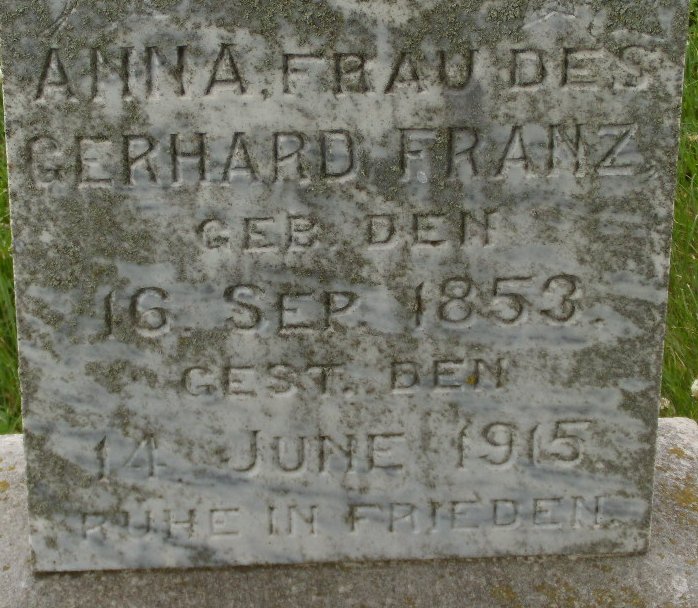
Grandma’s father Isaac G. Franz was the son of Anna Peters Franz, who was born on 16 September 1853 in the village of Fürstenau in Molotschna (just east of the Russian village of Tokmak on the north of the Molotschna colony; see the map here). She was baptized at the age of twenty, on 27 May 1873. A year and a half later she emigrated to the U.S. on the S.S. Vaderland, arriving in Philadelphia on the day after Christmas. She bore five children (three girls and two boys) over a fifteen-year span. Isaac was her middle child. She passed away in Henderson on 14 June 1915 and was laid to rest in the Faith Evangelical Bible Cemetery (aka Ebenezer Cemetery or Evangelical Mennonite Brethren Cemetery), which is one-half mile south of the Henderson golf course.

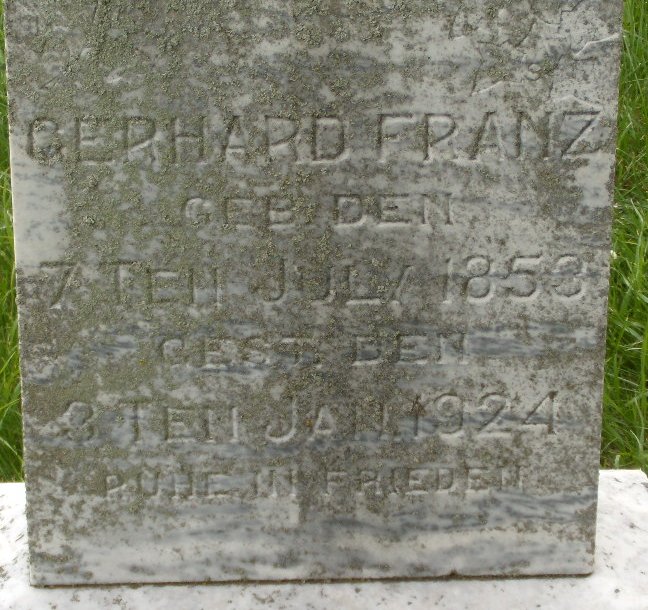
Gerhard Franz, Grandma’s grandfather on her father’s side, was born on 7 July 1853 in the village of Gnadenfeld (right and below center of the map previously linked). He was baptized at age eighteen, on 4 June 1872, and emigrated to the U.S. a year later on the S.S. Tuetonia, arriving in New York on 3 September 1874. After Anna passed away in 1915, he married Maria Dueck, a widow, on 23 October 1919. Gerhard passed away 3 January 1924; like his first wife, he was buried in the Faith Evangelical Bible Cemetery.


Much of the information about Gerhard and Anna Peters Franz is taken from the church register of the Evangelical Mennonite Brethren Church of Henderson (earlier known as the Ebenezer Church). Why this is important will become clearer when we meet Anna’s parents in a following post.

Tuesday, May 15, 2018

Lushton and the KMB

Even when there is no writing taking place at the Buller Time blog, the reading continues nonstop in the background. Recently I have been learning about a Mennonite group previously unknown to me: the Krimmer Mennonite Brethren Church. 

For the short version of the history of this group, see the Bender entry in GAMEO. C. F. Plett’s much longer history (which is what I have been reading) is available online here. Suffice it to say that this group, although bearing the name Mennonite Brethren, was not associated with the MB group that was organized in Molotschna in 1860. The Krimmer MB Church arose in the Crimea (German Krim) in the late 1860s as the result of spiritual revival, then spread to the United States when most of its members emigrated as part of the larger Mennonite migration of the 1870s.

The history of the group is intriguing in and of itself but not crucial to this post. Of greatest interest to Buller Time is the fact that our hometown Lushton has a Krimmer MB connection. It is not often that one encounters the name Lushton in history books, but the village merits several mentions in Plett’s history of the Krimmer MB Church. The most extensive reference is worth quoting in full:

The Nebraska community just north of Lushton, York County, was settled by Mennonites as early as 1874. At the time Jacob Fast, who had come from Russia with his parents at the age of eighteen, settled there with his parents. Here in York County a Krimmer Mennonite Brethren Church was started. Jacob Fast was elected elder in 1890 to serve York County and Jefferson County at Jansen. The church members met in the various homes. Jacob Fast moved to Jansen, making his home there in 1897. In 1918 he moved to Inman, Kansas, where he died in 1931. He had served as elder for about twenty-eight years, twenty-one which were at Jansen.
     Michael Plett, one of the early settlers at Lushton, came there in 1877 from Russia at the age of sixty-four. After about three and a half years in America he passed away. His son, Cornelius Plett, (the author’s grandfather) moved to Kansas with his family in February of 1893, desiring more acreage. He had purchased a farm two and a half miles west of Lehigh, Kansas, from Advents. He died in 1920. The Pletts became members of the Springfield Krimmer Mennonite Brethren Church, southwest of Lehigh. (Plett 1985, 198–99)

To be honest, Plett’s account is confusing on a number of fronts. First, the reference to the Nebraska community north of Lushton must be Henderson, whose first residents arrived in 1874. Presumably that is where Jacob Fast’s (GM 7452) family settled. Jacob married Maria Penner (GM 7453) on 5 March 1878, which is probably when he moved to Lushton, where their first child was born in July of 1879. To be completely accurate, we should say that Jacob and Maria moved to the Lushton area, since the village itself did not spring into existence until the railroad came through connecting Sutton and McCool Junction in 1887. This requires us also to qualify the statement that Michael Plett was one of the early settlers of Lushton in 1877; in fact, he was one of the earliest settlers of the area that became known as Lushton a decade later.

In any event, sometime between 1878 and 1890 a Krimmer MB church was established. The Lushton group never had a dedicated church building, it seems, since the congregation met in people’s homes. It did not have a long history either, since in 1897 Elder Fast moved 50 miles southeast to Jansen, the only other Nebraska town with a Krimmer MB church. What happened to the Lushton KMB church is left unexplained; it simply disappears from the record.

One small clue may point us in the right direction: GRANDMA reports that one source for Jacob Fast’s date of birth is the Henderson, Nebraska, Evangelical Mennonite Brethren church membership book (page 24). The Henderson EMB church was founded by Isaac Peters (Grandma Malinda’s great-grandfather) on 5 November 1882 as the Ebenezer Church (see here); the building was located a mile south of Henderson. 

Why, then, is a Krimmer MB church member—in fact, elder—recorded in the membership book of the Ebenezer Church? Did Fast first join Ebenezer, then shortly thereafter change his allegiance to the Krimmer MB group? Or did perhaps the members of the Krimmer MB congregation gravitate toward Ebenezer after their spiritual leader left in 1897? The precise connection between the two churches remains unclear, but that there was some sort of relation seems hard to deny. Perhaps someone with greater knowledge about the Mennonite churches of the Henderson–Lushton area can fill in some of the gaps within this interesting, surprising story. 


Works Cited

Bender, Harold S. 1957. Krimmer Mennonite Brethren. Global Anabaptist Mennonite Encyclopedia Online. Available online here.

Plett, C. F. 1985. The Story of the Krimmer Mennonite Brethren. Winnipeg: Kindred. Available online here.


Sunday, September 25, 2016

C. Henry Smith, The Coming of the Russian Mennonites

I recently received an interesting book written by an early and (as far as I know; please correct me if you know otherwise) generally reliable Mennonite historian: C. Henry Smith. A professor of history at several Mennonite schools and colleges (e.g.,  Elkhart Institute, Goshen College, Bethel College, Bluffton College), Smith wrote a number of works about the Mennonites, including:

  • The Mennonites: A Brief History of Their Origin and Later Development in both Europe and America (Berne, IN: Mennonite Book Concern, 1920). Available online here.

  • The Mennonites of America (Scottdale, PA: Mennonite Publishing House, 1909). Available online here.

Both of those more well-known works are worth reading more than once; I suspect the same will be true of a book I only recently discovered: Smith’s The Coming of the Russian Mennonites: An Episode in the Settling of the Last Frontier, 1874–1884 (Berne, IN. : Mennonite Book Concern, 1927).

The table of contents lists the following chapters:

1. The Ancestral Home in Prussia
2. A Century in the Land of the Czars
3. Spying out the Promised Land
4. A Petition That Miscarried
5. Beginning the Great Trek
6. Lending a Helping Hand
7. Establishing Frontier Homes: Kansas
8. Establishing Frontier Homes: Dakota—Minnesota—Nebraska
9. Establishing Frontier Homes: Manitoba
10. Transplanting a Bit of Russia
11. The Little Red School House
12. The Organized Church
13. Keeping the Faith

As far as I can tell, no Bullers are mentioned in the book—but at least one member of our family is both mentioned (p. 175) and pictured (opposite p. 100): the Reverend Isaac Peters, Grandma Malinda’s great-grandfather (see further here).

One other intriguing lead appears on page 174 and the photo opposite. Mention is made of Heinrich Epp of Elizabeththal (Molotschna), and the caption under his photo identifies him as the founder of the Henderson “Colony” (i.e., village). What is interesting is that it appears (this is only a hunch for now that awaits further investigation) that Heinrich Epp was the older brother of our own ancestor, Margaretha Epp Buller, that is, wife of Peter P. If this proves to be the case, then not only will we have learned a little more about our own broader family (the Epp part), but we will also gain greater insight into another instance of Buller matrilocality.

But enough talking about the book; it is far better to read the book. Thanks to U.S. copyright law, anyone reading this blog can also read the book for free. The Coming of the Russian Mennonites was published in the U.S. in 1927, so it is now in the public domain. That means it is legal for us all to read a scan of my copy, now converted into a handy (although large) PDF file. If you want to read the book for yourself, feel free to download it to your computer or device and read it on your preferred app. The 41 MB file has been posted and will remain accessible here. Beatus lectio!


Thursday, October 3, 2024

Peter D Buller: Death Notice

In early July of this year we examined a brief account of Peter D Buller’s death (here). There, in the 21 October 1897 issue of the Christlicher Bundesbote, we learned that Peter may have been ill for quite some time before he finally passed away on 28 September 1897. Since that time I have been consumed with questions about the circumstances surrounding Peter’s death, not to mention how the family’s ownership of the farm a mile west of Henderson may have been affected by his early demise (he was, after all, only fifty-two years old).

Even after poring over several hundred pages of the Aurora Sun (later called the Aurora News Register), a weekly eight-page paper that began publication in 1885, I have yet to discover any mention of the sale of Peter D and Sarah’s farm. However, last night I did discover a second reference to Peter’s death.

The Aurora Sun, like most rural papers of that day, devoted space in each issue to news from the small towns around it. Sometimes, though not often, the Aurora Sun included news from Henderson. Fortunately, the 16 October 1897 issue (p. 8) was one of those rare occasions when the paper included a Henderson column (shown on the right).

Obviously, our main interest is with the final entry (although see below for the source of this information, the Henderson Herald):

Died, Tuesday, Sept. 27 [sic], Peter Buller. He was buried Friday, Oct. 1, under the auspices of the Mennonite church. Mr. Buller had been sick for over a year.

The death notice from the July post contained many more details (and correctly gave his date of death as 28 September):

Buller—On 28 September, near Lushton, Nebraska, after a long illness, Brother Peter Buller, aged fifty-two years, eight months, and eighteen days. The deceased leaves a deeply bereaved widow and ten children to mourn the death of their father. The funeral took place on 1 October. Elder Peter Friesen delivered the funeral oration, on Job 16:22, to a large gathering in the home of the deceased, to which Elder Isaac Peters gave an introduction on Isa 57:2.

However, only the notice published in the Aurora Sun, taken from the Henderson Herald, tells us that Peter D had been sick for over a year before he finally passed away. What was his sickness? We do not (yet) know. Where was he living at the time of his death? Beyond the reference to living near Lushton, we cannot say. Did Peter D and Sarah still own the farm west of Henderson? Although it seems unlikely, we lack clear evidence one way or the other.

The search for additional information about Peter D’s last days, not to mention the disposition of his and Sarah’s farm, goes on. 
 
*****

The heading of the clipping above indicates that the source of the Henderson report was “the Herald.” Reports from other small towns generally were attributed to “our special correspondent,” someone in the town who compiled the local news for the paper to include. Intrigued by the reference to the Herald, I decided to investigate. It turns out that for a few years the Henderson Herald was published by a man named John W. Foster. The first mention of the paper is in the 13 March 1897 issue of the Aurora Sun:

J. W. Foster, of Henderson, is running a small weekly newspaper. It does not have a large amount of local news, but the quality is good. It is called the Henderson Herald. (p. 4)

Like many small papers of that era, the Henderson Herald lasted only a short time. The 30 July 1898 issue of the Aurora Sun reported:

J. W. Foster, the editor, announces the demise of the Henderson Herald this week. The town was too small for a newspaper. Mr. Foster would make a good local editor if he had the patronage sufficient to make it pay. (p. 4)

So, for approximately sixteen months, Henderson had a weekly newspaper. Fortunately for us, this short-lived newspaper reported an important detail about Peter D’s final year.


Wednesday, August 17, 2016

Henderson’s Mennonite Heritage Park

Stepping out of the past (where we generally live) and into the present, I would like to recommend that anyone in the central Nebraska area take an afternoon to explore all the offerings and attractions of the Henderson Mennonite Heritage Park (aka Henderson Heritage and Tourism). The park is just a mile north of Henderson along Henderson Spur (Road B), so easily accessible from I-80, if you do not live in the Henderson area.

The park includes a number of buildings, many of which serve as museums displaying period pieces. The reproduction of the Immigrant House (far left building below) is to scale, which gives visitors a good sense of the living conditions for the first thirty-five Molotschna Mennonite families who emigrated to Henderson in 1874 (our family came five years later, in 1879). The Immigrant House is packed with various items of historical interest (more on a particular item below), so plan on spending some time discovering all the artifacts held there.


Although it does not appear in the photograph above (but see the aerial shot below), a Burlington & Missouri River railroad depot stands north of the Immigrant House. This building is a close replica of the old Henderson railroad depot that stood near Kroeker Grain and Lumber. The latest addition is a railroad car that was delivered just yesterday (see here)!

To the right (north) is the park’s Visitor Center/General Store, which contains not only interesting books and items to buy but also a valuable collection of “family books” documenting the names and dates of many Henderson Mennonites. I did not see a Buller or Franz Family Record there, but I did find a copy of Elsie H. Friesen’s In the Days of Our Youth: The Mennonite Heritage and Descendants of Johann and Cornelius Siebert. Johann, of course, was the father of Sarah Siebert Buller, who was married to Peter D. A quick glance through did not reveal any information not previously known to us, but the book does deserve a closer examination at some point in the future.


Just to the north of the Visitor Center is a one-room schoolhouse, complete with antique desks and other items typical of that period. The schoolhouse, District 73E, was originally located 2 miles west of Henderson. Further north is an impressive barn that bears witness to Mennonite ingenuity. The man who built the barn was often away from home, so he designed the barn so that all animals could be fed from the front, so that his wife would not be forced to go behind them, where she might be kicked.

Northeast of the barn is the Country Mennonite Church. Its wooden benches and separate entrances for women and men convey a real sense of the worship life of our ancestors. A two-story house to the west of the church is filled with antique artifacts appropriate to the early twentieth century. The last building in the park (for now) is a machine shed where one can see early tractors and assorted other farm implements—and a display of the early digging and drilling of wells by the Thieszens: John J., Daniel, and Abraham J. The irrigation display will be developed into an entire irrigation hall, once the park’s next building is constructed to the southwest (?) of the barn.

Suffice it to say that a visit to the Henderson Mennonite Heritage Park will not disappoint. The staff are friendly, knowledgeable, and excellent tour leaders. (Adeline Huebert led my tour, and along the way we discovered that Adeline and our family are related distantly through Isaac Peters.) The gift shop sells a number of books (I bought Lois Preheim’s A Pact: Three Men and a Spade, a history of deep-well irrigation in Henderson) and even t-shirts that read: The Road from Molotschna Ends in Henderson (I got a gray one).

I encourage you to visit the park if you can (1 May–30 September 30, Tuesday–Saturday 1–4 PM). You can also learn more about the park at their website here. Be sure to watch the 5-minute video on the home page (or here). You can also like the Mennonite Heritage Park on Facebook here.


Now about that particular item mentioned above … it’s late, so I leave you with a photograph and a promise of discussion in the next day or two.


Sunday, June 12, 2016

Mennonites in Neumark 2

The initial post about the Neumark (aka Brandenburg, Driesen, or Netzebruch) Mennonites surveyed the beginnings of the settlement and sought to answer questions related to the emigration: When did the emigration occur? From where did the Mennonite families come? Why did they wish to move? A followup post addressed two additional questions: Why did the Prussian officials want the Mennonites to settle in the Netzebruch? Who owned the land on which they settled?

During the seventy years that Mennonites lived in the area, the inhabitants of Brenkenhoffswalde and Franztal exercised a greater role within the religious and political life of the Prussian Mennonite community, even within Prussian politics, than one would expect of two relatively small villages.

As previously mentioned, the early settlers of Brenkenhoffswalde “met in the homes of the members until the available rooms were too small. The government then gave them a building site for a church free of charge, and the funds for the building were donated by the Dutch Mennonites” (Hege 1957). So it was that on 8 November 1778 the Brenkenhoffswalde church met in its own building; Franztal followed suit nine years later, in 1787.

H. G. Mannhardt offers additional background about these Mennonites by identifying the group from which they derived (i.e., the Przechowka church):

They belonged to the “Groninger Mennonites,” or Groninger Old Flemish. This explains why they had not joined the larger Frisian congregation in the Culm lowlands at Schönsee, but had formed a congregation of their own with some scattered members at Thorn and Schwetz. They maintained contact and communion with these after they had come to Brenkenhoffswalde.

To be clear, the Przechowka church was not the only Mennonite church in the Schwetz/Culm area; there was another (Frisian) church in Schönsee, as well as other Mennonite churches at villages somewhat more distant.* Mannhardt’s point is that the Przechowka church was of the Groninger Old Flemish group, as were the Brenkenhoffswalde and Franztal churches.

Thanks to the Dutch Naamlijst der tegenwoordig in dienst zijnde predikanten der Mennoniten in de Vereenigde Nederlanden (here), we know the names of some of the preachers of the congregation at Brenkenhoffswalde: “Andreas Voet (Foth), Ernst Voet (Foth), Peter Jansz, Jacob Schmidt, and Peter Isaack” (Mannhardt 1953). The Peter Jansz/Jantz listed is probably the Brenkenhoffswalde preacher who, in 1814, “spent twenty-four hours in jail for resisting registration” for military service (Jantzen 2010, 93).

The most famous Mennonite figure to be associated with Brenkenhoffswalde, however, was not even born into a Mennonite family. Once again, Mannhardt explains:

In 1788 the Lutheran teacher Wilhelm Lange of Brenkenhoffswalde, who had been appointed to the position by the government, asked permission of the authorities to transfer to the Mennonite faith, since he had grown up and been educated among Mennonites and was inwardly bound to them. On 24 October 1788 he received permission to do so, on condition that his obligations to the state and his duties as a citizen would not suffer. Wilhelm Lange became a respected and influential member; in 1802 he was chosen preacher, and in 1810 elder, which office he still held when the congregation emigrated to Russia in 1834.

In late eighteenth-century Prussia, one could not easily change from one faith or church to another, for example, from Lutheran to Catholic or Lutheran to Mennonite. Joining a Mennonite church was especially limited, to prevent military-age males from converting in order to avoid military service. Lange, having served as the state-appointed teacher in Brenkenhoffswalde, was permitted to join the Mennonite church, though not with the benefit of thereby avoiding military conscription. Mennonite churches in the Vistula Delta rejected such converts, but Brenkenhoffswalde clearly permitted them (see Jantzen 2010, 116).

Letter of Wilhelm Lange to Peter Wedel, 1815.
Lange soon rose to prominence within the local congregation, then among the West Prussian Mennonite churches at large. As elder (from 1810 until his death in 1841), Lange exercised considerable authority and influence both in his own church and in Mennonite churches across West Prussia (as evidenced, e.g., in his letter to Elder Peter Wedel of Przechowka; for additional letters, see the Bethel College Mennonite Library and Archives here).

It seems likely that Lange also influenced the practices of the Brenkenhoffswalde church in a significant way when the congregation encountered a new challenge in the early nineteenth century. At that time “many groups hostile to the government were formed, and in consequence all meetings of private groups were prohibited, including the Mennonites. The only exception made to this ruling concerned meetings held under the auspices of the Bohemian Brethren” (Hege 1957). The church “at once formed connections with the Brethren [aka Moravians] and continued to meet unmolested” (Hege 1957).

Jantzen explains the significance of this association:

The Brenkenhofswalde congregation drank deeply from the wells of Moravian and early nineteenth-century Awakened revivalist piety, due perhaps to Lange’s own background. From these circles they adopted the ritual of child dedication as well as an interest in missions and education, all of which they communicated to Mennonites in the Vistula area and in Russia. The fusion of some aspects of Protestant identity with Mennonite theology in this congregation went so deep that they referred to themselves in an 1830 petition to the king as a “defenseless, Protestant, baptism-minded, Mennonite clan.”

The association of the Mennonites and Moravians is perhaps best exemplified by the fact that “in 1810 Elder Wilhelm Lange of Brenkenhofswalde undertook a preaching tour of the churches there together with a Pastor Jahr of the Moravian Brethren, and was well received” (Janzten 2010, 128). Peter M. Friesen adds, “Scores of people from other faiths thronged to hear him speak. His preaching tours in West Prussia were well-received and very successful” (Friesen 1980, 99)

Friesen elaborates further on the spiritual life of the Brenkenhoffswalde church, although we must be aware of the possibility that Friesen is projecting onto earlier history his own biases in favor of the Mennonite Brethren movement, which to a large extent has its roots in the Brenkenhoffswalde and Gnadenfeld churches (an entirely separate story):

Aside from the two regular Sunday services and one week-night service, they conducted private services here and there in the homes under the supervision of the elder and the ministers. These were not preaching services, but open discussions in which everyone was free to speak; the persons directly in charge were chosen from the ranks of the brotherhood by the congregation and its council, and designated as discussion leaders. (Friesen 1980, 98)**

Clearly, the Brenkenhoffswalde congregation was on the forefront of developments within the West Prussian Mennonite community, with Wilhelm Lange often leading the way. Although one might have expected this backwater church to have had little impact upon its religious and political world, for much of its history it exerted significant influence, even down to the very end of its habitation in the Neumark, which will be the subject of the following post.

Notes

* Is it possible that our direct ancestors attended one of the other Mennonite churches in the Schwetz or Przechowka area? We should not assume that all Bullers without fail attended any single church. This is an intriguing thought that must await evidence of some kind.

** Friesen argues that these developments did not arise from Moravian or Neopietist influence but rather were returns to earlier Mennonite practice (i.e., practices first established by Menno Simons). Friesen cites as evidence “an article in the Mennonitische Rundschau from the pen of the aged Elder Isaak Peters, formerly school teacher in Fuerstenau and Sparrau, Molotschna, South Russia, then elder of the Pordenau Church, and now, since 1874, in Henderson, Nebraska, one of our most knowledgeable, if not the most knowledgeable student of Anabaptist literature” (Friesen 1980, 71–72, citing Mennonitische Rundschau volume 37, 1906).

If that name sounds vaguely familiar, it is because the Isaac Peters in question was Grandma Malinda’s great-grandfather, whom we first encountered here.

Works Cited

Friesen, Peter M. 1980. The Mennonite Brotherhood in Russia (1789–1910). 2nd ed. Translated by J. B. Toews et al. Fresno, CA: Board of Christian Literature, General Conference of Mennonite Brethren Churches.

Hege, Christian. 1957. Netzebruch (Poland). Global Anabaptist Mennonite Encyclopedia Online. Available online here.

Jantzen, Mark. 2010. Mennonite German Soldiers: Nation, Religion, and Family in the Prussian East, 1772–1880. Notre Dame, IN: University of Notre Dame Press.

Mannhardt, H. G. 1953. Brenkenhoffswalde and Franztal (Lubusz Voivodeship, Poland). Global Anabaptist Mennonite Encyclopedia Online. Available online here.