Showing posts sorted by relevance for query steerage. Sort by date Show all posts

Monday, August 18, 2014

Steerage class on the Vaderland

Before we leave the post about the Vaderland too far behind (see here), additional background on traveling in steerage (or third) class can help us to fill out the picture of what Peter D, six-months-pregnant Sarah, and their six kids went through on their journey to the U.S.

The genealogical website Ancestry.com provides a helpful general comparison of travel in first class and second class versus travel in steerage:

First class and second class:
  • private accommodations
  • uppermost midship decks where pitching, rolling, and engine noise was at a minimum
  • access to private bathrooms
  • luxurious public rooms
  • stewards and stewardesses for passenger assistance
  • upon arriving in America, passengers inspected onboard ship

Third class (steerage):
  • dorm-like accommodations with little, if any, privacy
  • lowest decks at ends of the ship, where pitching, rolling, and engine noise was most noticeable
  • limited bathroom facilities
  • passengers often expected to bring their own food
  • passengers usually debarked the ship for processing in America

Of course, the quality of steerage accommodations varied from ship to ship, but most steerage areas in ships of this period were like that pictured below.
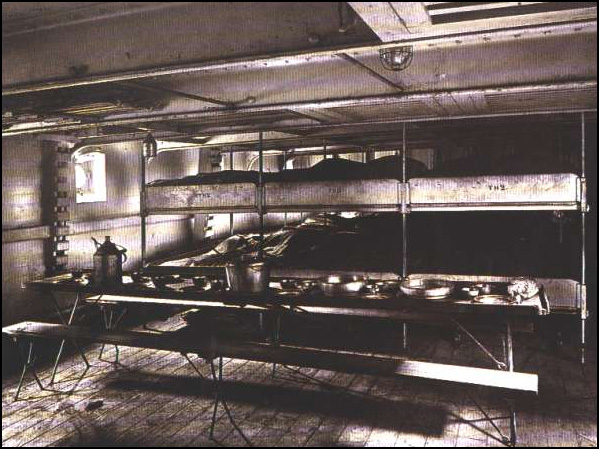


Time on deck was limited for steerage passengers, so this is the type of setting where the family would have spent most of the two weeks it took to cross the Atlantic.

The Buller Family Record also confirms another element of the Ancestry.com description when it records: “As for food for their long journey, they packed toasted bread, ham, and coffee.”

Peter D and family, like most immigrants who crossed the Atlantic in the last half of the nineteenth century, chose steerage for one simple reason: cost. The 1881 Red Star Line advertisement below shows that steerage tickets were significantly less expensive than first- or even second-class tickets:

  • first class: 180–220 francs
  • second class: 130 francs
  • third class: 48 francs


Little more can be said about the family’s journey across the Atlantic, at least for now, but that is only part of the story. As Aunts Maria and Sarah tell us in the Buller Family Record, the family began and ended their journey by wagon and also traveled by train across both continents. As time and information permits, we will trace those parts of the journey as well.

Saturday, December 27, 2014

Traveling by train and ship and train

Bernhard Warkentin was a Molotschna Mennonite of some means who toured the U.S. in 1872. Once here, he never returned. Eventually Warkentin became known for playing a key role in promoting the Mennonites’ Turkey Red hard winter wheat in North America and developing the milling industry in Kansas.

Before then, however, he served as a midwife of sorts, helping other Molotschna Mennonites make the trek from Russia to the U.S. One of Warkentin’s letters to a friend (we read elsewhere that it took forty days for a letter to be delivered) includes details that help fill in some gaps in our understanding of our ancestors’ journey from Kleefeld to Henderson. Warkentin writes:

As I have answered your questions to the best of my knowledge in my previous letter, I shall now just repeat; do not bring any unnecessary articles along, see to it that you will not have over four hundred pounds of baggage with your family, for each immigrant has two hundred pounds baggage free, children twelve years old, only one hundred pounds; they pay only half fare. —In Russia and Germany you may have to pay something for the baggage; if I am not mistaken the passenger on the ship is allowed two hundred pounds, in addition to what he has with him as hand baggage, and this should never be more than one absolutely needs and can carry comfortably. —What you ought to bring along you will know best; I would advise you at this time to bring the good featherbeds, the sheepskins, and the clothes which you already have will do no harm, but it would not be advisable to buy many new things. —Bring as much linen as you have, for that is very expensive here,—besides, hardly anyone wears linen, only cotton is used. —Do not bring kitchen utensils or implements of any kind ; what you have, sell there, for it is easiest and most convenient to carry the money for those articles in one’s pocket, for which everything can be bought here. How you are going to travel from Hamburg or Bremen, either in a cabin $100 per passenger, or in steerage $55 per passenger, is still a question. If you travel in a cabin you need not be concerned about anything after you have booked your baggage, since everything is taken care of, but if you travel in steerage you should provide yourself with bedding and kitchen utensils, for the steerage passenger also receives food, and I think enough, although it is quite plain. I would advise, however, that all who possibly can should spend the extra $45 and travel in a cabin; at any rate, older people and families with little children should do so. And so I would advise you too, as friend, not to travel in steerage, but in a cabin. Those who want to save and leave Hamburg in steerage, despite the fact that they have the means, would often regret on the voyage not to have taken a cabin. Young people could travel in steerage out of consideration for their purse, for in the end it takes only ten to twelve days till they again have firm ground under foot.  … The fare on an immigrant train from New York to St. Louis is from $15–$20 (I am not certain yet, but it is not more). (Krahn 1950, 255, 256)

Using the information shared in Warkentin’s letter, we might deduce the following for our family.
  • As indicated by the ship manifest discussed here (see also here), our ancestors did not spend the extra $45 for cabin accommodations and traveled instead in steerage class. Thus, the cost for the ocean portion of the journey would have been roughly $275 (two adults at $55 + six children at $27.50).
  • Assuming that travel by train from Philadelphia to Lincoln cost slightly more than the New York–St. Louis trip, and assuming that children received a reduced fare (as seems common), one could suggest that the last leg of the journey cost $125 (two adults at $25 and six children at $12.50).
  • We have no evidence about how much the train ride from Hochstadt, Germany, to Antwerp, Belgium cost, but if it was roughly the same as the last leg of the journey, then Peter D and Sarah needed an additional $125 for their family.
  • All told, then, the travel charges for this one family’s move to Henderson were likely in the vicinity of $525. As further noted in Warkentin’s letter, there were additional expenses along the way, such as baggage fees and possibly food during the train portions of the trek.
  • In theory, the Buller family of eight could have taken a thousand pounds of baggage (200 lbs. for each of two adults + 100 lbs. each for the six children) without paying extra, although it seems hard to imagine moving with that many goods.

The more we learn about our ancestors’ journey, the more awe-inspiring it becomes. Not only was their trek both long and arduous (steerage class was a miserable way to travel), but it also involved significant cost ($525 is equivalent to $12,500 today) and effort (keeping track of six children and who knows how many pounds of baggage). Finally, if, as was suggested before, Johann Siebert financed the journey for all of his children who moved at that time (fourteen full fares and eleven half-fares), his contribution to his family’s future prospects (nearly $50,000 in today’s dollars) is seen to be truly remarkable.

Source

Krahn, Cornelius, ed. 1950. Some Letters of Bernhard Warkentin Pertaining to the Migration of 1873–1875. MQR 24:248–63.


Tuesday, August 12, 2014

Vaderland

Aunts Maria and Sarah write in the Buller Family Record:

In May 1879 they [Peter D and family] moved to the United States of America, arriving here in the latter part of June. … They left Kleefeld, Russia, by wagon to Hochstadt, from there by train across Germany to Antwerpen, Belgium, then on the ship Vaterland of the Red Star Line. They went along the Schelde River to the North Sea, then through the English Channel and across the Atlantic Ocean and landed in Philadelphia, Pennsylvania, from there on train to York, Nebraska.

In fact, the ship was the SS Vaderland (Dutch spelling, not German), well known for its transport of passengers of all types across the Atlantic from 1872 until it sank off the coast of Nova Scotia in 1889. It should not be confused with a second ship also named the Vaderland, which was not built until 1900.

The SS prefix tells us that the Vaderland was a screw steamer, that is, a steam-powered ship that was propelled by a screw propeller (as opposed to a PS, or paddle steamer). But as one can see in the picture of the Vaderland below, the steam engine was not the ship’s only means of propulsion. Three sails also were available, if the engine happened to fail or the propeller became inoperable. Thus, the Vaderland can also be classified as a steam auxiliary ship (the sails being the auxiliary part).


The ship was roughly 300 feet long and 38.5 feet wide and could travel at a speed of 13 knots (15 mph). According to N. R. P. Bonsor, the placement of the engine and funnel aft (toward the rear of the ship) was unusual for this time (Bonsor 1975–1980, 2:849–50).

Originally designed to transport petroleum and passengers, the Vaderland was soon modified to serve as a regular freighter and passenger ship. The Vaderland could accommodate thirty (later seventy) first-class passengers and roughly eight hundred third-class (or steerage) passengers. In all likelihood, Peter D, Sarah, and their six kids traveled in the steerage class. According to available information, the 3,700-mile trip from Antwerp to Philadelphia took slightly less than two weeks.

As Sarah and Maria indicate, the Vaderland was part of the Red Star Line out of Antwerp, Belgium. Interestingly, the Pennsylvania Railroad Company provided funding for the Red Star Line to build four ocean liners (including the Vaderland), in order that freight and passengers could be delivered directly to Philadelphia rather than by way of New York City. According to the National Archives at Philadelphia website, “Passengers on an arriving steamship could disembark, go through customs and board a westbound train within an hour” (see here; for more on the Red Star Line and its U.S. connections, see here).

Sadly, neither Clarence Hiebert (1974) nor the Immigrant Ships Transcribers Guild (see here) list the manifest for our family’s 1879 voyage (but see here for an 1882 Vaderland manifest). However, if anyone happens to know how to receive microfilmed records from the National Archives, that information could presumably be found in roll 97 (Jan. 9–June 25, 1879; 1–49) of the Records of the Bureau of Customs, Record Group 36 (see further here).

Sources


Bonsor, N. R. P. 1975–1980. North Atlantic Seaway: An illustrated History of the Passenger Services Linking the Old World with the New. Rev. ed. 5 vols. Newton Abbot: David & Charles.

Hiebert, Clarence, ed. 1974. Brothers in Deed to Brothers in Need: A Scrapbook about Mennonite Immigrants from Russia 1870–1885. Newton, KS: Faith and Life.

Thursday, December 27, 2018

South Dakota Bullers 16

When we last saw Heinrich and Aganetha and family, they had just arrived in Warsaw, Poland, well on their way to a new life in the United States. Still, a cloud of uncertainty hung over the journey, since they had no passports authorizing them to cross the border from Russia to Prussia (Germany). We pick up their story ready to press on from Warsaw.

[27] At 6 o’clock in the evening therefore, a few days later, we find them again entrained from Warsaw to the Polish town of Loviech, where a mere acquaintance was to receive them and bring them to safe quarters. It might be added here that they had expected to take the boat here at Warsaw, but it happened that the Vistula was too low that summer, so that no boats plied its waters. Thus they arrived at Loviech about 11 o’clock at night. The acquaintance referred to failed to show up. So there they were, strangers in a [28] strange city and unaccustomed to city ways. What were they to do? It was late at night, and the city slept in darkness. A Pole stood nearby and was watching them. To him, father addressed himself, asking where suitable quarters could be found for the night. He was very officious and volunteered to lead them. They followed. Further and further he took them from the heart of the city through all sorts of devious ways. Mother had mistrusted the man from the start and kept urging father to let the fellow go. At first, he did not want to, but at last, also suspicious of the man’s actions, he dismissed his would-be friend from whom many a hearty oath and curse was called down upon them! But now where were they to go? Mother had noticed a light peeping from the window of a building not far away and advised going there. Arriving, they found it to be a cheap hotel. They asked for quarters, but there was no room. Finally, they were allowed to spend the remainder of the night in a barn loft where a mixed crowd of Poles and Jews were already asleep on the hay. That, indeed, was a dreary night!

They spent Sunday, August 22,  in  this place, and the next day in the early morn, left Loviech for Deutsch Wymysle, father’s birthplace. About three weeks were spent here in visiting friends and relatives and renewing old acquaintances. It had been fully twenty years since father had left the place, and now he was leaving, to see it no more. At the end of that period they resumed their journey. They took the train a few stations only, for they had come to the borderline between Russian Poland and Germany. They stopped off, and we may well surmise that fear and trepidation were disturbing them, for now was to follow the ticklish business of getting smuggled across this line. Beyond that line was freedom; if caught, back they would have to go, back to where they started from. Many a time father had regretted that he had not provided himself with passports, but that could not not be remedied, and the only recourse was a secret passage.

It appeared that there were a group of men who made it their regular business to smuggle people across the lines. Father soon met a member of this group, a German who for a few Rubles would undertake the job. Now, the line between the two countries at that particular point was a small, innocent-looking brook, which was perhaps three or [29] four steps wide and quite shallow. Everything was left in the hands of this guide, who at the proper moments would wake them and lead them across the small stream. So it was agreed, and in the small hours of the night, when the armed guards that were patrolling the line day and night were either asleep or drinking vodka in the tavern, they quietly crossed that stream, a crossing which meant so terribly much to them and to their future! Safely across on German soil, they could see in the early morning light these gendarmes with their shining arms marching back and forth, and doubtless secretly chagrined over the failure of their watch.

Thus, safely across on German soil, they took the train for Thoren, staying two and one-half days there to wait for Jacob Penner and his family, who were to be their traveling companions on this eventful journey. It may be appropriate to say here that these Penners located at Mountain Lake, Minnesota, joining a large Mennonite settlement there. Two sons of theirs should also be mentioned: Wilhelm and Jacob Jr. The former was the second husband of Mrs. Martens, who comes into this tale at its close, and the latter was instrumental in bringing about that chance meeting with her that culminated in father’s second marriage. This Penner now lives at New Home, North Dakota.

After the Penners had joined them, they took the train for Berlin, the capital city of Germany, arriving there early in the morning. The Nord-Deutche-Lloyd steamship company of Bremen had local offices here, and so father went to see the agent. The contract covering their passage across the seas having been closed, they waited in patience until about 11 o’clock in the forenoon, when they took the train for Bremen and arrived there about 9 o’clock p.m. On the next day, which was either the 22nd or 23rd of September, at 2 o’clock p.m., they went on board the steamship “Leipzig”—a 3,000 ton boat—for passage to America.

Their voyage was uneventful except that it was the time of the autumnal equinox with considerable stormy, foggy weather. They were on board ship a full twenty days—so long a time that it had been quite given up for lost. They were only steerage passengers (Zwischen deckers) but were treated very kindly by captain and crew. Gladly, at the [30] end of their voyage, did they sign statements expressing their satisfaction over the treatment accorded them. At last, on the 12th of October, they landed at Baltimore, Maryland. They had no medical examination to make, nor were they required to show any stated sum of money as the immigration laws of today required. Their captain was a courteous, well-meaning man and took thought of their needs even after they left the ship. He instructed his steward to provide them with food—salt herring and bread—for the great part of their journey inland. “For,” said he, “you are going into a wilderness where food of any kind is very dear.” He further instructed a man to attend them as far as Chicago to look after all their wants. Thus, with minds eased and thankful for the favors of Divine Providence that had brought them safely to these shores, they soon left Baltimore for Chicago. From Chicago they went by way of Milwaukee to Sioux City, and from there to Yankton, South Dakota, arriving there at 6 o’clock in the evening of October 15th, 1875, thankful to God that they had at last reached their long journey’s end.

1. The Polish town Loviech cannot be identified or located on any map known to me. The most we can deduce is that the town was presumably on the Vistula River, since the family had hoped to take a boat to it, and that it was located somewhere between Warsaw and Deutsch Wymysle. That it was a five-hour train ride from Warsaw does not tell us a great deal, since we do not know how fast the train traveled or how many stops it had between Warsaw and Loviech.

2. Deutsch Wymysle is well known to us as Heinrich’s former home and as a Mennonite community where many other Bullers lived during the first half of the nineteenth century. The small village (the middle arrow below) was on the south side of the Vistula approximately 50 miles west-northwest of Warsaw (arrow on the right). 


3. The border between Russia (technically, Congress Poland, which was part of the Russian Empire) and Prussia (which was part of the German Empire that existed 1871–1918) is the blue line in the map above. We cannot say where exactly the family crossed the border, but presumably it was not far south of where the Vistula River intersected the border.

4. The family’s next stop was Thoren, or Thorn, modern Torun (the left arrow in the map above). I suspect that the family disembarked from the train at the last stop in Russia, made their nighttime dash across the border, and then got on the same rail line on the Prussian side of the border for their trip to Torun.

5. Jacob Penner (GM 56904) was another Deutsch Wymysle native who had moved to Crimea. Why the Penners and Bullers did not travel together on the first leg of their common journey is unknown, but perhaps it seemed best to travel individually until everyone was out of Russia, so as not to attract too much attention.

6. From Torun the parties had a direct route to Berlin on the Prussian Eastern Railway. The distance between the two is approximately 220 miles as the crow flies. In the map below, the arrow on the right marks Torun; that on the left points to Berlin.


The trip from Berlin to Bremen would have gone through Hanover; this last leg of the European part of the journey was another 190 miles. 


7. As one can see in the map immediately above, Bremen is not a port city, but our story recounts that the family sought to book passage on the “Nord-Deutche-Lloyd steamship company of Bremen.” In fact, according to the Norway-Heritage website discussion of Norddeutscher Lloyd steamers (here), “Passengers were conveyed by special train the short run from Bremen [lower left arrow] to the docks at Bremerhaven [upper left arrow]. The railway-station was but a few steps from the pier, and passengers walked on board the tender, while the Company’s porters were shipping the baggage. The steamers waited not far off the mouth of the river.”

8. The S.S. Leipzig was indeed a ship of the Norddeutscher Lloyd line (see here); it was built in 1869 and measured 269 feet stem to stern. The Bullers and Penners traveled steerage, which is known as “Zwischendeck” in German. As noted previously (here), steerage was the cheapest class offered by ships. 

According to one source (here), the Leipzig traveled at an average rate of 10 knots, which is 11.5 miles per hour. The trip across the Atlantic to Baltimore, where they landed, would take about sixteen days at this pace. The fact that the October 1875 trip took twenty days explains why those waiting for it to arrive worried that the ship was lost. 

9. The last leg of the journey, nearly 1,200 miles, took three days by train, from Baltimore to Chicago to Milwaukee to Sioux City to Yankton—precisely where Daniel Unruh has landed a year earlier. The fact that they went straight to Yankton, rather than Mountain Lake, Minnesota, or some Mennonite community in Nebraska or Kansas, was no accident. Heinrich and Aganetha had followed Unruh’s route exactly, just as he had intended them to do. In fact, like Unruh, they settled in Turner County, although in Brotherfield Township, whereas Unruh had made his home in Childstown Township (see the map here). 

The Life Story of Heinrich Buller and His Wife Agnetha Duerksen Buller goes on to recount the family’s early years in South Dakota, but we will take our leave at this point. We may return to the rest of the story at some point in the future, but for now I think Franztal in Molotschna beckons for our attention. 

Work Cited 

Buller, William B. 1915. Life Story of Heinrich Buller and His Wife Agnetha Duerksen Buller. Parker, SD: privately printed.


Friday, June 15, 2018

Four Years and Counting

With apologies for the recent light blogging and a promise to pick up the pace once again (or at least to do my best to do so), I take a moment in this post to note that today, 15 June 2018, Buller Time blog turns four years old. Woohoo!

If you recall, Buller Time was launched on Father’s Day in 2014 with a simple post of a few lines and a photograph of a Mennonite barn in Molotschna colony (here). Since then we have covered a lot of miles, practically circling the globe from Kazakhstan on Russia’s east through Russia, Volhynia, Poland, Prussia, Germany, and the Netherlands in western Europe, then across the Atlantic and North America and all the way west to Hawaii. We have also covered a large number of topics, ranging from the size of a typical Wirstschaft in a Molotschna village to the reason a large body of Waldheim residents left the village within a decade of originally settling there, from the challenges in Prussian Poland that led so many Mennonites to emigrate to Russia to the hardships that our family experienced traveling in steerage class across the Atlantic in 1879, from life on an early nineteenth-century Volhynian estate to memories of both hard and good times on Grandpa and Grandma’s farm south of Lushton.

We have made a few mistakes but have also had some notable discoveries, not least in identifying the man the Przechovka church book knew only as *** Buller as George Buller, husband of Dina Thoms. With the help of good friends who are also more expert in matters of Mennonite history (thanks most of all to Glenn Penner), we have also extended our own family tree by more than a century. No longer do we meet a dead end at David and Helena Zielke Buller, the first couple listed in the Buller Family Record. We now have documented proof that David was the son of Benjamin, whose father was also named Benjamin, who was, we think, the son of Heinrich, who was the son of Hans, who was the son of George and Dina Thoms Buller—a couple who take us back to sometime in the latter half of the 1600s.

Another way to quantify the last four years is to consider the number of posts written. This post is, according to the blog totals in the right-hand margin, number 65 in 2018. Add that to the 116 of 2014, the 90 of 2015, the 200 of 2016, and the 107 of 2017, and the total to date is 578, roughly 144 a year, or one post every 2.5 days. 

It would take a lot of tedious work to calculate how much has been written, but we can extrapolate from 2016 and gain a reasonable sense of how wordy Buller Time has been. During that year, with its 200 posts, Buller Time published just over 172,000 words. Thus, each 2016 post was roughly 860 words long. If that average holds for all four years of posts—a reasonable enough assumption—then the total number of words published is approaching half a million: 860 x 578 = 497,080. Depending on the number of footnotes, headings, and figures (photographs, tables, and diagrams), a typical academic book averages around 400 words a page, often less. If we use the 400-word figure for our purposes, then the blog would fill nearly 1,250 pages—over four 300-page books. 

One final set of figures: the number of page visits to the blog. In this case it is impossible to calculate all the page visits over the last four years: the statistics kept by Blogger were inflated by Russian bot activity (seriously) in 2015–2016, so the current Google Analytics numbers begin only on 21 July 2016. In other words, we have less than two years of data. Since that day Buller Time has enjoyed 15,683 page visits, which translates into approximately 682 page visits a month, or 22.6 page visits per day. If we use this average to estimate the entire history of Buller Time, assuming that the visit rate the past two years is higher than it was the first two years, we can conservatively project a total of perhaps 27,000 page visits. In the blogging world, this is quite a small number (some blogs would be upset if they fell below that number in a day), but I consider it quite good for the descendants of a bunch of landless hicks from Molotschna colony.

Looking ahead, I do not expect us to run low on topics to discuss or questions to explore. Time is our only limitation, and even that is temporary, what with retirement being maybe a decade away. Thank you to all the Bullers and others who stop by and read and especially to those who take the time to write. In truth, I would continue to post even if Dad were my only reader, but it is also nice to know that others find some enjoyment, even value, in the Buller Time blog. As always, stay tuned not only for more explorations but also for more questions that we do not yet know but need to be asked. 


Thursday, September 25, 2014

Life and death on the S.S. Switzerland

Reading through the S.S. Switzerland manifest for the voyage that brought our family to the U.S., one encounters several depressing marginal notes:

  • Aaron Cornelson, age twenty-one, “died at sea from meningitis”
  • Helena Wiens, thirty-four-year-old mother of two, “delivered stillborn child on Tuesday, June 17, 1879; 11 p.m.”
  • Sara Voth, twenty-five-year-old mother of a one-year-old daughter, “died in child bed June 23, 1879, 11:30 a.m.” (the fact that no newborn child is listed on the manifest probably means that mother and child both died during childbirth)

At least four people died on this one journey to a new land and a new life—Sara Voth and newborn child a mere day before the ship docked in Philadelphia.

To make matters worse, it is likely that not one of these individuals endured his or her final struggle in any form of comfort or even privacy. As the earlier discussion on traveling in steerage class made clear (see here), the 700+ Mennonites on this ship had little if any “personal space” during the voyage. Thus, these life-and-death events were played out within full hearing, and probably in partial view, of all who shared that limited space.

How were Peter Voth and one-year-old Maria able to go on after the loss of wife and mother? What thoughts and fears passed through the mind of six-months-pregnant Sarah Siebert Buller as she learned of the childbirth-related deaths that took place on board? It is fascinating to speculate, but that is all it really is—speculation. The one thing we can know with certainty is that we owe our forebears a debt of gratitude for the courage and determination that led them to undertake such a difficult and perilous journey on the way to a new land and a better life for all of us.