Sunday, May 31, 2015

Peter and Margaretha’s farm

In anticipation of a bit more regular blogging activity over the coming weeks, during which we will pick up the From Brüttisellen to Lushton series and take a step back with a recent discovery about Heinrich Buller (plus an update of the birthday list for May and June—where did the month of May go?!), today up a few loose ends by posting the rest of the photographs recently taken of the Peter P and Margaretha farm east of Henderson (number 4 in the first satellite photo below; see here).

The first photo, which is looking west, was taken from the gravel road to the east of the farm with the lens zoomed in on the building. The driveway into the farmstead is on the right side of the photo. The original barn and house are clearly visible in the center (the garage north of the house is not original). The second photo below is taken from the same location but is zoomed in even further.


The next two photographs were taken from the same location as the two above, but without the lens zoomed in. Although both photos are looking generally west, the first is turned slightly to the north, the second slightly to the south.


The final photo, below, was taken from the north end of the barn looking east down the long driveway that connects the farmstead to the county road on the east side of the farm.


A few more photographs to come in the near future, but first I want to recap where we have traveled and get us back on the road from Brüttisellen to Lushton.

Thursday, May 14, 2015

A little context

Even those for whom the Henderson, Lushton, and greater York County areas are familiar may not know exactly where our family history took place, where it began and the road it followed. Having now seen Peter P and Margaretha’s barn and house, it is a good time to take a step back, or rather, to take a bird’s-eye view of the area, so we can flesh out, fill in, and refine our mental maps of the Buller family history.

The satellite photograph below offers the widest look, both geographically and chronologically. Easily identifiable left of center is the town of Henderson. The east–west road to the south is County Road 6. Follow that road a little over a mile west of Henderson (just past the first north–south road, which also is the boundary between York County and Hamilton County) and you will see the number 1: this marks the farm that Peter D and Sarah Siebert Buller (Peter P’s father and mother) purchased (80 acres) and homesteaded (80 acres) after they came to the U.S. in 1879.

Go to the next north–south mile to the west, then north 3/8 of a mile and you will see a 2. This is the Friesen Cemetery, where Peter D and Sarah were laid to rest, in 1897 and 1922, respectively (see further here).

Doubling back to Road 6, then east 4 miles, south 1 mile, east 1/4 mile, then south into the field leads one to number 3: the Franz farm where Grandma grew up. The number is just north of the building site, which looks only vaguely like it did when she was a girl. The house still stands, but it has an addition that obscures most of the original structure. No barns or other outbuildings seem to be left.

Number 4 is a little over a mile to the east-northeast. This is the Peter P and Margaretha farm, where Grandpa grew up and where the barn and house of the previous posts are still located. As before, the number is just north of the farmstead. If you want to visit the place on your own, go 4 miles east of the intersection of the Henderson Spur and Road 6, then south nearly 3/4 of a mile, and, finally, west on the driveway to the farmstead.


Our final stopping point on this map is the final resting place for many Bullers: number 5 marks the northwest corner of the Buller (actually, Mennonite) Cemetery. I never realized until several days ago that it is just south of the farm where Grandpa grew up. In fact, one has a clear view of the south end of the Peter P farmstead from the cemetery entrance.


After moving from the Peter D farm west of Henderson to the Peter P farm east of Henderson, our family turned south, as Grandpa and Grandma raised eight kids and a variety of critters on a farm south of Lushton. The photograph below includes two places already noted, to help you orient yourself: the Peter P farm (1) and Grandma’s childhood home (2). Lushton lies roughly 2 miles to the south (and slightly east) of the Franz and Buller farms (3), and Grandpa and Grandma’s Lushton farm is a mile and a half south of that (4).


That is probably enough context for one post. At some point in the not too distant future we will zoom in on Lushton, to mark the places where some of us lived so many years ago, then move in even closer with pictures of family landmarks taken earlier this month.

(BTW, it is still Thursday in Colorado, so this legitimately qualifies as the “tomorrow’s post” promised yesterday.)


Wednesday, May 13, 2015

The barn is …

the same barn as shown in this previously posted photograph.


As explained in that earlier post here, this is the barn on the Peter P Buller farm, where Grandpa and his brothers and sisters grew up.

I am uncertain when this barn was built, but it must be nearly a century old, if not more. Given its age, the barn remains in remarkable condition, with all but the north end bearing the same original siding and the brick silo still standing.

To the west of the barn, across the current driveway, is the house where Peter P and Margaretha raised their family. Like the barn, the original structure remains in good shape. (Not pictured is an addition to the north [right] that leads to a separate but attached garage.)


We will return to the From Brüttisellen to Lushton series shortly, but tomorrow’s post will put the Peter P farm in geographical context, showing its relation to Peter D’s original farm, Henderson, Grandma’s childhood home, several cemeteries where our ancestors were laid to rest, Lushton, and Grandpa and Grandma’s Lushton farm.


Tuesday, May 12, 2015

Name that barn 2!

Yesterday’s photograph shows the west side, the southwest corner, and the south end of the barn. The first of today’s photographs shows the east side, the northeast corner, and the north end of the same barn. Note also the brick silo with a metal roof, which makes the identification of this barn certain.


The second photo is from north of the barn looking south.


Tomorrow’s post will identify the barn and show the building west across the driveway.


Monday, May 11, 2015

Name that barn!

This is not the first time the barn pictured below has appeared on Buller Time blog. Can you identify it? This photograph was taken just a few days ago (8 May 2015, at 9:51 AM CDT, to be exact). I will offer an additional clue tomorrow.


Since I am running behind on all fronts, including Buller Time, let me say for now:

  • Happy birthday, Payten!
  • Happy birthday, Dan!
  • Happy birthday, Taylor!

Sunday, April 19, 2015

From Brüttisellen to Lushton 7

Deuteronomy 26:5–9, often referred to as Israel’s “Little Credo” because it captures in relatively few words the essence of the Israelite story, begins: “A wandering Aramean was my ancestor.…” From what we have learned thus far of our family history, these words seem oddly appropriate for our story as well: A wandering Anabaptist was our ancestor.…

Heinrich Bühler was born and lived the first twenty or so years of his life not far from Zurich, but in 1602 he began a life of wandering: first he migrated 500 miles east to Moravia (the eastern third of today’s Czech Republic); two decades later he moved again, leaving his Hutterite home near Wessely on the Marava River (modern Veselí nad Moravou) for a new residence near another river in a land farther north.

Specifically, Heinrich and family (he had a wife and an unknown number of children) left behind the ashes of Wessely (on the ravages of the Thirty Years’ War, see here) for another Anabaptist enclave to the north, the Vistula River delta.

The Bühlers traveled roughly 400 miles north-northeast to the area of Culm (modern Chełmno), probably to the village of Deutsch Konopat. If that village name sounds familiar, it is because we have already visited there (see here).

Heinrich’s travels from Zurich, Switzerland, to Wessely, Moravia (Veseli nad Moravou, Czech Republic), to the
Culm (Chełmno) area of Poland. The city of Warsaw was southeast of Culm; more important to the Mennonites
of the Culm area was the city of Danzig (modern Gdańsk) to the north

The following map* provides a closer look at the immediate environs of Heinrich’s new home. The arrow in the upper left points to the area between Groß (Greater) Deutsch Konopat on the west and Klein (Lesser) Deutsch Konopat on the east. Culm is clearly visible on the south side of the bend in the river, which on this 1906 map is identified as the Weichsel, the German name for the river we know as the Vistula. In Polish, the river is known as the Wisła.

There does not appear to be a bridge across the river, only a road on each side going up to the river. Presumably a barge provided transport across the Vistula in Heinrich and our family’s time, and it may be that the residents in 1906 relied on a similar arrangement. Today a modern bridge enables cars and pedestrians to cross easily from one side to the other (see the photos at the end of this post).


Before we end this introductory post, let me point out one interesting feature on the map: the close-set parallel lines southeast of Deutsch Konopat, northeast of Culm, and elsewhere. What do you think the lines indicate? Stay tuned for a likely answer in the next installment of From Brüttisellen to Lushton (and I will try to post that installment much sooner than I have been lately).


Bridge over the Vistula River between Przechówko (the Wintersdorf–Konopat area) and Chełmno.
The photograph is looking straight north.


Bridge over the Vistula River between Przechówko (the Wintersdorf–Konopat area) and Chełmno.
The photograph is looking southeast.

* A larger version of the Culm-area map is available here.


Monday, April 13, 2015

Wagonload of kids

Dad and Suely recently provided an interesting photograph of Grandpa and Grandma’s kids plus two others. By now most of the kids in the picture should be relatively familiar (left to right):
  1. Esther
  2. new kid
  3. Ruth
  4. new kid
  5. Darlene
  6. Daniel (way in back)
  7. Carl
  8. Wayne
  9. Alma
  10. Matilda


I am told that this photo was taken at the Isaac G. and Sarah Epp Franz farm, that is, where Grandma grew up down the road to the west from the Peter P Buller farm. If I understand correctly, the wagon in which the kids are sitting was often used to collect and haul potatoes. Apparently our family ate a lot of potatoes back in the day, practically living on them when times were tight.

As for the new kids, number 2 in the photo is Elvina Lou Franz, and number 4 is Lois Jean Franz. (Is this where Lois Jean Thorne got her first and middle names?) They are the two oldest daughters of Albert A. and Elisabeth Kroeker Franz. If you recall, Grandma was the firstborn in her family (1906); she was followed by Lydia in 1910 and Albert A. in 1914. In other words, this is a cousin photo one generation back.

Elvina was born in 1936, Lois in early 1939, and Alma in 1938, so we can date this photo between mid-1940 and 1941 (probably closer to the former). To add some context, Grandpa and Grandma were in their mid-thirties, and Grandma’s youngest brother August was fifteen (the five children in Grandma’s family were spread out over nineteen years).


Sunday, April 12, 2015

Buller reunion 2015

I just discovered the following email from Steve in my Gmail inbox:

Happy Easter to all! Just a short note reminding you of our Buller reunion planned for June 27, 2015. It will be held at 401 Martin in Beaver Crossing, Nebraska at the home of Charlotte & Jerry Zieg. A noon potluck is planned and Charlotte has games planned for the afternoon. I hope all of you will let your siblings and children know of these plans. If you don't see their names on the email list above, please forward this to them or contact one of the committee members [Marcia Thomas, Mary Henrichson, Steve Buller] so we can add their email address to the list. … We will be sending out one or two more emails with more information. In June, we will need a response from each of you whether you will or will not attend. We had a great time in 2014 and we hope many of you will be able to join us this year.

For the committee,
Steve Buller

If you need the committee members’ email addresses, feel free to email me at [my last name].[my three-letter first name]@gmail.com.


All three committee members attended this early Buller family reunion.

Sunday, April 5, 2015

Holiday reflections

Sociologist, author, educator, and Christian activist Tony Campolo is known for many things, but perhaps nothing has defined his ministry more than his sermon “It’s Friday but Sunday’s Coming” (the entire hour-long sermon is available online here; the explanation of the key phrase begins at about the 49-minute mark).

Although Tony is neither a Buller nor even a Mennonite (not even close!), the thrust of his message is appropriate for our observance of Good Friday and Easter. Simply stated, Tony Campolo reminds us that we live in the reality of Friday, the day of death and loss, but anticipate and know that Sunday’s coming, the day when all will be made whole, when we will rejoin those who have left us, forever to celebrate the joy of each other’s company. Grandma and Grandpa and so many others are no longer with us, but someday we will all be together once again.

I am reminded of one of several poignant moments from Grandma’s funeral. The service at Metz Mortuary was finished, and everyone was getting ready for the drive to Buller cemetery. As Donna and I walked out of the sanctuary and turned down the corridor toward the south parking lot, we saw Grandpa standing at the end. We joined him and stood for a moment. Suddenly he looked up half-startled and said, “Oh, I guess I don’t need to wait for Mom.” In that instant Grandpa knew what it means to live in the reality of Friday. Thankfully, he also had the hope and the assurance of Sunday.

As we remember the death and resurrection of our Lord this weekend, let us also recall the lives and faith of those who came before us, not just Grandpa and Grandma but also Peter P and Margaretha, Peter D and Sarah, David and Helena, all the way back past the Unknown Buller to Heinrich Bühler, our earliest known ancestor, who actually suffered for his faith. It is Friday for all of us who remain today, but Sunday is coming, too.

Where, O death, is your victory? Where, O death, is your sting? … Thanks be to God, who gives us the victory through our Lord Jesus Christ. (1 Cor 15:55, 57)


Tuesday, March 24, 2015

Four sisters

The kids in the photograph are likely familiar even to their grandchildren by now (L to R): Matilda and Esther in the back, Darlene and Ruth in the front. Given Ruth’s apparent age and the fact that Alma isn't standing in the picture, one might plausibly date this photo to sometime in 1939.


The location of the photo is a place that we have not seen before: the farm of Isaac G. and Sarah Epp Franz, Grandma’s parents. If you recall (see here and scroll down to the plat map), the Franz family farm was less than a mile down the road west of Peter P and Margaretha’s place (section 15). It was roughly a five-mile drive from Grandpa and Grandma’s Lushton farm.

Part of the fun of looking at these old photographs is exploring the background, seeing what was in the daily lives of the people who are pictured here. This particular photo is busy: the barn appears to be well-built and well-kept; one wonders whether the windmill in front of it was just for livestock or also provided water for the house; the flower garden to the right of the girls is watched over by two wooden figurines, what appear to be young girls in sun dresses and bonnets; the utility pole behind the girls presumably brought electricity to the Franz house. (When did electricity come to Grandpa and Grandma’s Lushton farm?)

What else do you see? I notice that all four girls part their hair on their left and comb it to the right, that a chicken-wire fence appears to enclose the farmyard, and that there is a faint outline of a single rod at the left tip of the roof, likely a lightning rod to protect the structure from strikes. Take time to explore the photograph with your eyes, to enter that time and place where four sisters stood together one sunny day. It is the best way to get to know not only the people—our family—pictured there but also their lives back in 1939.


Saturday, March 21, 2015

From Brüttisellen to Lushton 6

It always comes as a surprise when an occasionally mentioned, barely remembered, and never truly understood historical event pops up in our family history. More remarkable is when a single ancestor of ours perseveres through several of those events during his or her lifetime.

Heinrich Bühler, for example, experienced the persecution of the Swiss Reformed Church first-hand when in mid-1614 he spent fourteen weeks (or at least some time) in Zurich’s Wellenberg tower. Just a few years later, Heinrich’s life was upset and uprooted again by a more wide-ranging development: the Thirty Years’ War of 1618–1648.

This is neither the place nor the time to attempt to summarize such a complex historical period and series of events. Those who wish to dig deeper may consult the abbreviated Encyclopaedia Britannica article here or the History Channel summary here.

Instead of trying to teach about the Thirty Years’ War, the rest of this post will rather step into, as it were, the events of that time by allowing the anonymous Hutterite Chroniclers recount what they, or at least their co-religionists, went through during the early years of the war. We begin in 1618 with the outbreak of the war.

[633] This same year, 1618, fierce agitation and revolt broke out in the kingdom of Bohemia, developing into terrible war and bloodshed between the [Roman Catholic] emperor and the Lutheran Estates in Bohemia. [The Bohemian Revolt of May 1618, which was to develop into the Thirty Years War. Count Heinrich von Thurn (1567–1640), a prominent leader of the Protestant Estates, had succeeded in forcing Emperor Rudolf II in 1609 to issue the Letter of Majesty granting religious freedom in Bohemia. In May 1618 Count von Thurn called a meeting of Protestant Estates at Prague University to discuss threats to that freedom. … Complaints made to Emperor Matthias were denounced as rebellion. The meetings ended on May 23 with the famous Defenestration of Prague, when von Thurn himself threw two Catholic councillors, Jaroslav of Martinitz and William of Slavata, and their secretary, Fabricius, from a window of the Hradschin [Bohemian Chancellery] into the moat. This act of violence marks the beginning of the Thirty Years War. Under the leadership of Count Matthias von Thurn, the Bohemian Protestants (by far the majority in the country) set up their own council and appointed thirty Directors.] Because of this, on John the Baptist’s Day [June 24], the Provincial Diet at Olmütz decided to recruit 5,000 men—cavalry and foot soldiers—for the defense of Moravia. … As a consequence, on top of the heavy annual tax of one hundred gulden on each community, a tax of fifty gulden was added on every house. … [634] In many places livestock, grain, wine, and other goods were taken in lieu of the tax at a much lower valuation than our selling price. In addition, several communities had to quarter soldiers for many weeks in summer and winter. On their marches back and forth, the soldiers often overran our communities, and we had to give them food—as much as they wanted. … Through this heavy consumption, our food supply was greatly diminished.


The area of the Thirty Years’s War. Bohemia and Moravia are underlined in red, as are Prague just below Bohemia
and Vienna somewhat south of Moravia. Heinrich’s city of residence, Wessely, is marked by a small x.

In the year 1619 we still had the hope and the great longing that the war between the Holy Roman Emperor Matthias and the Bohemian Protestants would come to an end, not only to save the church community and the whole country from further harm, but also to bring relief from the heavy taxes which … were imposed on us in the year 1618. On March 20, 1619, however, the emperor Matthias I died, and King Ferdinand continued the Bohemian War that had started under Emperor Matthias. Through his generals … he acted with a brutality never known before in the kingdom of Bohemia—the war only continued all the more intense and widespread—and the Bohemian Estates tried to get the Moravians to support their side (while the king thought Moravia was on his side).

[635] As a consequence, Count Heinrich Matthias von Thurn, lieutenant general to the Crown of Bohemia, marched into Moravia in early spring with a large number of cavalry and infantry. He succeeded—although not without opposition—in convincing the Moravian Estates to support Bohemia as allies. … The Catholic lords, who held the power and the chief positions in Moravia at that time, were deposed from office, and the most important ones were imprisoned. Just as in Bohemia at that time, directors or provincial governors were elected from the three remaining Estates.… All of this gave rise to Ferdinand’s hatred toward this country.

Now Count von Thurn…, who had marched from Moravia to Vienna in Austria with his Bohemian troops and a good number of Moravian forces, had to leave Vienna and return to Bohemia because enemies were vandalizing his country. As Moravia was now without soldiers, King Ferdinand sent in several thousand men under General Dampierre to force Moravia to submit to his rule again.

This terrible and remorseless punishment … fell most heavily on the church communities of the Lord, although they were innocent of all that was going on. They suffered incalculable damage and unspeakably great sorrow, trouble, and anxiety from robbery, murder, and fire at the hands of Dampierre’s soldiers, and even more from the ungodly Hungarians. …

[646] In the year 1620 the terrible war continued to spread. … [I]t grew worse and worse until nearly all kingdoms and countries were in revolt. The emperor Ferdinand II, who had come to power on the death of Emperor Matthias, grew more and more hostile because the Bohemians, Moravians, Silesians, Upper and Lower Lusatians, with the help of the Hungarians, had chosen and crowned Frederick, the elector palatine of the Rhine, as king of Bohemia. In order to crush this rebellion, Emperor Ferdinand II recruited bands of cruel men from distant countries: Poles, Croatians, Frenchmen, Walloons, Spaniards, and Italians. He enlisted them to fight against Frederick and his allies, who were relying too heavily on their own strength and good fortune. …

In 1620, because of this terrible war, the communities again suffered incalculable grief and misery—worse than anything the church had endured before.

[657] The distress and misery already described continued into the year 1621. It was an evil year, full of anguish. … On January 23, as the imperial army reached the Hungarian frontier and the Hungarian army made its way over the Little Carpathians, our two coummunities at Wessely and Neudorf were burned to the ground. There were a few at Wessely who [658] were too sick to flee, and with no one able to help them, they died an agonizing death in the fire.

Wessely was rebuilt several decades later, but Heinrich and family were not part of that rebuilding. We do not know where they fled before the fury of the forces of the Holy Roman Empire. We know that many Hutterites fled east to Hungary, while others tried to stay out of sight in Moravia. In time they were impelled by more than the ravages of war to leave Moravia, for 1622 saw the proclamation of an imperial decree:

Neither they nor their fellows in faith were to be tolerated any longer, not only in Moravia but in any country under the emperor’s power. Even in Transylvania [to the east of of Moravia] they would not be safe but would be a people marked for death. (Hutterian Brethren 1987, 670)

If Heinrich had not already left Moravia by this point (I suspect that he left after the 1621 razing of Wessely), he most certainly did so now. Interestingly, however, the next we know of Heinrich, he is no longer in a Hutterite Bruderhof (allow that to sink in for a moment: Heinrich left both his home and his community of faith). Rather, he is now living in a Mennonite community on the banks of another river 400 miles to the north of Wessely. That journey will be the subject of our next post in the series From Brüttisellen to Lushton


Source

Hutterian Brethren. 1987. The Chronicle of the Hutterian Brethren. Vol. 1. Rifton, N.Y.: Plough.


Tuesday, March 17, 2015

Kids and their critters

One last photograph from that day in 1940. From left to right we see Alma, Ruth, and Wayne. Each one is holding a puppy (at least I think all three are dogs, not rabbits): Alma’s is completely white; Ruth’s, white with a dark face and head but a white stripe down the middle; Wayne’s, dark all over.

Does anyone remember the names of these puppies (or if they are puppies)?


Monday, March 16, 2015

From Brüttisellen to Lushton 5

We have already learned that in 1602 Heinrich Bühler emigrated from his homeland Switzerland to Moravia, specifically, to a Hutterite Bruderhof near Wessely, on the east bank of the Marava River. Apart from four missionary journeys back to Zurich, Heinrich lived at least the next twelve years (probably more), until 1614, in the Wessely Bruderhof. So what can we discover about this Hutterite farm colony and the surrounding area?

Sudomír’s original castle was converted to a
Renaissance palace in the mid-1500s.
According to the Czechoslovakian blogger referenced earlier (see here), the town got its start with the building of a castle (one of at least three erected to provide a defensive perimeter against attacks from the east) by a nobleman named Sudomír during the 1250s. Over time, an actual town grew up around the fortifications.

The Hutterites first entered Moravia in large numbers during the 1520s; their numbers only continued to increase, which led them to to found new Bruderhofs where they could practice their communal lifestyle. The Chronicle of the Hutterian Brethren includes the following record for the year 1545:

At Martinmas [Nov. 11] Jakob Säckler bought a house on our behalf from a nobleman at Wessely. We moved in, but on June 2, 1546, it burned down, and we made a contract with the owner for the burned-out site.
     On St. Catherine’s Day [Apr. 30] Michael Matschidel, our servant of the Lord’s Word at that time, bought another house on our behalf in Wessely. This house, too, burned down in the fire of 1546. The lord at Wessely gave us another burned-out site in exchange, situated by the upper gate near the March River. This location was more convenient for us, and we built a new house there in 1547. (Hutterian Brethren 1987, 244)

The translator of The Chronicle adds: “The Hutterites occupied a house adjoining the seigneurial zoological gardens in the Wessely suburb of Břeh” (Hutterian Brethren 1987, 244 n. 1). Where this zoological garden was located remains unclear, although Beck (1883, 165 n. 3) indicates that it was located on the southwest corner of town, opposite the Milokošt neighborhood or, perhaps better, suburb.

The Milokošt area today, facing southwest and thus looking toward the Morava River in the distance

In any event, this is in all likelihood the colony, or commune, where Heinrich and family lived when they joined this Bruderhof in 1602. (Recall that a Bruderhof was usually a collection of several communal houses organized around a common square.)

Although we have been associating Heinrich and family with the town Wessely, we need to keep in mind the fact that Heinrich was not a city-dweller per se. Rather, as we learned earlier, Heinrich was a vinedresser (see here), one who prunes and cares for grape vines. Whether he brought these skills with him from Switzerland or acquired them later, they certainly were appropriate for his Moravian home.

Modern vineyard in the Veselí nad Moravou area
According to the Tourist Centre of the Veselsko Region, viticulture and wine-making first began in this area in the mid-1500s (i.e., roughly when the Hutterites established a Bruderhof here) but expanded significantly during the 1600s and 1700s (see here). Grapes were grown only on the manors, it seems, so we should probably imagine Heinrich working for one of the lords of the manors, caring for the lord’s grapes to be used in the lord’s wine-making operations.

Much more could be written about the history of the town and the beauty of the area, but those interested in exploring further are better off going directly to the Tourist Centre website here. There you will find a complete discussion of the area’s history of vine-growing and wine-making, gorgeous photographs of the palace park and the Morava River, and much more.

After exploring the town and the area, you may wonder why Heinrich and family ever left. That part of the story must wait for another post on another day, as we work our way forward on the road from Brüttisellen to Lushton.


Sources

Beck, Josef, ed. 1883. Die Geschichts-Bücher der Wiedertäufer in Oesterreich-Ungarn, … 1526–1785. Vienna: Carl Gerold’s Sohn. Available online here.

Hutterian Brethren. 1987. The Chronicle of the Hutterian Brethren. Vol. 1. Rifton, N.Y.: Plough.

Zeman, Jarold K. 1967. Historical Topography of Moravian Anabaptism. MQR 41:116–60. See no. 171 for Wessely.


Sunday, March 15, 2015

Mennonite history

Exploring and learning about our family history, especially within the context of Mennonite and even world history, has never been more convenient than it is today. In addition to resources such as the Global Anabaptist Mennonite Encyclopedia Online and the Grandma database, many websites and webpages offering both primary historical records and guides to accessing those records (see, e.g., here).

Even those of us who prefer a traditional book format are well served these days. For example, all those reading this post have easy access to one of the standard histories of the Mennonites, C. Henry Smith’s The Mennonites: A Brief History of Their Origin and Later Development in Both Europe and America (1920).


The book is old enough that it has entered the public domain (i.e., it is no longer under copyright), so the Internet Archive has scanned it and made it available for free to anyone who wants to read it. You can read it online in a page-flip format as shown above (go ahead and click on the right page to turn it to the next page) or download it to your computer, tablet, or phone to read it whenever you want (see further below).

Although the work is now nearly a hundred years old, it remains a reliable, informative, and engaging guide to the birth of the Anabaptists and then Mennonites and their journey through and spread across Europe and North America.

I especially recommend chapters 1 and 2, on the Anabaptists and Menno Simons; chapter 6.1, on Moravia; chapter 7, on Russia; and chapter 16, on immigration from Russia. York County makes a brief appearance in this last chapter.

To read the book online in a page-flip format, go here.

To download the book as a PDF, EPUB, or Kindle file, go here. (The EPUB and Kindle files offer uncorrected text created by optical character recognition, I assume, so they may be typographically “messy.”)

As I find them, I will alert you to other online books of interest. Happy reading!


Source

Smith, C. Henry. 1920. The Mennonites: A Brief History of Their Origin and Later Development in Both Europe and America. Berne, IN: Mennonite Book Concern.


Saturday, March 14, 2015

From Brüttisellen to Lushton 4

It’s time to get back on track with Heinrich Bühler and his offspring (our family) on the road from Brüttisellen to Lushton. To recap …

1. We began in a small village named Brüttisellen just outside of Zurich, Switzerland (see here), the original home of Heinrich Bühler and who knows how many generations of ancestors before him.

2. At some point Heinrich adopted the Anabaptist faith, and in 1602, no doubt fearing for his and his family’s safety, he fled more than 500 miles east to Moravia, where he joined a Hutterite Bruderhof (see further here).

3. According to the Mennonitisches Lexikon, Heinrich returned to Zurich at least four times, the last time in 1614, when he was imprisoned and then threatened with more severe punishment if ever he showed his face in Zurich again (see here; so also The Chronicle of the Hutterian Brethren).

4. The Mennonitisches Lexikon also identifies Heinrich’s place of residence in Moravia: a Hutterite Bruderhof known as Weselen, which is where we pick up the story now.

Obviously, the first questions that come to mind are: Where is Weselen? Does it still exist, or is it, like Kleefeld our later home, nothing more than a spot in a field? Answering these questions is not as simple as one would think, since Google knows of no such city or village today. As luck would have it, however, a Czechoslovakian blogger with an interest in genealogy discusses a town in Moravia Veselí nad Moravou that probably is our ancestor’s home (see here). He writes:

We know a few versions of the name Veselí: Wessele, Weseli, Wessely, and from 1437 on also a German form Wessels. The phrase “nad Moravou” was added in 1883 to distinguish this town from another homonymic towns [sic].

All the forms bear a strong resemblance to the name given in the Menninitisches Lexicon, the main difference being an -n at the end of Weselen, which is most likely a case ending, not part of the basic stem or root Wesel-.

Although the mention of at least one town with a similar-sounding name (it is unclear if the blogger means “another homonymic town” or “other homonymic towns”) should caution us against jumping to conclusions, a map of Hutterite Bruderhofs during this period seems to cinch the case.


As noted earlier, Nikolsburg was the center of Hutterite life in Moravia, but around a hundred Bruderhofs populated the area. According to the key to the map above, number 82 (far right and just north of center) was a Bruderhof named Wessely. This Bruderhof was located just east of the March River, which is now known as the Maravou or, more commonly, Marava River. The correspondence between Wessely, Weselen, and Veselí nad Maravou seems conclusive.

Assuming that all this is correct, we can now sketch Heinrich and his family’s journey a little more accurately, a journey that took them over 500 miles from Zurich to a town on the border between Moravia and Hungary.


The next post will finally take a look around the area of Veselí nad Maravou, which will offer further evidence that our ancestor Heinrich Bühler did call this town home four centuries ago.

In the meantime, I leave you with a comment from our Czechoslovakian blogger that is at least a little intriguing:

Most common among the oldest surnames [in Veselí nad Maravou] are: Bílek, Brumovský, Buráň, Cigánek, Čambala, Čech, Čermáček, Čermák, Černoch, Černý, Červenka, Dobrozemský, Doubrava, Fiala, Gazda, Gregůrek, Groš, Hanák, Heinrich, Horký, Húska, Chmelařík, Jalubský, Kadlček, Karas, Kočí, Kolář, Komoň, Královský, Kratochvíl, Krejčí, Krušina, Kučera, Kůrka, Kutalík, Kuželka, Macháček, Maršálek, Menšík, Novák, Pleva, Pokorný, Polášek, Příborský, Scholtz, Skupina, Slanina, Smutný, Spěváček, Springer, Švec, Vadovský, Vojtík, Všetula, Zámečník, Zbořil, Žilka.

Maybe it is mere coincidence, but I am struck by the similarity of the last name listed with a last name that we have already encountered, way back here.


Friday, March 13, 2015

A photographic rabbit trail

The full or partial family photographs shown earlier were not the only pictures taken on that day in 1940 (?). The two shown below apparently stem from the same day, since the clothes are once again the same as in the others.

The first picture is of nine-year-old Daniel (possibly ten) squatted down on the cement landing just outside the gate and trellis. If you look closely, you can see that he is holding something on his lap, since parts of his tie and leg are hidden, and his right hand seems to be cupped around some object. Look more closely and you can see a black spot above Daniel’s left leg and the outline of a long ear just under his chin.


The photograph of two-year-old Alma shows more clearly what Daniel is holding: a nice-sized white rabbit. As you may recall, the family had rabbit hutches in the area of buildings 9, 10, and 11 in the farmstead photo one post down. If any of the kids would like to fill in more details, answers would be welcome to the following questions:
  • On average, how many rabbits did they raise at one time?

  • Were they raised for food or fun or sale or all of the above?

  • Are the hutches visible in the (later) farmstead photograph?


Sunday, March 8, 2015

Oops … plus Grandpa and the boys

Unlike books, which after they are printed cannot be fixed without destroying a lot of inventory and printing new copies, a blog can be corrected at any point and in a matter of minutes.

For example, the statement in the previous post about the photograph of Grandma and the girls being taken at the Isaac G. and Sarah Epp Franz farm was a mistake based on a misunderstanding. In fact, the photo in that post and the one below were both taken at Grandpa and Grandma’s Lushton farm, on the south side of the house (actually, facing the southeast corner). The approximate (!) location is marked with an x in the numbered photo farther below.


Now that we are clear on the location from which the photo was taken, a few observations:
  1. The trellis in the background of the Grandma–girls and Grandpa–boys photos is not the same as in the full family picture, since it is far too small for any adult to walk through. Presumably it was a trellis for some sort of climbing vine.

  2. Behind and between Matilda and Grandma one can see what appears to be a cellar entrance. Assuming I understand correctly, this is where one entered the cellar before Grandpa excavated the full basement.

  3. The covered porch visible in the color farmstead photograph had not yet been added by 1940, when the three family photos were taken. Does anyone know when Grandpa added that porch?


All that the earlier post wrote about the location of Isaac G. and Sarah Epp Franz’s farm was correct, irrelevant for these photos but nonetheless correct. We will return to that farm in the near future, as there are several old photographs that actually were taken on the Franz family farm.


Saturday, March 7, 2015

Grandma and the girls

I am told that the photograph below was taken at the farm of Grandma’s parents: Isaac G. and Sarah Epp Franz. One might further suggest that it was taken the same day as the photo from the last post (see here), since everyone in the photograph is wearing exactly the same clothes (even socks) as in the prior photo. Maltilda and Grandma are in back, of course, with Alma, Ruth, Darlene, and Esther in front (left to right).


Speaking of Isaac and Sarah Franz’s farm, where exactly was it? I trust those who actually know to correct the following as needed, but I believe it was a mile east of Peter P and Margaretha’s farm, which would mean that it was roughly a 4.5-mile drive from Grandpa and Grandma’s farm south of Lushton.

The 1911 plat map below indicates that Jacob Epp, Grandma’s grandfather (see here) owned most of the north half of section 15 in Henderson township; note that Peter P owned the southeast quarter of section 11 at that time (in other words, Grandpa and Grandma lived relatively close growing up).


Thirteen years later, in 1924, some of the Jacob Epp farm was owned by Isaac Franz, Grandma’s father (see map below).


The simplest explanation is that after Jacob and Margaretha Epp died (1921 and 1922, respectively), the farm passed to or was purchased by Grandma’s parents: Isaac G. and Sarah Epp Franz—and some years later, in 1940 and Grandpa and Grandma and their eight kids drove up the rode to take several family photographs on Grandma’s family farm.

Now if I only knew exactly what the building in the background is …


Thursday, March 5, 2015

And we’re back …

Sorry for the hiatus. It’s annoying when too much work gets in the way of the really important things in life, namely, Buller Time. A brief photograph-based post to get us back on track …


The photo shows, of course, the entire family (left to right): Grandpa and Grandma in back; Matilda, Daniel, and Esther in front of them; then Wayne, Carl, and Darlene; and, finally, Alma and Ruth in front. Looking closely a little behind Darlene, you can also see either the back end of a fluffy-tailed white dog or perhaps a chicken bent over eating. Even further in the background is a white dog with a dark face standing and looking at the family.

The photograph was taken in front of the Lushton farmhouse, probably in 1940 (since Alma looks to be two or so). Referring to the photograph below, the picture was taken roughly where the arrow starts and faces the direction of the arrow.


Thanks to Dad and Suely for providing a scan of the family photo above, as well as a number of others that will make their way to Buller Time over the coming days.


Friday, February 27, 2015

Anabaptist history

For those who want to learn much more about the history of Anabaptism (and have a lot of time on their hands), the videos linked below may be a good place to turn. The twenty-two class sessions (each over an hour in length) are led by Dean Taylor and were filmed at Faith Builders Educational Programs (Guy Mills, Pennsylvania).

One might want to begin with day 5, when the topic turns to the Reformation. Note also days 13 and 14, which deal with the Hutterites, and day 18, which turns to the Russian experience.


Thursday, February 26, 2015

History of Anabaptism video 2

An earlier video (see here) touched on the origins of Anabaptism before focusing on the Hutterite influence on the modern Bruderhof movement. The video embedded below provides further details on the 1525 birth of Anabaptism in Zurich as well as the persecution and spread of Anabaptism over the following centuries. The video, titled “The Spread of the Anabaptists: The Story of the Amish, Mennonites, and Hutterites,” was produced for a Lancaster, Pennsylvania, historical society, hence the focus on Lancaster at the outset.


Tuesday, February 24, 2015

From Brüttisellen to Lushton 3

The road from Brüttisellen has led us thus far to a Hutterite Bruderhof in Moravia (see here). Before we stop and look around at our Moravian wilderness experience (to appropriate a biblical concept), we need to tie up some loose ends.

Little by little additional details of Heinrich Bühler’s life are falling into place, most recently thanks to an article on him in the Mennonitisches Lexikon. First the article in full (German original, written by Christian Neff, below), then a few observations.

Bühler, Heinrich, a Täufer [Baptist] from Brütisell in the county of Kyburg in Switzerland (Canton of Zurich) moved in 1602 with his wife and children to Moravia. Four times he came back to his home as an emissary of the Hutterite Brethren to work for emigration to Moravia. When he left Moravia the fourth time, he brought many letters given him by his Swiss brothers and sisters for their loved ones at home. He was imprisoned in the Wellenberg with his companion Joachim Arbel. During his interrogation he stated that he had come home from Weselen (a Hutterite Brethren Bruderhof), having received from the Brotherhood a command to visit his friends in Switzerland, to persuade them to go with him to Moravia. He had been in the country (Switzerland) six weeks. On 6 July 1614 the prisoners were released from their [imprisonment], after they promised not to return, “failing which it would be counted as perjury and they would be punished accordingly.” Their return to Moravia was delayed until autumn. Nothing further is known about them. See Loserth 1895. (Neff 1913, 290–91)

1. Heinrich’s return to Zurich in 1614 was not the first time he had made the 450-mile journey. In fact, it was his fourth trip home in twelve years.

2. Although Heinrich may well have hoped to claim his inheritance, as stated in The Chronicle of the Hutterian Brethren (see further here), that probably was not his primary reason for returning. Rather, his real purpose was missional: to convince Swiss citizens to join a Hutterite community in Moravia. It was the same reason that led him to return to Zurich the first three times. (As a side note, Heinrich would have turned over any proceeds from the inheritance to his Bruderhof, so he had nothing to gain personally by securing his inheritance.)

3. As stated in the Chronicle, Heinrich brought back letters from fellow Hutterites to their families in Switzerland. (The Loserth article cited at the end of the Neff entry tells quite a bit more about those letters; we will return to that topic in the near future.)

4. The Chronicle differs from the Neff entry in several details: (1) the last name of Heinrich’s companion is Arter in the Chronicle, Arbel here; (2) the Chronicle has the two Hutterites arrested on 9 July and released on 24 October, while the Neff entry does not indicate when the two were arrested but has them released on 6 July. Loserth agrees with Neff and cites the official acts for 6 July found in the Zurich State Archives as evidence.

5. Both sources agree that the two men returned to Moravia in the autumn. The Chronicle attributes this to a long imprisonment, but Loserth explains that the men stayed in the Zurich area until a third Hutterite, Heinrich Hartmann, was also released from prison (Loserth 1895, 209 n. 1).

6. Remarkably, and most important of all, we learn where Heinrich lived in Moravia: in a Bruderhof in Weselen. Now that we know exactly where to look, we are ready to stop and explore our family’s Moravian temporary home. We will do so in the next post in this series; for now a simple photo of Weselen will have to suffice.


Photograph © Honnyho Žblecht. Posted on Flickr here.


Bühler, Heinrich, ein Täufer aus Brütisell in der Grafschaft Kyburg in der Schwiez (Kanton Zürich), war 1602 mit Frau und Kindern nach Mähren verzogen. Viermal kam er wieder in seine Heimat als Emissär der huterischen Brüder, um für die Auswanderung nach Mähren zu wirken. Als er das vierte Mal Mähren verließ, kam er viele Briefe mit, die ihm seine schweizerischen Brüder und Schwestern für ihre Lieben in der Heimat mitgaben. Er wurde mit seinem Gefährten [291] Joachim Arbel in dem Wellenberg gefangen gehalten. Bei seinem Verhör gab er an, daß er von Hause Weselen (Haushabe der huterischen Brüder) gekommen sei und von der Bruderschaft daselbst den Befehl erhalten habe seine Freunde in der Schweiz zu besuchen, um sie zu bewegen mit ihm nach Mähren zu ziehen. Sechs Wochen habe er sich im Land (in der Schweiz) ausgehalten. Um 6. Juli 1614 wurden die Gesangenen aus ihrer hast entlassen, nachdem sie zuvor versprochen hatten nicht wieder zurückzukehren, “widrigenfalls es ihnen als Meineid angerechnet und sie darnach gestraft würden.” Ihre Rückkehr nach Mähren verzögerte sich bis in den Herbst. Weiteres ist nicht über sie bekannt. (s. Loserth, “Der Communismus d. mähr. Wiedert.).


Sources

Loserth, Johann. 1895. “Der Communismus der mährischen Wiedertäufer im 16. and 17. Jahrhundert: Beiträge zu ihrer Lehre, Geschichte and Verfassung,” Archiv für österreichische Geschichte 81:135–322. Available online here.

Neff, Christian. 1913. Bühler. Pages 290–91 in vol. 1 of Mennonitisches Lexikon. Edited by Christian Hege and Christian Neff. Frankfurt am Main: Hege and Neff.


Monday, February 23, 2015

History of Anabaptism video 1

In 1920 Eberhard Arnold, inspired by Jesus’s Sermon on the Mount as well as Anabaptist writings rediscovered in the late nineteenth century, established a Bruderhof community in Sannerz, Germany. The video embedded below offers a brief (5:33) explanation of the relation of the modern Bruderhof movement to Anabaptists in general and Hutterites in particular, teaching us about Anabaptist and Hutterite history along the way.


To learn more about Eberhard Arnold and the Bruderhof movement, see here.

Sunday, February 22, 2015

From Brüttisellen to Lushton 2

The first post in this series (see here) began with our ancestor Heinrich Bühler (aka the younger) in Brüttisellen, a village 6 miles northeast of Zurich, Switzerland. We then traced his journey in 1602 to Moravia 450 miles to the east. This post explores the Anabaptist exodus to Moravia in greater detail, in order to contextualize Heinrich’s 1602 emigration and life in Moravia.

Execution of two Mennonites in the Netherlands; they were
strangled, held over a fire, then killed with a pitchfork.
As has been noted several times, the Anabaptist movement suffered persecution almost immediately after it arose. In all cases the persecutors were the officials of the state religion and their political allies, whether the Catholic Church (e.g., in Austria or the Spanish-controlled parts of the Netherlands) or the Reformed Church (e.g., in Switzerland). With regard to the latter, C. Henry Smith elaborates:

The story of the persecution of the Mennonites in the land of their origin, the Swiss Republic, supposedly the home of religious toleration, was the most bitter and the most disgraceful in all the annals of Europe. They were relentlessly attacked by both State and Church for nearly three hundred years. The death penalty was inflicted until well within the seventeenth century; they were condemned to serve as galley slaves as late as the eighteenth century; and were left to rot in filthy prisons, and banished to foreign lands up to the beginning of the nineteenth century. (Smith 1920, 83)

As a result of this persecution, which was particularly fierce in the Zurich area, many Anabaptists fled to more tolerant locations. A favored destination was Moravia, then part of the Kingdom of Bohemia. Although Bohemia was ruled by the staunch Catholic Archduke Ferdinand of Habsburg (beginning in 1556, Holy Roman Emperor Ferdinand I), the lords of the manor cities were the real power on the local level, and they generally had little interest in persecuting otherwise industrious subjects.

Moravia (dark green) within the context of today’s Czech Republic
(dark gray) and the surrounding nations.
So it was that beginning in the 1530s thousands of Anabaptists flocked to Moravia. Except for a few limited times of persecution, they were able to live in relative peace and safety. One of these Anabaptist groups was the Hutterites (or Hutterian Brethren), who fled to Moravia from Tyrol (Austria). By the end of the sixteenth century (i.e., just before Heinrich immigrated), Hutterites in Moravia numbered 17,000 or more.

The Hutterites adhered to all of the typical Anabaptist beliefs—adult baptism of believers, nonviolence, and separation from the world—but also practiced a community of goods, giving up their claims to private ownership and holding all possessions in common. To that end, Hutterites were organized into Bruderhofs (farm colonies). Friedmann writes:

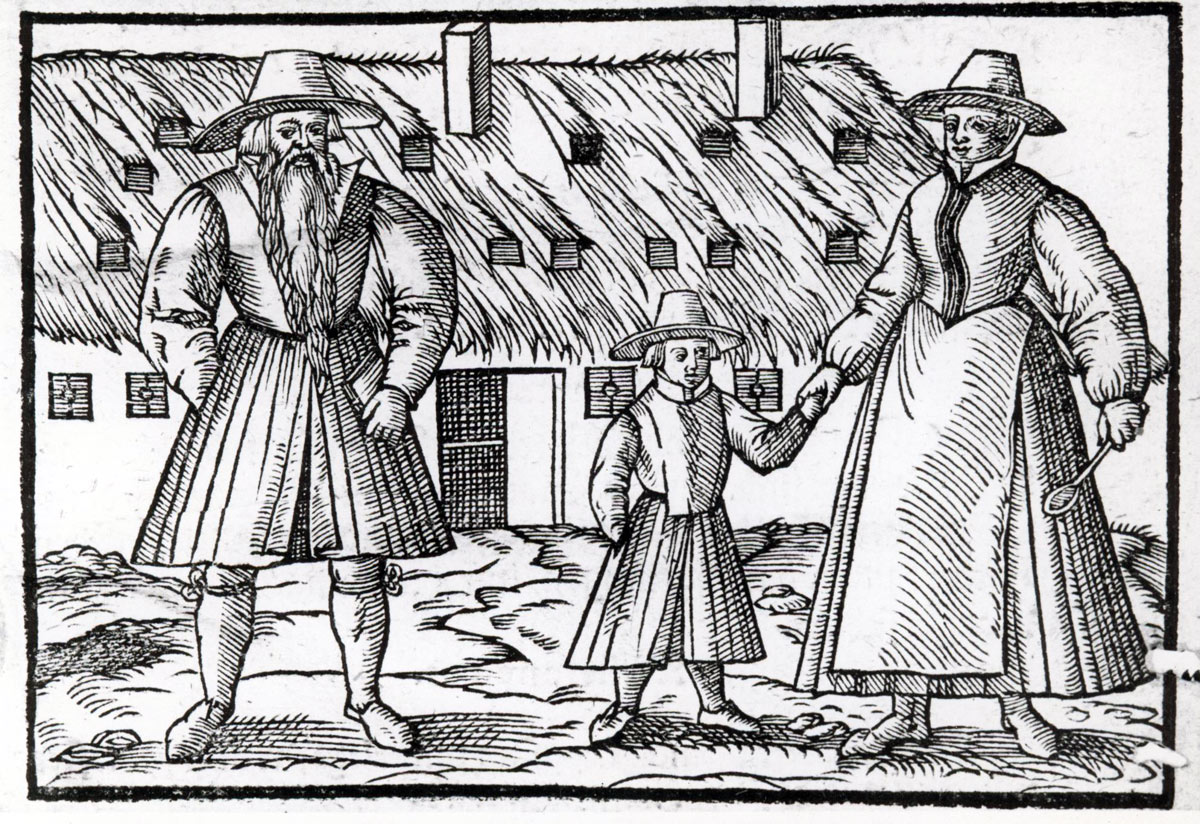
Bruderhofs were quite elaborate establishments consisting as a rule of several larger and smaller houses…, usually around a village common or square. The ground floor of the buildings was used for community living: dining hall, kitchen, and rooms for nursery, school, laundry, spinning, weaving, and sewing, and also for maternity rooms. The roofs (thatch mixed with clay to make them fireproof, a much-discussed invention of the Brethren) were high and steep so that the attics contained two stories of small chambers (Stuben, Oertel) where the married couples lived with their small children. 

By the beginning of the seventeenth century, there were around one hundred Bruderhofs scattered across Moravia, although they were clustered most densely around the city of Nikolsburg.

So why this long excursus on Moravia and the Hutterites? Because Heinrich Bühler did not simply emigrate to Moravia to live alongside the Hutterites and other Anabaptists. According to the account of his imprisonment in The Chronicle of the Hutterian Brethren (see here), Heinrich was a Hutterite who returned to Zurich from Moravia in 1614 to claim his inheritance.

We will probably never know when Heinrich became a Hutterite—Was he won over by Hutterian missionaries to the Zurich area, or did he flee Brüttisellen for Moravia on his own and join the Hutterites after encountering them there?—or where exactly in Moravia Heinrich lived, but we can have a good sense of his life while he was there.

He no doubt lived in a Bruderhof along with his wife and children and alongside his Hutterite brothers and sisters. He dined with them, worked with them, and worshiped with them. In short, he became a part of the Bruderhof community. That community life was short-lived, however, and it was not too many years before Heinrich had to pick up and move his family to a safer locale once again. That is a story for another post, but before that we should stop and look around a bit at the area of Moravia in which Heinrich may have lived, which will be the subject of the next post in the series.

Sources

Friedmann, Robert. 1953. Bruderhof. Global Anabaptist Mennonite Encyclopedia Online.

Smith, C. Henry. 1920. The Mennonites: A Brief History of Their Origin and Later Development in Both Europe and America. Berne, IN: Mennonite Book Concern. Available online here.

Wednesday, February 18, 2015

From Brüttisellen to Lushton 1

Assuming the line traced from Grandpa back to Heinrich Bühler in the early seventeenth century (see here) is correct, we know that the earliest known point of our family journey lies in Switzerland, in a small village outside of Zurich. So how did get from point A to point B, from where we were at the beginning of the seventeenth century to where we ended up in the first half of the twentieth century? Over the course of the next week or two we will explore, in varying degrees of detail, the main points on the journey from Switzerland to the United States, from the Canton of Zurich to a farm just south of Lushton, Nebraska. Who knows? We may even construct an actual map of our family wanderings along the way.

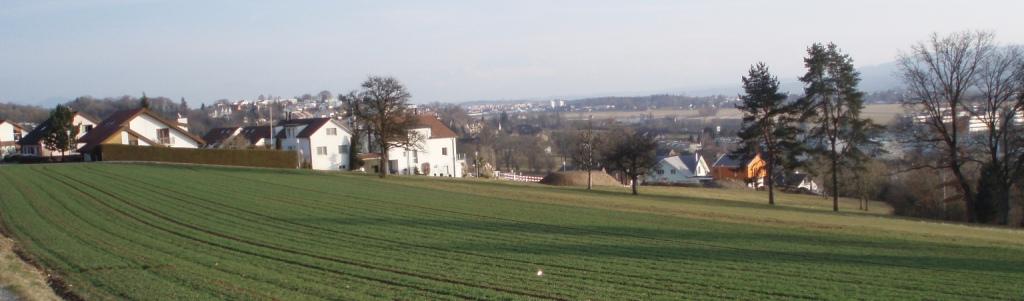
Wangen-Brüttisellen today.


We begin in the region of Zurich, Switzerland. If the Heinrich Bühler who died in 1613 (see here) is our first known ancestor (I suspect he was), our story begins in the village of Feldbach, on the north shore of Lake Zurich. If the elder Heinrich was not the father of Heinrich Bühler the younger, whose return to Zurich is recounted The Chronicle of the Hutterian Brethren, then our story starts with the younger Heinrich, in the village of Brüttisellen, 6 miles northeast of Zurich (or 16 miles northwest of Feldbach).

Either way, we can say with relative certainty that our earliest known ancestors were of Swiss stock. We can also conclude that they were Anabaptists, at least beginning with Heinrich the younger. If, as we suspect, Heinrich the younger was born around 1580, then by his early twenties he had joined an Anabaptist church or community. How do we know this? Because in 1602 Heinrich the younger left his native Switzerland and settled in Moravia, roughly 450 miles to the east (see further here).

Why did Heinrich move his family so far away? Only one explanation makes sense. The Switzerland of his day was dominated by the Reformed Church established by Huldrych Zwingli (1484–1531), a state church that had no patience with or tolerance of the individualistic, nonconforming Anabaptists. As the ruling power, the Reformed authorities sought to stamp out every trace of Anabaptist practice and thought, often using any means necessary.

During the mid-1500s many Swiss Anabaptists fled for their lives to safer locales in the surrounding states, including Prussia. But beginning around 1570, Moravia (in the eastern part of today’s Czech Republic) became a favored destination. Horst Penner elaborates:

Following this first Swiss flight directly to Prussia, Moravia enjoyed priority in the years 1570–1610; it was the “golden age” of the Hutterites. The news of the “promised land” in Moravia and the “new Jerusalem” in Nikolsburg penetrated even into the best circles of the city of Bern. Women from these families—the name Vogt also appears in this context—went with their children to Moravia. Hans Schellenberg, Hanß Albrecht, and Heinrich Buhler from the Canton of Zurich moved from Switzerland and went to Moravia.


Route from Brüttisellen, Switzerland, to Nikolsburg (modern Mikulov), Moravia.

The only reasonable explanation for Heinrich Bühler the younger’s actions is that he left Brüttisellen in order to avoid persecution, quite possibly to save his and his family members’ lives. By fleeing the area for the safety of Moravia, Heinrich saved himself and his family from the fate of Hans Landis of Zurich, who was executed in 1614, the last of a long line of Swiss Anabaptist martyrs (Smith 1920, 85).

Step 1, then, involved a journey of around 450 miles from Switzerland to Moravia. We will talk more about Moravia in the next post of this series. I think we've covered quite enough ground for one day.

Sources

Penner, Horst. 1978. Die ost- und westpreussischen Mennoniten in ihrem religiösen und sozialen Leben in ihren kulturellen und wirtschaftlichen Leistungen. Weierhof: Mennonitischer Geschichtsverein.

Smith, C. Henry. 1920. The Mennonites: A Brief History of Their Origin and Later Development in Both Europe and America. Berne, IN: Mennonite Book Concern. Available online here.