Friday, December 11, 2015

A Dutch visitor to Poland 2

In addition to the travel diary included in the previous post, Hendrik Berents provided several lists of names of people in the Schwetz area.  These lists have been a primary source for researchers in Mennonite geneaology and history, and they continue to help us to identify the inhabitants of that eighteenth-century community.

Looking toward Świecie (Schwetz), Poland, today
Interestingly, Berents did more than record the names of the Mennonites whom he encountered on his visit to the area; he also included a list of names by someone who preceded him by several years: Ale (or Alle) Derks. As Glenn Penner explains, “the exact year of the Derks visit is unknown,” but “a comparison of the list below with the Przechowka records would suggest 1714 to 1716” (see here). Berents included and updated the Derks list, using a cross to identify those who had died between Derks’s and Berents’s visits.

We begin with the first section of the Berents list as provided by Glenn Penner, who kindly granted permission to post this information (for the complete assemblage of lists, see here). For fun, see how many names you can decipher—and how many Bullers you can spot.

List of Names of Mennonite Families in the Environs of Schwetz

Andries WeedelTrijntie Richers his wife
Hermen Vrien†Saartie Wedels
Hindrik Onrouw†Widower


Benjemijn WeedelSaartie Raatslafs
Tobias RaatslafEefke Spaarlinkx
Aaltien AdamsAndries Raatslafs widw.is one household
Abraham OnrouwBoetsie Ijsaäks, now Onrouw}
Cornelis RichersTrijntie Antsen}
Abraham Richters†Elske Bekers}
Hans Voet Widower     
} in one house


Jurjen Boeler†

Dijna Toomske

reside in the new school

   Jacob Raatslaf has not been written in and is now dead already. [annotation by Hendrik Berents]

Hendrik Voet†        Marike Swegelers                  }
Peter RaatslafSaartie Smits}
Hans Raatslaf Widower
} in one house
   remarried the widow of Abraham Rigger [annotation by Hendrik Berents]

Hans Raatslaf                Trijntie Weedels                    }
Cornelis VoetSaartie Bollers} in one house


Tobias SpaarlinkTrijntie Raatslafs}
Ijsaak SpaarlinkGrietie Onrouw} in one house


Peter BekkerTrijntie Raatslaf
   The hired hand is dead; Antje Keuns is dead. [annotation by Hendrik Berents]

Hans Frein                    Grietje Voets†}
Sijmon WedelMarike Riggers                    } in one house
 
The list continues with Konopat and Schönsee, among other villages. Of particular interest for us is the mention of Hans Boller and Boeiste Onrouw in Konopat. Beyond that, several entries for Konopat indicate that Lutherans lived alongside these Mennonites. Interestingly, the Schönsee part of the list rates some of the people’s homes as “bad housing” or “very bad housing.”

After reproducing and annotating the Derks list, Berents provides his own list of households for the Schwetz area. According to Glenn Penner, Berents lists only baptized individuals, so children are not counted. Included below is the Przechovka portion of this list. (The names with asterisks had passed away by Berents’s second visit to the area in 1733.)

Sijmon Wedel, Merijke Riggers his housewife2
Andries Wedel, Trijntje Riggers his housewife, Saartje widow3
Jacob Wedel, widower, Antje Koppers* widow2
Benjamin Wedel*, Saartje Raatslaf his housewife, Trijntje Wedel*, Peter Wedel, Aaltjen Schellenberg's* widow, Adam Raatslaf
6
Abraham Onrouw, Boetsje Ijsaäks his housewife*, Berent and Boetsje Raatslaf, Boetje Jansens
5
Cornelis Riggers*, Trijntje Jansen* his housewife, Derk* and Mertje Riggers, Lijsabet Wedel
Dijna Tomas, Marijke Swegelers his widows, reside in the school2
Hans Raatslaf, Elske Berents*, Heijn Riggerts*, Lijsabet Buijlers, Peter Smit, Trijntje Bekkers6
Peter Raatslaf, Saartje Smits*, Eefke Voets, Antje Jansen*, Hans Raatslaf, Hendrik Onrouw6
Jeurijen Nagtegaal, Antje Riggerts, Elsje Riggerts*, Trijntje Buijlerts, Benjamin Wedel,
Jeurijen Buijelerts
6
Tobijas Spaarlink, Trijntje Raatslaf, Marijken Wedels*, Jan Jansen, Ijsaäk Spaarlink*,
Grietje Onrouw
6
Tobijas Raatslaf*, Eefje Spaarlink, Pieter Smit, Jan Riggerts, Boetsje Bekkers5
Hans Vrij*, Boetsje Voets*, Trijntje Riggerts3
Berents continues with Konopat and other locales nearby. In those sections of the list we encounter both Saartje Boelers and the Hans Boeler who was married to Boetstje Onrouw in the Konopat list above.

So, how many Bullers did you spot? How many different spellings of the family name? The next post will explore one of these Bullers and tie up the loose end mentioned a few posts back. For now, we puzzle over one observation about the spelling of those who appear to be Bullers.

It is understandable that the Dutchman Berents would spell the names according to his own phonetic and orthographic background, so we should not expect him to spell the last names as those whose last names he was recording might have spelled them. However, one would at least expect him to spell the same name consistently.

How, then, are we to explain the listing in this last section of Lijsabet Buijlers, Trijntje Buijlerts, and Jeurijen Buijelerts in Przechovka versus Saartje Boelers and Hans Boeler in Konopat? The simplest explanation would be that Berents was hearing different surnames at this point, not spelling the same surname differently. Further, the simplest explanation of the different pronunciations would be that these names represented different, probably unrelated, family lines.

We do not have enough evidence to know whether the “obvious” explanation is the correct one, let alone to suggest that either the Buijelerts (I take the lack of a -t- in Lijsabet Buijlers to be an error, not evidence for a different pronunciation) or the Boelers were part of our larger family. For now, as so often, we end with questions for further exploration. (Step 1: Compare Berents’s spellings of all the names listed, first and last, to assess the level of his consistency and to identify any spelling or phonetic similarities either to Buijelerts or Boeler.)

That investigation will take time, so in the meantime I invite you to pore over all the possible Bullers given in this post to see if you can spot a remarkable piece of evidence about a Buller whom we have discussed on more than a few occasions.

Sources

Hulshoff, H. Ch. 1938. Bezoekreis van Hendrik Berents Hulshoff aan de Doopsgezinden Gemeenten der Oude Vlamingen in Pruisen in Polen in 1719. Bijdragen en Mededeelingen van het Historisch Genootschap 59:32–82. This is a standard article on the Berents diary. It is available online here in Dutch but can be translated to English by your browser or at translate.google.com.

Penner, Glenn H. Przechowka, West Prussia, Memberships lists for 1715 and 1733 from the Travel Diary of Hendrik Berents Hulshoff. Available online here.

Zijpp, Nanne van der. 1956. Hulshoff, Hendrik (1664–1745). Global Anabaptist Mennonite Encyclopedia Online. Available online here.


Happy birthday, Dad! (reposted)


Eighty-two years young!

Thursday, December 10, 2015

A Dutch visitor to Poland 1

Historical research at its best relies more on primary sources than secondary resources. That is to say, although a historical investigator may learn from what others say about a given subject in secondary resources such as journal articles, textbooks, monographs, encyclopedias, and the like, the real work of historical discovery takes place when a researcher deals with realia, the records and papers and artifacts of the time under investigation.

For the past eighteen months this blog has relied on secondary sources when necessary (e.g., links to articles in the Global Anabaptist Mennonite Encyclopedia Online or quotations from relevant and reliable books), but we generally have found the greatest enlightenment by working with the primary sources themselves: the ship manifest from the S.S. Switzerland (see here), the Przechovka church book (first mentioned here), school records from Kleefeld and other villages (here), and a number of photographs of Bullers from years gone by.

With this post we encounter another type of primary source: a travel diary from the first half of the eighteenth century. But first, Nanne van der Zijpp provides background in a secondary resource: “Hendrik Hulshoff, usually called Hendrik Berents, was … an elder of the Groningen Old Flemish Mennonites. … As elder he made official trips to the Old Flemish congregations; in 1719 he made a journey all the way to Polish Prussia. On 22 May, accompanied by his brother Arent Berends, he started out on a trip via Groningen and Harlingen, to Vlieland, and from there by boat to Danzig, where they arrived on 28 June. Here he met with Mennonite leaders.… In Gruppe he visited Jacob Bertelt (Bartel), … for whom he had brought a letter and a ‘great basket full of books’ from Holland. On 5 July the travelers arrived at Przechovka or Przysierk, later called Wintersdorf, not far from Schwetz” (van der Zijpp 1956).

We pick up the story there, thanks to Glenn H Penner, who graciously gave this blog permission to reproduce a portion of his translation of the Berents diary. For Glenn’s introduction to the diary and the entire account of Berents’s time in Poland, see here.

At friends in Przysierk [Przechowka]. About 1 o’clock we came upon Pschighofke [Przysierk, later called Heinrichsdorf, in the neighbourhood of the city of Schwetz] at our friends, at uncle [oom, Aeltester in German] Benjamin Wedels’ house, who received us with uncommon love and affection; just as that afternoon came many friends, who welcomed us with tears and showed us such love, that it cannot be said or written well, and that furthermore, because we had traveled for so long; for which they had been so concerned, that we might have died accidentally, so that the joy was now uncommonly great for them; sang several welcoming songs for our diversion. Thursday the 6th we made plans to speak to brothers and sisters a bit to thank the Lord for showing us his goodness, that we arrived at our friends in good health and in good bodily state. With a hearty address and exhortation, that we may together pray to the attention of the Lord in celebration and strength of mind, that it may please his fatherly goodness to shine upon us with his strength of mind [fortitude], to first open my mouth; to be allowed to speak of the secret of the evangelism Jesus Christ and secondly to open the ears of the friends and to unify hearts, so to be allowed to hear and understand correctly, so that our work not become idle and poisoned, but that it may bring forth fruits; that thereby the name of the Lord be honoured and praised etc.

The Biestken’s Bible, one of the “most
wanted” books (Duerksen 1967, 108).
Friday the 7th we made some deliberations to ordain the most wanted books and then many friends have also visited us and showed us uncommonly great love, with whom we there spent the day. Saturday the 8th more friends again visited us, but, because I had to preach Sunday, so I needed time to practise, but would not leave me in peace; such love they showed us; yes they are so full of love, that they could not conceal. Sunday the 9th I preached about Heb: 1 etc. which the friends received with many tears. That afternoon the friends had a brotherly gathering to speak of the election and a few arrivals. Then came the women and many youths, such menfolk and womenfolk and spoke with us; showed us much love, which much diverted us, spent our time with singing and talking about what the blessed instruction came to.

Monday the 10th called upon me the prospects for school, which were 31 in number; to whom I then spoke of teaching and edification, so that they might think right, what they were about to embark upon. Tuesday we spoke to a few friends and the love, that they showed us can one in no measure describe well. Wednesday the 12th we held together a day of fasting and prayer to access the Lord; that He would allow our attempts to succeed and to go with us in work and labour and to steer us according to his Will etc. Thursday the 13th was then held the election of two preachers of the word and the most votes went to Jacob IJsaäks [Jacob Isaacs] residing across the Wijsel [Weichsel] and to Abraham Onrouw [Abraham Unrau], residing at Pschighofke [Przechowka]. Friday and Saturday the 14th and 15th I had to keep very quiet alone with the books in order to do the offering and investiture Sunday. Then it was very swoel hot weather, like it had been at departure and almost no rain.

Sunday the 16th I served the offering; were 31 persons and the investiture etc. Monday the 17th we spoke a bit with the friends. Tuesday the 18th we drove to ‘t Wolt [Wolz] and further to Schoonzee [Schönsee] in order to also visit some friends there, lodged with Hans Voet [Hans Voth] in Schoonzee. Wednesday the 19th I preached [served] there, about the fruits of the mind, and in the afternoon spoke to the friends. Thursday the 20th we visited some more friends there and then we attended Hans Voet [Hans Voth] and his wife and ate lunch at Jacob IJsaäks’ [Jacob Isaacs] and then visited other friends in ‘t Wolt and travelled further with uncle Benjamin and Pieter Dekker [Peter Decker] back to their house. Friday and Saturday the 21st and the 22nd, I had to once again remain with the books, in order to serve the offering and washing of feet on Sunday, although Saturday afternoon we had business of the circumstance of Hans Voet [Hans Voth]; brought it to the satisfaction of the friends in the end. Sunday the 23rd we held unity [service] and the washing of feet which occurred with the shedding of many tears.

Area of Schönsee, which is known as Sosnówka today.

After that exhortation, I made it known to the brothers and sisters that we were of the intention to again leave the friends on the Wednesday the 26th, to again turn back to ours and that with permission of the Lord I was of the intention to take leave of the friends with the serving of a last meal on Tuesday the 25th, which caused almost all friends to shed tears (but not so with everyone of them); because their love is so great, that they could not conceal it. Have received many more visitors that afternoon and when one speaks of leaving, then run forthwith the eyes of many friends. Monday the 24th I kept myself again with the books, but then came several friends and complained, that they would gladly travel with us to Dansig, but because it was the middle of harvest, that very time it would be necessary to take in the rye; so they could not venture it and almost none of the friends could travel with us; arranged therefore with tears, that we really should stay until Saturday the 29th, because to just let us drive on like that, they would not forget in a lifetime. Something which we could not resolve to do, since we had been so long away from home; so that in the end we resolve to stay until Saturday; which brought such gladness to the friends, that it was shortly known to the friends in ‘t Koepat [Konopat in the environs of Schwetz] and also across the Wijsel [Weichsel].

Tuesday the 25th have I then preached about Efe: 6 [Paul to the Ephesians, Chapter 6, verse 11 and 13.]; of God’s weapons rest etc. There had come many friends from the other side of the Wijsel and also two servers of the word from the other Mennonites, named Derk Wiggerts and IJsaäk Geerts and several more of their friends. Afternoon we had so much talk with the friends, that it was so uncomfortable due to heat in the house, that one could not comfortably remain. …

Farewell. Saturday the 29th most of the friends visited us at the house of uncle Benjamin to say their last good-byes, to which end we first said good-bye at half past ten, with an uncommonly great sadness due to leaving each other. Then the friends saw us off as long as they could. Then drove with us four wagons full of our friends for close to three hours in order to keep us company, which after we said good-byes with great sadness to separate from each other.

Like most diaries, travel or otherwise, a significant amount of minutiae is included, as the key events of each day are recounted. One’s mind can easily wander with the repetitiveness of the day-by-day narration. Looking more closely, paying attention to details, however, one can also see glimpses of our ancestors’ daily lives.

For example, we see that our forebears in Poland grew rye, which had to be harvested mid-July. We notice also a school with thirty-one students in the community. Berents mentions several times the washing of feet, which was part of the worship practices of some Mennonites of that time. Mention is also made of books that were wanted. Here a secondary resource can help us understand more. Jacob A. Duerksen explains that Hendrik Berents “brought a large basketful of Dutch books with him from the Netherlands which had been requested by members of the Old Flemish Mennonite Church in Przekhovka and by members of the Frisian churches in Montau and Schönsee” (Duerksen 1967, 108, emphasis added). In Poland, at least at this time, these Mennonites still relied on Dutch materials. Of course, this raises the question of what language they used in their worship services.

So many more observations could be made, but these few will have to do for now, since there is other material in the Hendrik Berents travel diary that demands our attention. The next post will reproduce another part of Glenn Penner’s translation of the diary, the part that lists the names of the Mennonites whom Hendrik Berents (and others) encountered during their time in the Przechovka area. Needless to say, we will see a Buller or two recorded there.

Sources

Duerksen, Jacob A. 1967. Transition from Dutch to German in West Prussia. Mennonite Life 22:107–9. Available online here.

Penner, Glenn H. Przechowka, West Prussia, Memberships lists for 1715 and 1733 from the Travel Diary of Hendrik Berents Hulshoff. Available online here.

Zijpp, Nanne van der. 1956. Hulshoff, Hendrik (1664–1745). Global Anabaptist Mennonite Encyclopedia Online. Available online here.


Tuesday, December 8, 2015

A photographic interlude

Before we tie up the loose end mentioned earlier, another early picture of Grandpa and his siblings deserves our attention.


Peter P and Margaretha Epp Buller (Grandpa’s parents) had twelve children. The first son, named Peter, was born on 10 August 1891 and died eight days later. Based on this information and working from the list of other children, we can identify the nine children in this photograph with a fair degree of certainty. The children who survived infancy are:

  • Magaretha P—29 July 1892 (see further here)
  • Katharina P—1 March 1895 (see further here)
  • Benjamin P—5 July 1897 (see further here)
  • Sara P—30 September 1899 (see further here)
  • Klaas P—3 March 1902 (see further here)
  • Elizabeth P—21 March 1904 (see further here)
  • Cornelius P—17 April 1906 (see further here)
  • Maria P—21 May 1908 (see further here)
  • Peter E—25 May 1911 (see further here)
  • Anna P—9 October 1913 (see further here)
  • Henry P—20 December 1915 (see further here)

The two oldest girls in the center are obviously Margaretha and Katharina, although it is hard to tell which looks three years older than the other. The oldest boy on the right must be Benjamin, followed by the younger girl toward the left of the back row: Sara (one of the compilers of the Buller Family Record). That would make the boy to the far left Klaas, and Elizabeth would be the girl farthest to the right.

The lad wearing the double-breasted coat in the front is Grandpa Chris. The two remaining kids are Maria (another compiler of the Buller Family Record) and Peter, who seems to be just shy of two years of age.

If Peter is almost two, then we might date the photo to spring of 1913, when he was twenty-three months. Obviously, Anna and Henry were not yet born at that time. If the photo is correctly dated to 1913, Grandpa was seven years old

There is no indication of where the photograph was taken, but it was probably somewhere close to home, if not on the Peter P farm itself.

***
Thanks to Abe and Alice Buller for providing the photograph and to Dad for supplying it to the Buller Time blog.

Saturday, December 5, 2015

Polish/Prussian Bullers: Jeziorka 3

Thus far (here and here) we have discussed the founding of Jeziorka in 1727 by thirteen Mennonite families who leased the land associated with the newly established village from Frau Hedwig von Steffens-Wybczyriski. The initial leases were for forty years and could be renewed, if the two sides agreed on terms.

We have also discovered that Bullers lived in Jeziorka nearly from its beginning and through most of the eighteenth century. Hans Buller (Przechovka church book 341) and his wife raised six children there in the 1730s and later. After that, George Buller (PCB 375) and his family lived there and were even listed in the 1772 Prussian land register and the 1776 census of Mennonites.

A portion of Jeziorki (Jeziorka) today, looking to the northwest.

One might wonder, however, why neither Hans 341 nor any of his sons is listed in either the 1772 or the 1776 lists. There is an explanation for that. Peter J. Klassen provides the context:

Tensions … arose with the local landlord, a Polish noble who demanded that Mennonite settlers on his lands perform the same scutage services provided by Polish settlers. For Mennonites, who had come as free persons and not as serfs, this seemed a novel and extraordinary request. A number … began to look for better opportunities elsewhere. In 1764, delegates from Jeziorka went to Berlin to explore settlement possibilities. Such a move would mean leaving Polish jurisdiction and moving to lands ruled by Frederick II. One of the king’s officials, Franz Balthasar Schonberg von Brenkenhoff, was charged with bringing new settlers to the Netze (Noted) River region, near Driesen in Brandenburg.… When he invited Mennonites to settle there, they accepted. In 1764, twenty-eight Mennonite families received settlement rights, with specified privileges. They were granted religious freedom, exemption from military service and the swearing of oaths, and each received forty morgen of land. Later they also received permission to establish and maintain their own schools. In the spring of 1765, thirty-five families arrived at their new home; the twenty-eight from Jeziorka had been joined by others from Przechowka and Schönsee. Several treks eventually brought some 166 Mennonites to the area. (Klassen 2009, 86–87)

Without going into too much detail, note that, near the end of the lease term the Jeziorka landlord decided to change the terms, presumably on the renewal of leases. Some Mennonites leasing the land did not want to accept those terms, so they explored other options. Eventually, at the invitation of Franz Balthasar Schonberg von Brenkenhoff, a representative of the Prussian king Frederick II, a group of families from the area moved roughly 120 miles southwest to the Netzebruch, a “boggy wetland along the lower course of the Netze/Noteć river” (Hege 1957). The red line in the map below shows the relation and distance between the Schwetz area and the Netzebruch.


As Klassen states, the thirty-five families moved in 1765, which would seem to have been two years before the end of the initial forty-year lease. Several explanations seem possible: the leases began in 1725 rather than 1727; the two parties agreed on some sort of early termination terms; the original lease holders sold the remaining years on the lease to other Mennonites, who would then be in a good position to renew the leases. Which of these explanations is correct (if any) is unknown.

The fact that George 375 appears on the 1772 and 1776 censuses proves that he was not one of those who left. The observation that neither Hans 341 nor none of his sons appears on the censuses might imply that they were among the group that left. However, that cannot be known, since at present we do not have evidence that they lived in the villages of the Netzebruch. Perhaps Hans 341’s family leased other land in the Schwetz/Przechovka area.

We do know that some Bullers made the trek southwest, since the 1767 lists of families from the two main villages in the Netze area give us their names. According to table 4 in Adalbert Goertz’s “From Jeziorka, Prussia to Russia in 1804” webpage (see here), Peter Buller and his wife plus their four children (two sons and two daughters) lived in the village of Brenckenhoffswalde, while George and his wife and their one son and one daughter lived in Frantzthal. We cannot know with absolute certainty who this Peter and this George were, but based on our survey of Georges from Przechovka in the previous post, I would put my money on brothers George 350 and Peter 351 in the scan from the church book below.


Their departure from the Schwetz area might explain why such scant information is included for them: the church book was composed at least twenty years later, and little more than their names and their father’s name was known. I say “little more” because the church book contains one more hint.

The standard entry in the church book lists a person’s name, parentage, date and location of birth, date of baptism, and information related to the person’s marriage: when, who, and where. The last column (the where) has entries for George and Peter.


If you are viewing this on a computer rather than a phone or tablet, you should be able to see that the top entry reads FrThal; the second is less clear, but it appears to begin with a B and end with Wald. In other words, George was married in FrThal = Frantzthal in the Netze area, and Peter his brother was married in B??Wald = Brenckenhoffswalde in the same locale.

These are the two Bullers who show up on Adalbert Goertz’s list of names, which reminds us once again that our larger, extended family constantly grew and spread even before our more immediate forebears settled in Molotschna.

This Jeziorka trilogy of posts probably does not relate to any of our direct ancestors (although we cannot say that for certain), but it does give us a window into the lives of our larger family through most of the eighteenth century. We will return to other Bullers in the Przechovka area in the near future, since there are many more of our family to identify and get to know. Before we do that, however, we have an important loose end to tie up. Stay tuned!

Sources

Hege, Christian. 1957. Netzebruch (Poland). Global Anabaptist Mennonite Encyclopedia Online. Available here.

Klassen, Peter J. 2009. Mennonites in Early Modern Poland and Prussia. Young Center Books in Anabaptist and Pietist Studies. Baltimore: Johns Hopkins University Press.

Zijpp, Nanne van der, and Richard D. Thiessen. 2014. Jeziorka (Kuyavian-Pomeranian Voivodeship, Poland). Global Anabaptist Mennonite Encyclopedia Online. Available here.


Friday, December 4, 2015

Polish/Prussian Bullers: Jeziorka 2

The first Jeziorka post (here) provided a brief history of the 1727 founding of the village by thirteen Mennonite families from the Przechovka (pshe-KHOF-ka) area. It also noted that Bullers—the family of George Buller—lived in the village, as attested by the 1772 Prussian land register and the 1776 census of Mennonites. We ended with several questions that beg to be answered.

  • When did George Buller and his family first live in Jeziorka?
  • Were they the first Bullers to live in that village?
  • Since all the Jeziorka Mennonites leased their land, in what sense was George an Eigentümer (owner)?
  • What happened to George after this time?
  • What happened to his family?

The Przechovka church book (hereafter PCB) provides a likely answer to the first question. The PCB lists several George Bullers, but only one fits the evidence of the census.

We begin with the first George Buller listed (PCB number 3XXXX), whose name appears above the red line in the scan below.


George’s father was our old friend *** Buller, whom we have dubbed Unknown Buller (PCB number 339 above). The following page shows 3XXXX’s children (359–364).


The column after the names gives the number of the father (here 3XXXX); several columns after that we read the village of birth. All of this George’s children were born in Konopat (Deutsch Konopat, to the southwest of Przechovka), so it is unlikely that he ever lived in Jeziorka.

The second George Buller listed (342 below) is another option. He was the son of Hans (340) and thus the grandson of Unknown Buller. One can see further below that he had two sons: George (350) and Peter (351). Neither the place of birth nor the year of birth is given for either son, so we cannot link George 342 or his sons with Jeziorka. The GRANDMA database records 342’s place of birth as Jeziorka, but it also says that he was born around 1705, which was twenty-two years before Jeziorka was founded. Needless to say, GRANDMA cannot be trusted at this point (although the 1705 date of birth is probably close).


George the third (350 above, son of George 342) has no recorded children, so there are no villages of birth listed in the PCB. Therefore, we cannot say one way or another whether this George ever lived in Jeziorka.

The fourth and last George Buller listed in the main part of the PCB is number 375 in the scan below.


The next page in the church book records that George 375 had four sons, numbers 389–392 below.


Note the place of birth for the four sons: Jeziorken, aka Jeziorka. One further observation establishes the identification of George 375 with the George Buller of the 1776 census. The census indicates (see here) that George and his wife had two sons. According to the church book, George’s sons were born in 1773 (Peter), 1776 (Andreas), 1780 (David), and 1783 (Jacob). In other words, George 375 had two sons in 1776.

In light of the fact that George 375 and family lived in Jeziorka at least between 1770 (the year of his marriage) and 1783 (the year of his last son’s birth) and that George had two sons in 1776, it seems relatively settled that George 375 is the George listed in the 1772 land register and the 1776 census of Mennonites.

When George 375 and his family first lived in Jeziorka is more difficult to determine. Looking again at George’s line (two scans up), we see that George 375 was born in Konopat (Deutsch-Konopat) in 1747 but was married in 1770 in Jeziorka. Since the first leases for the Jeziorka land presumably expired in 1767 (they were forty-year leases written in 1727), one wonders if George acquired an expired lease in order to provide both a household and a living for his developing family. The next Jeziorka post will provide further background that makes this theory even more likely.

So much for the questions about which George is listed in the census and when he began to live in Jeziorka. Were there other Bullers in the village?

Again, the PCB provides evidence. Hans Buller 341, son of Hans 340 and thus also the grandson of Unknown Buller, is said to have been married in Jeziorka in 1731. This would place him later than the original group of thirteen Mennonite families who settled the village in 1727 but close to the later group of twelve families who joined the community in 1732. All of Hans 341’s children (344–349) were born in Jeziorka, which confirms his long-term residence in the village (see below).


No other Bullers are recorded as being born in Jeziorka, and only Ancke Buller (PCB 373) is listed as being married in Jeziorka to Andres Köhn (595). Like George, Andres and Ancke are listed in the 1776 census, along with their two sons and two daughters; interestingly, the PCB has two sons and three daughters for them by 1776. In any event, we can say that Bullers lived in Jeziorka nearly from its establishment in 1727 at least through 1783.

Three questions remain, but there is too much to the story to be recounted in full here. For now, it is sufficient to address the question of how George 375 could be called an Eigentümer (owner), as he was in the 1776 census, even when all the Jeziorka Mennonites leased their land. Steve Fast, co-moderator of the Low German Mennonite Genealogy Forum, writes, “There was no bright line between owning and leasing like we understand today. The translations of the words are only generalized and not very helpful. … Mennonites who were Eigenthuemers held long-term leases (40–90 years) that could be sold, inherited, and renewed.” Although George 375 did not own the land, he did own exclusive, long-term rights to farm the land, so he was accurately and properly designated as an Eigentümer by the census taker.

****

The Low German Mennonite Genealogy Forum is a bulletin board that seeks “to facilitate research into Low German Mennonite Genealogy, from the newest beginner to the most senior expert. And we want to organize the community to push the boundaries of our knowledge and share what we learn with everyone so that we can accelerate our research.” Anyone can read the discussions on the site; in fact, anyone can register to ask questions or to take part in the discussions. Feel free to browse the bulletin board at http://mennonitegenealogyforum.com/forum/index.php. The sections of greatest interest to us are those on Poland-Lithuania, Prussia, and Germany (here) and Russia and (former) Soviet Union (here).

Sources

Klassen, 2009. Mennonites in Early Modern Poland and Prussia. Young Center Books in Anabaptist and Pietist Studies. Baltimore: Johns Hopkins University Press.

Zijpp, Nanne van der, and Richard D. Thiessen. 2014. Jeziorka (Kuyavian-Pomeranian Voivodeship, Poland). Global Anabaptist Mennonite Encyclopedia Online. See here.


Wednesday, December 2, 2015

Reading recommendation

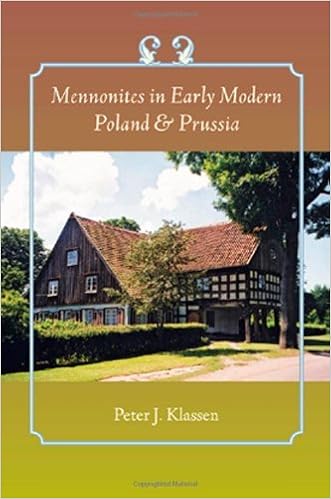
My before-falling-asleep reading the past several weeks has been an interesting and informative book that relates to the Polish and Prussian years of our family history: Peter J. Klassen’s Mennonites in Early Modern Poland and Prussia (Baltimore: Johns Hopkins University Press, 2009).

The book’s table of contents includes the following chapters and sections:

Preface
Acknowledgments
Chapter 1. A Haven in Troubled Times
Chapter 2. A Legacy of Rivers and Dikes
Chapter 3. The Challenges of Urban Settings
Chapter 4. Along the Banks of Poland’s Mighty River
Chapter 5. Bridges between the Netherlands and the Vistula Delta
Chapter 6. Psalms, Sermons, and Congregations
Chapter 7. A House Divided
Chapter 8. Conflicting Loyalties in a Progressive Society
Chapter 9. A Changing Vision
Epilogue
Appendix 1. Selected Documents concerning Religious Liberty
Appendix 2.  Key Events and Dates in Polish History
List of Abbreviations
Notes
Bibliography
Index

In a full and informative survey and assessment of the book, Steven Schroeder writes that this book “ is the most comprehensive, and widely accessible, examination of the Polish/Prussian Mennonites in the early modern era.” He elaborates:

Utilizing an impressive range of archival resources, Klassen argues that Poland was a safe haven for persecuted Mennonites during the first decades of the Reformation. The author shows how, after Poles invited Mennonites to farm the wetlands of the Vistula Delta, Mennonites were “generally supported by a tolerant political and economic structure [which] allowed [them] to flourish” (46). The author focuses the first five chapters on the economic and political interaction and agreements between Mennonites and the various local governments and ecclesiastical authorities in Royal Prussia (Polish rule) and Ducal Prussia (Hohenzollern rule). The agreements, mostly conducted at the local level, relied on mutual benefit: as long as the Mennonites were of value economically, their “heretical” theology would be tolerated and they would be granted limited privileges. Mennonites could lease and farm the land, set up their own religious congregations and schools, and were exempt from military service. However, Mennonites were always insecure to some degree, as they were not equals with their Catholic and mainline Protestant neighbors. (for the full review, see here)

Chapter 4 is of greatest interest to us, as it discusses the development and expansion of Mennonite communities in the Vistula River basin. Even though this chapter does not mention any Bullers by name, it clues us in to what happened with a certain Buller living in the village of Jeziorka. More on that in a subsequent post.

If you are interested in the Polish/Prussian years of Mennonites in general or of our family history in particular, I highly commend this book. Amazon sells both a hardcover edition and a Kindle edition; the latter is fairly inexpensive and can be read on not just Kindles but an iPad or any other tablet for which Amazon has developed a Kindle app.


Sunday, November 29, 2015

Polish/Prussian Bullers: Jeziorka 1

Ten to eleven miles west-northwest of Schwetz (modern Świecie) lay the village of Jeziorka (aka Jeziorken, Kleinsee, and modern Jeziorki). Jeziorka was located far enough from the Vistula River that it was not within the river valley itself (the red A in the map); according to the Polish Wikipedia article on the village, Jeziorka was the only Mennonite village in the Vistula area that was not in the actual valley (see here).

Unlike many other Mennonite villages of that time, Jeziorka did not have a pre-Mennonite history; rather, it was established in 1727 by a group of thirteen Mennonite families from the Przechovka area. Five years later the village added twelve Mennonite families from Culm (Chełmno), roughly twenty-one miles to the southeast. According to Peter J. Klassen, all these settlers “were granted a lease for forty years by the owner, Hedwig von Steffens-Wybczyriski” (2009, 86). Herbert Wiebe agrees in broad terms but clarifies that the lease was made with Frau (Mrs.) Hedwig von Steffens-Wybczyriski with the consent of the guardians of her children (Wiebe 1952, 30). Wiebe adds that the lease was for 1 Hufe (1 Hufe = 30 Morgens = ca. 41.5 acres) of meadow and 19 Morgens (= ca. 26 acres) of arable land that had been damaged by soldiers.

Nanne van der Zijpp and Richard D. Thiessen note that a church was erected early on, in 1743, but the residents of the village “never formed an independent congregation, but were in one congregation with their brethren in Przechovka and Konopath.” The Przechovka church is, of course, the one with which our Bullers were associated.

Today, nearly three hundred years later, the village still exists in a loose form (the houses on each side of the road in the center of the photograph below) and is reported to have around 150 residents, though that seems doubtful.


As we noted previously, Bullers lived in Jeziorka during the latter part of the eighteenth century. For example, both the 1772 land register (see here) and the 1776 census of Mennonites (see here) list a Georg(e) Buller as living in Jeziorka. The 1772 register simply gives his name and location, but the 1776 census adds important details. At the time of the census George had a wife and two sons, and he was a farmer and Eigentümer (owner) whose financial status was schlecht (low).

Still, there are more questions than answers at this point. When did George Buller and his family first live in Jeziorka? Were they the first Bullers to live in that village? Since all the Jeziorka Mennonites leased their land, in what sense was George an Eigentümer (owner)? What happened to George after this time? What happened to his family? Is is possible that George was a direct ancestor of ours?

Fortunately, the Przechovka church book and other historical sources will allow us to fill in some of the details, but that is a task for another post.

Sources

Klassen, Peter J. 2009. Mennonites in Early Modern Poland and Prussia. Young Center Books in Anabaptist and Pietist Studies. Baltimore: Johns Hopkins University Press.

Wiebe, Herbert. 1952. Das Siedlungswerk niederländischer Mennoniten im Weichseltal zwischen Fordon und Weissenberg bis zum Ausgang des 18. Jahrhunderts. Wissenschaftliche Beiträge zur Geschichte und Landeskunde Ost-Mitteleuropas 3. Marburg: Johann Gottfried Herder-Institut.

Zijpp, Nanne van der, and Richard D. Thiessen. 2014. Jeziorka (Kuyavian-Pomeranian Voivodeship, Poland). Global Anabaptist Mennonite Encyclopedia Online. See here.

Friday, November 27, 2015

Polish/Prussian Bullers: the land register of 1772

Before Frederick the Great took a census of all the Mennonites in West Prussia (Poland) in 1776 (see here), he took stock of all the land owners in his newly added territory. The purpose of the survey (or registration) was simple: to “produce the necessary foundation for the introduction of the Prussian taxation system in the new territory” (see further here).

Because the purpose of the register was not to count heads (as in all the people), only the male heads of taxable households are recorded. The original records also list the number of children, but these numbers are not readily available online. Fortunately, the basic information for fourteen Buhler or Buller households in West Prussia is provided by Reuben R. Drefs at the Odessa Digital Library (link above).

Last Name        First Name         Village             AreaCounty
BuhlerAbrahamRuckenauTiegenhoff
BuhlerAbrahamTiegenhoffTiegenhoff
BuhlerWilhelmTiegenhoffTiegenhoff
BuhlernWittwe (widow)TiegenhoffTiegenhoff
BuhlerJac.LaakendorfAmt Elb. Niederung  
Buller?SazewkaCammin
Buller?SazewkaCamminZempelburg
BullerAdamSazewkaCammin
BullerAdamSazewkaCamminZempelburg
BullerAdamDworziskaSchwetz
BullerGeorgJesiorkySchwetz
BullerHeinrichOstrower Kämpe  Schwetz
BullerHeinrichOstrower KämpeSchwetz
BullerPeterDeutsch KonopatSchwetz

Of greatest interest for us are the last five Bullers listed: Adam, Georg, Heinrich, Heinrich, and Peter. These five families lived in the Schwetz area (Schwetz is the village just left of E in the map below), some in villages that we have already encountered: Jeziorka (A), Ostrower Kämpe (F; aka Ehrenthal; modern Ostrów Świecki), and Deutsch Konopat (B/C). The only village new to us is Dworziska (or Divorczieka; German, Wilhelmsmark), which was just to the southwest of the B on the map.


Not only have we encountered some of these villages; we have also already encountered the persons listed. The following list compares several individuals in the 1772 land register with the names given in the 1776 census of West Prussian Mennonites (here):

  • 1772 George in Jesiorky = 1776 George in Jeziorken (both Jeziorka)

  • 1772 Peter in Deutsch-Konopat = one of two 1776 Peters in Deutsch Konopat

  • one of two 1772 Heinrichs in Ostrower Kämpe = 1776 Heinrich in Schwetzerkampen

Only Adam Buller of Dworziska is not included in the later census. One wonders whether he moved or died in the interim. This is not the last we will hear of the other Bullers, however. Future posts will return to the Przechovka church book to flesh out these families even further.

To be clear, we do not know whether any of these Bullers are our direct ancestors. However, we can conclude with relative confidence that they are part of our larger family. The same cannot be known at this time for the other Buhlers and Bullers listed. Although at least one of them was a Mennonite (Abraham of Tiegenhoff is listed in the 1776 Mennonite census), we do not know even that much of the others. Perhaps the Buller surname is not as rare as we thought!

***

For additional background on the 1772 land register, see the introduction by Rueben R. Drefs here.

Thursday, November 26, 2015

Polish/Prussian Bullers: background

The Buller family history, like most other family histories, is very much a tangled mess of similar-looking but separate threads. We know which thread we want to follow—that of David Buller (father of Peter D, grandfather of Peter P, and great-grandfather of Grandpa Chris)—but the deeper we dig into the tangle, the more confounding and confusing it all becomes. There is no clear way to trace the one thread that interests us systematically back in time.

Rather, we must approach the task much as we would a storage room stuffed with the accumulations of life over a number of years. To clean out such a room, to bring order to it, we first create a bigger mess as we drag out and pile up different categories of items: clothes for Goodwill here, books for the local library there, kitchen gadgets over there, and all those things that we should have thrown away years ago in the dumpster sitting in the driveway.

With those two images in mind—our family history as a mess of threads that need to be untangled and as a storage room that can be cleaned out only by creating an even bigger mess—let us begin to sort out what we know about our family’s existence in Poland/West Prussia during the seventeenth, eighteenth, and early nineteenth centuries.

To set the stage for the messiness to follow, I ask you to indulge one last rehearsal of some of the basic geographical and historical facts that will be in the background of many of our discussions.

1. The area of our interest is located modern-day Poland, from the Baltic Sea in the north, down the Vistula River basin to the south. For the most part, Mennonites in Poland (there were Mennonites in other countries and regions) lived in the area shown below.


Our specific interest will often focus on the area south of Świecie (German Schwetz), which is identified by the arrow left of center in the map above. This is not only where most Mennonite Bullers lived; it is also where our Bullers lived. For a more detailed map of this area, see here.

2. We do not need to know a great deal of history to explore our family history, but it is helpful to keep in mind that our Bullers first lived within the Kingdom of Poland but then, in 1772, became a part of the Prussian kingdom of Frederick II. This change in political rule did not entail immediate changes, but eventually it created the conditions that led our family and many other Mennonites to leave West Prussia for Catherine the Great’s New Russia.

3. In addition to geography and history, it will be useful to remind ourselves of a genealogical fact, that the earliest known (that is, earliest documented) Buller in the Schwetz area was the *** Buller listed in the Przechovka (pronounced pshe-KHOF-ka) church register.


Unknown Buller, as previously discussed here, was probably born sometime in the mid-seventeenth century, perhaps in the 1650–1660 range. At present, this is the earliest recorded Buller we have for the area, possibly for all of Poland (we will have to explore further before we can confirm the latter). Although certainty will not be possible, we will work from the hypothesis that the Przechovka-area Bullers listed in land leases and other historical documents after 1660 probably are descendants of Unknown Buller and his wife Dina Thoms.

 Now that we have set the broad background of the geographical, historical, and genealogical context, we are ready to dive into the mess of details about Bullers in Poland/West Prussia during the period 1650–1820, that is, from the early days of Unknown Buller until David Buller and family emigrated to Molotschna colony in Russia.

Saturday, November 21, 2015

New territory

Exploring our family history requires us to enter a variety of new territories. The history of the times is unfamiliar to many of us, and the script and even the language of key documents is often difficult to comprehend. The geographical setting of our family history is frequently as unfamiliar as all the rest. So, before we proceed further in our trek into the Prussian/Polish period of the Buller family history, we should take a moment to orient ourselves.

If you recall, before Bullers lived in the U.S. we lived in the Molotschna Mennonite colony in New Russia (present-day Ukraine). Before that we lived in the lowlands of the Vistula (Wisła) River in a part of the Prussian Empire, West Prussia, to be exact, modern Poland. The map below offers a wide view of the area of our interest.


The city Gdańsk, Poland, on the shore of the Baltic Sea was known as Danzig during the period in question. Approximately 75 miles south of Danzig lies the area where Bullers lived several centuries ago. The red rectangle shows the rough location of our forebears’ home, which is shown in greater detail below.


The area in the detail map is roughly 20 miles by 14 miles, so essentially the same size as the south half of York County, Nebraska. The most noteworthy feature on this map is, of course, the Vistula River, which cuts across the lower right.

We will zoom in further on portions of this detail map in future posts; for now it is enough to note a number of specific locales.
  • The red letter A in the upper left marks the village of Jeziorken (Jeziorka), where the George listed in the 1776 census of Mennonits (see here) is located. 

  • The two Peters listed in that census are associated with Deutsch Konopat (B: Greater Deutsch Konopat; C: Lesser Deutsch Konopat).

  • The Heinrich in the 1776 census is said to have lived at Schwetzerkamp (E). Heinrich is also linked to Ehrenthal (F) in another source.

  • D marks the village of Przechovka, which housed the church where many of the Bullers in the area were members. (See earlier posts on the Przechovka church book here.)
Except for the Jeziorka Bullers, the rest lived and worshiped within a 5 mile radius that extended from Deutsch Konopat on the west to Ehrenthal on the east. We will do well to learn more about all these villages and areas, beginning with Heinrich Buller’s Schwetzerkamp.

Saturday, November 14, 2015

Peter P farm 4

Before we go back to eighteenth-century West Prussia (Poland), one more photo from the farm of Peter P and Margaretha Epp Buller.

We have already highlighted Grandpa Chris and his brother Klaas (see here) and their parents Peter P and Margaretha (here); now we turn our gaze toward the buggies in the background.


Looking closely, one can make out three horse and buggies in the background. One can also see two people each in the middle and right buggies. It is impossible, of course, to know exactly who is in the buggies, but we can offer a reasonable guess.

Assuming that the picture was taken circa 1913, it is plausible to think that one of the buggies holds Grandpa’s older sister Margaretha P, who married Klaas Friesen in 1912. Presumably they rode in the buggy to visit her parents’ home. The next-oldest daughter, Katharina, did not marry until 1915, so it is less likely that she and her future husband (Dietrich Quiring) are one of the other couples.

In the lower right of the picture one can see two girls standing on the driveway. The girl on the right is head and shoulders taller than the girl on the left. The girls are no doubt some combination of Sara (born 1899), Elizabeth (1904), and Maria (1908).

Further examination of this detail reveals that there may be one more person previously unnoticed. Look carefully at Peter P and Margaretha at the left of the photograph. It appears that Margaretha is holding a young child in her arms. Peter E was born in 1911, so it is probably not him. Anna was born in October 1913, so it might be her.

If Margaretha is indeed holding a child, this would imply that the picture was taken in 1914, before Anna’s first birthday. Notice that the trees seem to have all their leaves, so it is not later in the year. This almost-overlooked detail may well hold the key to the date of this photo. Certainty will continue to elude us, but for the time being we should probably date this photo circa 1914.

One final item: the two-story house in the background. The photograph below shows that Peter P and Margaretha’s house still stands today in excellent shape, but notice how much the trees have grown in the intervening century!


Wednesday, November 11, 2015

Peter P farm 3

First a correction, then a new photo.

The previous post identified the two boys as Ben and Grandpa Chris. Dad (Carl) advises me that the older boy is probably Klaas, not Ben. Dad also learned that the original photo came from Don and Margaret Huebert, who made it available to Abe Buller.

And now today’s photo detail.


Standing at the north end of the barn are, it is thought, Peter P and Margaretha Epp Buller, parents of Grandpa Chris. If you recall, both Peter P and Margaretha were born in the Molotschna colony, Peter in 1869 and Margaretha in 1870. They were likely in their mid-40s when this photo was taken, circa 1913. They lived on this farm for another twenty-three years, until they moved to California in 1936. Margaretha died at the age of eighty in 1951, Peter at the age of ninety-five in 1964.

Not a great deal more to say about this detail, except to note the horse and buggies in the background. We will focus in on those next.

Sunday, November 8, 2015

Peter P farm 2

As noted earlier, the photograph provided by Abe and Alice Buller contains details that merit closer examination. With that in mind, we begin by zooming in on two boys in a wagon left of center in the 1913 photo. First the full photo, then the detail:


The sharpness of the image is degraded when we zoom in, but we are still able to see two boys sitting on a wagon (a buckboard?) drawn by two horses. The older boy on our left is wearing a light-colored hat; the younger boy on our right may be wearing a dark hat. According to Abe, the older boy is his father Ben and the younger boy is Grandpa Chris. As far as I recall, this is the earliest photograph of Grandpa that we have seen thus far.

The apparent ages of Ben and Chris enable us to suggest a date between 1912 and 1914. Ben was born in 1897 and was thus fifteen in 1912; Grandpa was born in 1906 and so was six at that time. Since it appears that Ben could be fifteen to seventeen and Grandpa six to eight, a 1912–1914 time frame seems likely for this picture.

One final observation just made: a sliding door is clearly visible in the background of the detail above (to the left of the window in the middle). That sliding door is still visible today (see the detail from a 2015 photograph below), even though it was closed off and sided over. We will zoom in on other people and elements in the 1913 photograph in subsequent posts.


Saturday, November 7, 2015

Peter P farm circa 1913

Thanks to Abe and Alice Buller (Abe’s father was Ben, Grandpa Chris’s older brother), we have a new photographic treasure to enjoy and to examine: the farm yard of Peter P and Margaretha Epp Buller.

We have already seen the same area in earlier pictures, such as the 1936 photograph of Grandpa, Grandma, and five kids below. (Keep in mind that the 1936 photo was taken looking northeast and the new photo was taken looking southwest. See further here.)


We have also seen how the Peter P farm yard looked earlier this year.


What is new, thanks to Abe and Alice, is a photograph of the Peter P farm yard from over a hundred years ago, probably sometime between 1912 and 1914. More about the date of the photo later.


A few general observations will suffice for today, after which we will zoom in specific details in the photo.

1. The 1913 photo was taken from north of the driveway and east of the barn, roughly where the red arrow is pointing in the photograph farther below.

2. The little silo on the north end of the barn today and visible in the background of the 1936 photo had not yet been constructed in 1913.

3. On the other hand, the shed in the cow lot in 1913 no longer stands in the same spot. Whether it stood in 1936 is impossible to tell.


4. The windmill was located in the cow lot in 1913, but today it is farther south. If you look closely at the picture immediately above you can see the top of the structure (no wheel) between the bins.

5. The house, which stands west and north of the barn, is visible in the background of the 1913 photo and the photo immediately above.

6. The 1913 photo includes a number of people, some of whom we can identify. But that is a post for another day.


Friday, November 6, 2015

Prussian Bullers in 1776

According to the Buller Family Record, David Buller (recall the sequence moving backward in time: Chris > Peter P. > Peter D. > David) was born in 1817 and moved from Prussia to the Molotschna Mennonite colony around the year 1820.

Taking another step back before David, we encounter several Bullers (actually, Buhlers and Büllers) in the 1776 Prussian census. In terms of historical context, after a period of war in which the Poles proved unable to defend their territory, a significant portion of the Kingdom of Poland was divided between the three powers Austria, Prussia, and Russia in 1772. So it was that the area in which our ancestors lived came under the control of the Prussian king Frederick II.

As one way of taking inventory, as it were, of his newly gained territory, Frederick conducted a census of Mennonites living in most parts of the province of West Prussia (Danzig and the Thorn territory were excluded). According to Glenn H. Penner, this census “contains information on 2,638 families and accounts for 12,186 people.”

Listed among the 2,638 heads of households are two Buhlers, three Büllers, and one Butler whose name was actually Buller, according to a later marginal note. Although the actual census documents are not available for viewing online, as far as I know, Horst Penner and others have transcribed the recorded data so that we can learn something of the individuals included. The figure below shows a portion of page 421 in Horst 1978.


The third name listed is Abra. (Abraham) Buhler, followed by Abrah. (Abraham) Buller. Immediately below are Heinrich Büller and two Peter Büllers. Five names below one spies George Butler, but the note in the right margin indicates that Butler is actually a Buller. So much for the names. What else can we learn about these 1776 Prussian Bullers?

The column after the names lists the village of residence, followed by the occupation of the person listed. The six “number” columns that follow list, in order: husband, wife, number of sons, number of daughters, number of male servants, and number of female servants. The last two columns identify the household head’s status as owner or renter and the family’s relative financial condition.

The first Abraham Buhler lived in Alt Schottland, an area just outside of Danzig and thus not in the area of our Bullers, who lived farther south in the Vistula River delta. He was, if you can make out the Fraktur script, a Häker, which Glenn Penner indicates was a proprietor of a general store. His household contained only Abraham and his wife plus a female servant. The E. in the next-to-last column indicates that he was an Eigentümer, that is, an owner (presumably of his house and shop). His financial condition is listed as mm., meaning mittelmässig, “average,” what we might call today middle class.

The second Abraham Buhler lived in Tiegenhof (a village east of Danzig, so likewise some distance from our Bullers). He was a Schuster (cobbler) whose household contained him, his wife, three sons, and one daughter. He was a Mietsmann (renter) rather than an Eigentümer, and his financial status was characterized as s. (= schlecht), that is, low (but not the lowest).

All the Büllers (including George Butler = Buller) lived in the same general area of the Vistula River delta: Heinrich in Schwetzerkampen (or Schwetzer Kampe), George in Jeziorken (aka Jeziorka), and the two Peters in Deutsch-Konopat. The occupation for all four is given as Lw., an abbreviation for Landwirt, or “farmer.” All four are said to have owned their farmland, and all four are characterized as schlecht (low). The four families include husband and wife (no widows or widowers) and between one and seven children. Only the second Peter lists a servant, in this case a female.

We end with a few passing observations and questions.

1. It is interesting that the two Buhlers lived in the Danzig region to the north and the four Büllers were farmers in the area farther south. Is there any connection between these two family-groups, or is it a coincidence that their names appear to stem from the same original name?

2. If these family-groups are related, does the distinction between Buhlers in the north and Büllers in the south shed light on the statement in the Przechovka church register about the first Buller listed, that this was “the first time that this family name appears” (see here)?

3. Does the listing of four Büller families around the Vistula comport with the number of Bullers included in the Przechovka church register (see here)? I think that is worth exploring further.

More questions than answers, as usual, but at least we have added a bit more detail to the portrait of our family’s life in Prussia. As of 1776, there were twenty-one Büllers living in the Vistula River area (eight adults and thirteen children), all of them land-owning farm familes who were not quite middle-class.

***

For additional online resources, see Glenn H. Penner’s introduction to the census list here. He also provides a complete census with additional notes here.

Source

Penner, Horst. 1978. Die ost- und westpreußischen Mennoniten in ihrem religiösen und sozialen Leben, in ihren kulturellen und wirtschaftlichen Leistungen. Teil 1: 1526 bis 1772. Weierhof: Mennonitischer Geschichtsverein.


Thursday, November 5, 2015

Heinrich, we have a problem!

A funny thing happened on the way from Brüttisellen to Lushton (see here for the last post in that series): we lost Heinrich Buller. Allow me to explain.

Last year I was excited to learn that the GRANDMA database (which collects pertinent information about all known Mennonites) included Heinrich Buller, who not only was probably our ancestor but obviously was the same individual as the Heinrich Bühler whose story is told in The Chronicle of the Hutterian Brethren (see further here). The approximate time and location of the births are identical, and other sources seem to confirm that these individuals were one and the same.


Some time ago for reasons that I no longer recall, I went back into the GRANDMA database, asked for record 273782 (Heinrich’s number above), and was surprised to see an entry for one Anna Zinn. Where was Heinrich? I tried several other search approaches, and Heinrich was nowhere to be found.

I wrote the GRANDMA staff and asked if they could explain, although I had a feeling that I already knew the explanation (people do not disappear from geneaological databases for no reason). They politely replied that Heinrich Buller 273782 has been removed from the database because there is no documentary evidence that he ever existed. He may be nothing more than a plausible fiction.

You are probably feeling some of the dis-ease that I did then, so let me be clear about what we are and, more important, are not saying.

1. There is no documentary evidence for the existence of a Heinrich Buller (note the spelling!) who was born outside of Zurich, Switzerland, in the late seventeenth century and lived for part of his life in Deutsch Konopat, Prussia (Poland).

2. There is documentary evidence for the existence of a Heinrich Bühler who was born outside of Zurich, Switzerland, in the late seventeenth century.

3. Whether or not Heinrich Bühler ever lived in Deutsch Konopat is at present unknown. Horst Penner says that he “probably” did, but the documentary evidence proving that claim is lacking.

So what is the truth of the matter? We simply do not know. I happen to think it plausible that the Hutterite Heinrich Bühler did emigrate to Deutsch Konopat, where he established a sizeable family whose last name sometimer thereafter began to be written Buller. That’s my story for now, but I do not know if I’ll be sticking to it.

In the end, although it is disconcerting not to find Heinrich Buller in the GRANDMA database, nothing really has changed. It is just as plausible now as it was earlier to work from the hypothesis that all the Molotschna–Prussian Bullers descended from the Hutterite Heinrich Bühler. As long as we remember that we are dealing with hypotheses, we can freely and confidently explore all the data that we can uncover. Who knows? Maybe someday documentary evidence of Heinrich Buller (aka Bühler) will come into the light of day.

Source

Penner, Horst. 1978. Die ost- und westpreußischen Mennoniten in ihrem religiösen und sozialen Leben, in ihren kulturellen und wirtschaftlichen Leistungen. Teil 1: 1526 bis 1772. Weierhof: Mennonitischer Geschichtsverein.


Wednesday, November 4, 2015

It says “occasional” right there under the title

Okay, lame joke and lamer excuse. I don’t think a nearly four-month gap between posts qualifies as “occasional” by anyone’s definition. Sincere apologies all around! I am going to attempt to resume blogging at least a little over the next days, weeks, and months. Pray that work does not overtake me once again.

The posts will probably be shorter and may be a bit scattered, jumping from one topic to another. The scope is likely to be broader as well, focusing not just on the descendants of Chris and Malinda Franz Buller but also on other Bullers of the distant and recent past.

I plan to start with “Heinrich, we have a problem!” and then begin to think out loud about “Whatever happened to Katja Buller?” In between I will jot a note here about Georg Buller buying land in 1700, recount which Bullers are listed in the Prussian census of 1776, and begin to compile and then note information on all the Bühlers, Buijlers, and Bullers that I can find.

If anyone is still checking and reading, stay tuned!


Katja Buller is indicated by the farthest-right arrow.
This 1930 photograph shows the students and teacher  of the Kleefeld school.